On September 18, 2012, the Tennessee Department of Health received a report that did not initially look like the beginning of a national outbreak. A 56-year-old patient had developed Aspergillus fumigatus meningitis despite having no recognized condition that would ordinarily explain such a rare infection. The useful clue sat 46 days behind the diagnosis: the patient had received an epidural steroid injection for back pain at an ambulatory surgical center.[1]
That interval gave the contaminated drug a head start. The injection was over, the vial had left the room, and the patient's early symptoms could be mistaken for something unrelated. Meanwhile, three implicated lots of preservative-free methylprednisolone acetate had traveled from the New England Compounding Center, or NECC, in Framingham, Massachusetts, to 76 facilities in 23 states.[2] The outbreak could not be stopped by isolating one patient, because the infection was not passing from person to person. Investigators had to reconstruct a distribution system.
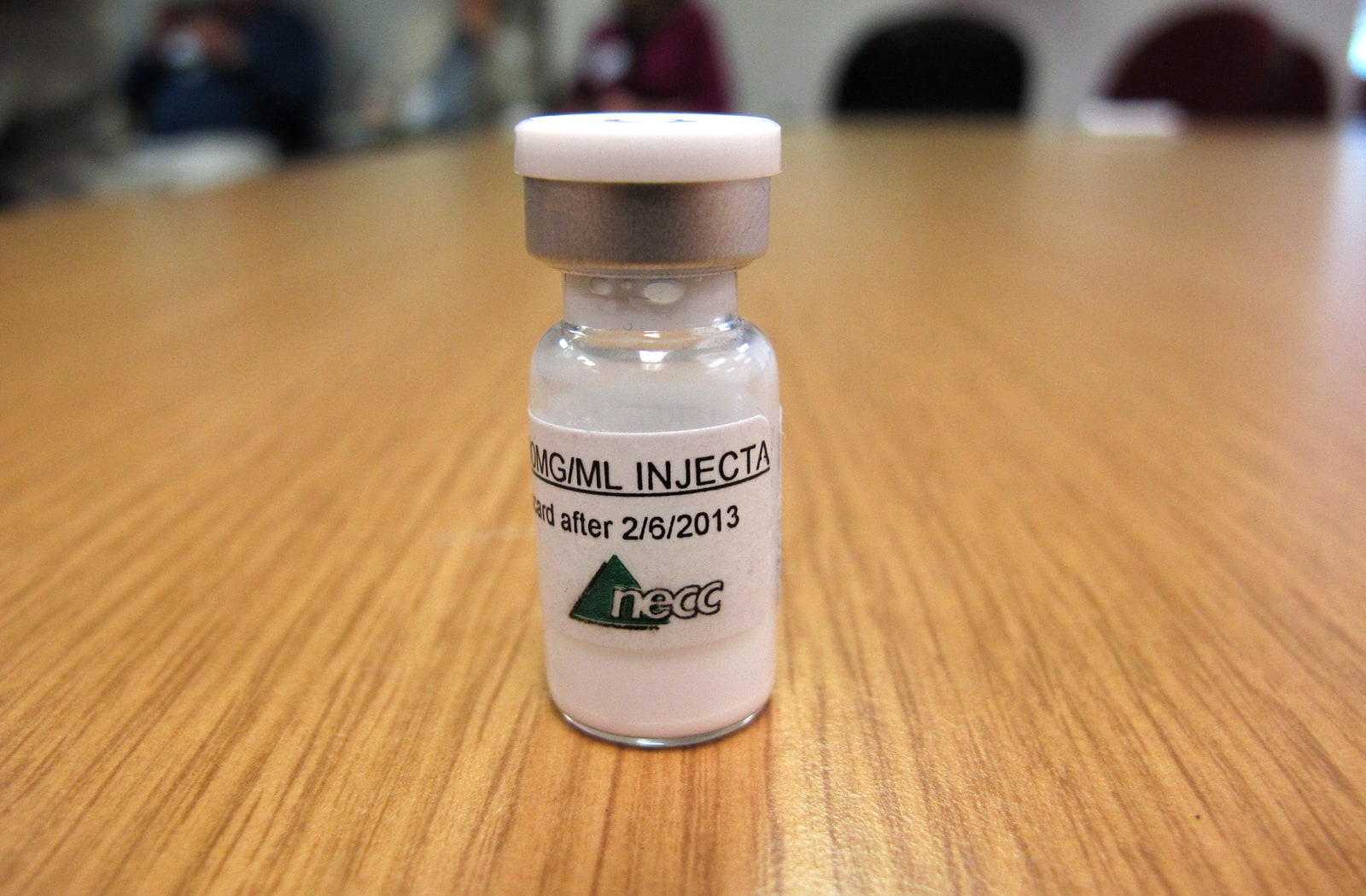
The vial in the lead photograph was documented at the Tennessee Department of Health during that investigation.[7] It looks like an ordinary clinical object, and that is precisely why it belongs here. In 2012, the decisive public-health instrument was not a dramatic microscope image. It was the ability to connect an unremarkable container to a lot number, a clinic invoice, a procedure record, and finally a person who might not yet feel ill.
Eight days from an odd case to a recall
- May 21, 2012: NECC produced the earliest of the three methylprednisolone lots later included in the initial recall.[1]
- September 18: Tennessee received the report of the index patient's fungal meningitis, 46 days after that patient's injection.[1]
- September 20–25: active surveillance found seven additional patients from the same clinic with a similar subacute meningitis syndrome; four had posterior-circulation strokes, while cultures from the seven additional patients were initially negative.[1]
- September 26: NECC voluntarily recalled the three lots shared by the emerging cases.[2][4]
- September 28: health departments and the clinics that had administered the drug began identifying and directly notifying exposed patients.[1]
- October 4: FDA microscopy found fungal contamination in an unopened vial from one implicated lot.[2]
- October 6: the recall expanded from three methylprednisolone lots to all products distributed from the NECC facility.[4]
- October 19: more than 99% of 13,534 people considered potentially exposed had been contacted.[1]
This sequence matters because laboratory certainty arrived after action had begun. The first cultured organism was Aspergillus fumigatus. The fungus eventually found most often in patients was Exserohilum rostratum, an environmental mold that rarely caused human disease.[1][4] If the response had required every early patient to produce the same organism in culture, the cluster would have stayed artificially small.
Instead, investigators built operational case definitions around the syndrome and the shared exposure. The early definition included meningitis, posterior-circulation stroke, spinal or epidural infection, and joint infection after an injection with the implicated NECC product.[3] That was not a declaration that every headache after an injection was part of the outbreak. It was a disciplined way to find comparable cases while cultures, pathology, and polymerase-chain-reaction testing caught up.
The patient list became the intervention
At first, the Tennessee clinic itself was a plausible source. Investigators reviewed procedure rooms, dates, clinicians, trays, antiseptics, anesthetic, needles, and the methylprednisolone. No clinic pattern explained why the cases occurred on different days and at different times. The shared drug, its lots, and the appearance of a similar case in North Carolina shifted the map from one facility to a multistate product trail.[1][2]
That shift changed the response. Because symptoms were delayed and the exposure had already happened, a public warning alone would leave too much to chance. The invoice list identified facilities; their procedure records identified recipients; calls and letters told those recipients what symptoms required attention. By October 19, outreach had reached more than 99% of the 13,534 people on the potential-exposure list.[1] The list did not predict who would become ill. It shortened the distance between an otherwise puzzling symptom and the correct exposure history.
The time distributions show why that mattered. In the detailed Tennessee cohort, median time from the last injection to symptom onset was 18 days, with a range from 0 to 56 days.[2] In the larger multistate analysis, the median interval from the last injection to the first diagnosis was 47 days, with a range from 0 to 249 days.[1] Those are different clocks—illness beginning and illness being recognized—and the gap between them was part of the hazard.
The Tennessee data also made contamination look less like a single binary event than a process unfolding inside stored vials. Among 656 people exposed at the principal clinic, 58 developed infection. Exposure to one lot was associated with a 12% attack rate, compared with 3% for the other two lots alone, a relative risk of 4.0. Within that higher-risk lot, people exposed only to vials more than 50 days old had a 19% attack rate, compared with 3% among those exposed only to newer vials.[2] These observational comparisons could not reconstruct every microscopic step inside the container, but they strengthened the inference that the drug—not a single procedure room—was carrying the risk.
Recall was the beginning of the long tail
The final CDC count reached 753 cases in 20 states and 64 deaths.[4] “Fungal meningitis outbreak” became the shorthand, but it does not describe the full clinical burden. Some patients had meningitis alone; others developed strokes, spinal or paraspinal infections, epidural abscesses, arachnoiditis, or infections around peripheral joints.[1][4] A contaminated steroid placed deep near the spine did not produce one neat disease course.
Nor did the calendar close when the product disappeared from shelves. CDC's 2015 follow-up said most monitored patients received antifungal treatment for at least six months. At 12 months after diagnosis, 42% of 455 followed patients met the study's definition of cured; 41% had stopped antifungal treatment but did not yet meet that definition; 7% were still receiving treatment; and 8% had died, including deaths not all attributed to the outbreak infection. Eight relapses had been reported.[5]
One probable case was identified after clinical meningitis appeared in November 2014, 26 months after the patient's contaminated injection. CDC explicitly said it was unclear whether that very late illness was caused by the injection or was unrelated.[5] That uncertainty is important. A long surveillance window should not be turned into a claim of certainty. It shows the practical problem officials faced: the response needed enough patience to detect slow infection without pretending that time alone proved causation.
A pharmacy operating at batch scale
The outbreak's physical mechanism and its governance mechanism met at the same point: scale. Traditional compounding is commonly described as preparing a modified drug for an individual patient's needs.[8] NECC's implicated lots moved in bulk across state lines to dozens of facilities.[1][2] When contamination entered that system, one preparation failure could become a distributed exposure network before the first patient was diagnosed.
FDA investigators documented troubling observations during their October 2012 inspection. Environmental monitoring records from January through September showed bacteria or mold in production hoods, but the Form 483 said those results had not been investigated, the isolates had not been identified, and product-impact assessments or corrective actions were not documented. Inspectors also recorded residue, discoloration, condensation, and other conditions in areas used to prepare sterile drugs.[6] A Form 483 records inspectional observations, not a final agency determination; its own notice makes that boundary explicit.[6]
The oversight boundary was wider than one dirty room. In 2013, the Government Accountability Office reported that FDA and national pharmacy-organization officials did not agree on when large-quantity, anticipatory, interstate compounding stopped being pharmacy practice and became drug manufacturing. Manufacturers faced federal registration, inspection, and approval requirements; qualifying pharmacies were generally exempt, and state capacity varied.[8] The ambiguity left a product able to move with manufacturing-scale reach through a system divided over who should supervise it as such.
Congress responded in November 2013 with the Drug Quality and Security Act, which created an “outsourcing facility” category for sterile compounders that choose to register with FDA and accept federal requirements and inspection.[8] The law did not retroactively rescue the people exposed in 2012, nor did a new category make every oversight problem disappear. Its significance was conceptual: volume, advance production, sterility, and interstate distribution were not merely business details. They changed the shape of public-health risk.
The most consequential move in this reconstruction happened before investigators knew the predominant fungus and long before they knew the final case count. One clinician treated an implausible infection as a reportable signal. Epidemiologists joined it to seven culture-negative syndromes. Lot numbers turned those cases into a product hypothesis. Invoices turned the hypothesis into a list of clinics, and procedure records turned the clinic list into calls to people. The contaminated steroid had a forty-six-day head start; the response recovered time by making distribution traceable.
Sources
- Smith et al., “Fungal Infections Associated with Contaminated Methylprednisolone Injections.” New England Journal of Medicine, 2013 — multistate investigation, index case, patient notification, incubation-to-diagnosis interval, and national outcomes.
- Kainer et al., “Fungal Infections Associated with Contaminated Methylprednisolone in Tennessee.” New England Journal of Medicine, 2012 — clinic investigation, recall chronology, lot distribution, symptom-onset interval, and cohort risk estimates.
- Centers for Disease Control and Prevention, “Multistate Outbreak of Fungal Infection Associated with Injection of Methylprednisolone Acetate Solution from a Single Compounding Pharmacy — United States, 2012.” MMWR — early case definitions and outbreak counts.
- Centers for Disease Control and Prevention, “Multistate Outbreak of Fungal Meningitis and Other Infections” — archived final case count, organisms, clinical scope, and recall timeline.
- McCotter et al., “Update on Multistate Outbreak of Fungal Infections Associated with Contaminated Methylprednisolone Injections, 2012–2014.” MMWR, 2015 — long-term treatment, outcomes, relapse, and the late probable case.
- U.S. Food and Drug Administration, Form FDA 483: New England Compounding Pharmacy Inc., issued October 26, 2012 — inspectional observations and the document's stated evidentiary boundary.
- Lynn Jolicoeur, “Victims of Contaminated Steroids Still Hurting: ‘My Life's Upside-Down.’” NPR/WBUR, 2017 — source and credit for Kristin M. Hall's 2012 AP photograph of the NECC vial.
- U.S. Government Accountability Office, Drug Compounding: Clear Authority and More Reliable Data Needed to Strengthen FDA Oversight, GAO-13-702, 2013 — the pharmacy-manufacturer oversight gap and subsequent implementation note.