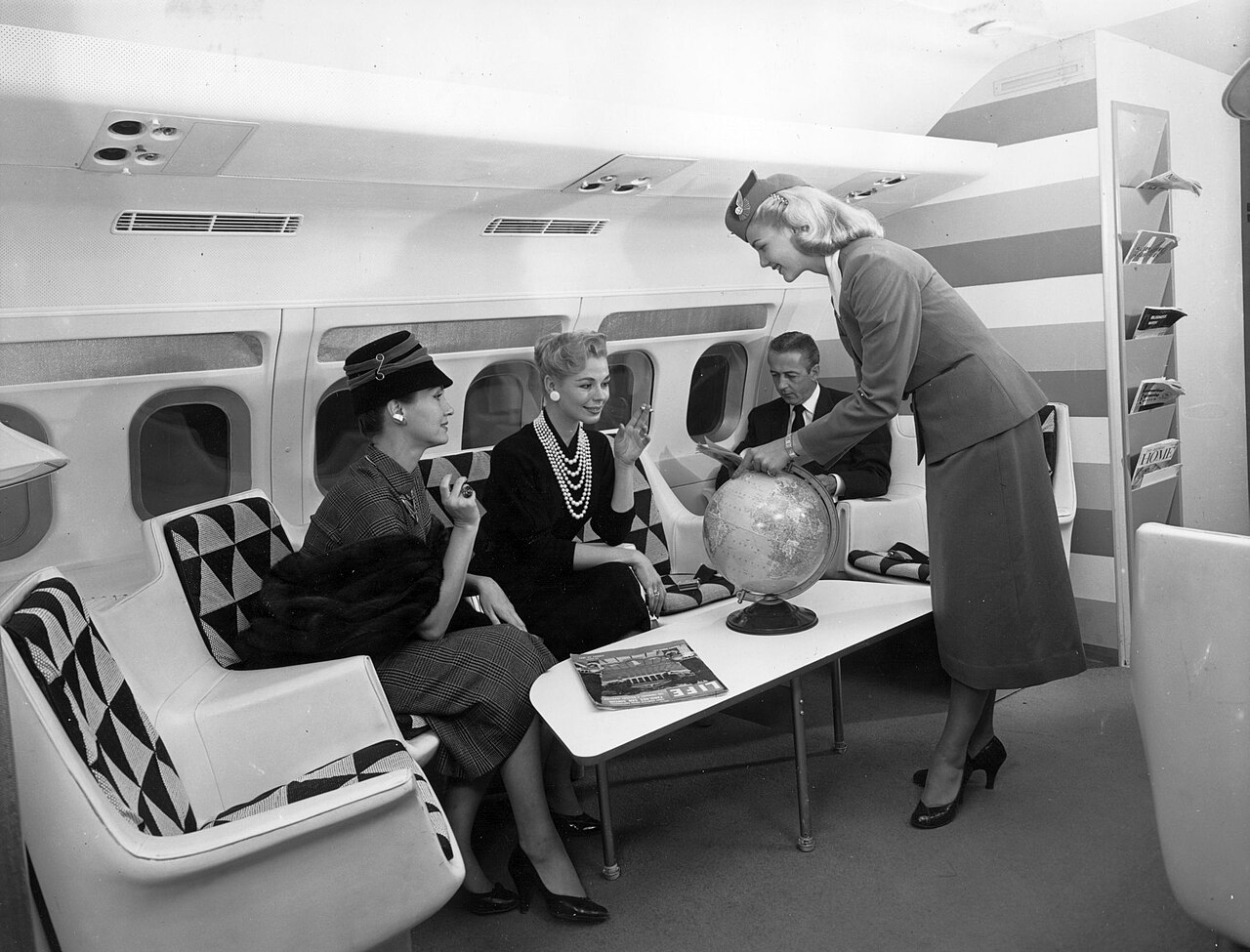
In the cover photograph, a passenger holds a cigarette while a TWA flight attendant points to a globe. It is a staged publicity scene dated January 8, 1958, not a candid record of a flight. That staging is exactly what makes it useful: tobacco appears as an ordinary part of polished airline service, and the worker standing closest to it is part of the sales image.[8]
By then, U.S. airlines were supposed to divide that room into smoking and non-smoking sections. The boundary could move as demand changed. It could be marked by a sign, a seat row, or a curtain. It could not make separate air.
The usual memory of in-flight smoking compresses its disappearance into a change in manners: passengers grew tired of the smell, airlines modernized, and the cigarette vanished. The documentary record shows a harder transition. For almost three decades, regulators treated smoke first as an annoyance, then as a cabin-air problem that might yield to seating and ventilation, and finally as an involuntary occupational exposure that could be controlled only at its source. Flight attendants were central because they crossed every boundary the rules drew. Science made that movement measurable; labor organizing made it politically difficult to ignore.[1][2][3]
1973: a boundary drawn for comfort
The first campaigns did not begin with a settled estimate of disease risk. Flight attendants were raising concerns by 1966. Ralph Nader petitioned the Federal Aviation Administration for a complete passenger-flight ban in 1969, while attorney John Banzhaf III pressed for separation of smokers and nonsmokers. The FAA rejected both approaches. In 1971, United Airlines began offering separate seating voluntarily, and other large carriers followed.[1]
The strongest contemporary federal evidence was equivocal. A joint government study in December 1971 reported no persuasive health hazard at the concentrations it expected under normal ventilation. Its passenger survey nevertheless found that more than 60 percent of nonsmokers and 38 percent of smokers were annoyed by other people's smoke. Those results supported two interpretations. Regulators could say that exposure was mainly a comfort problem and that a designated section was proportionate. Advocates could answer that widespread involuntary exposure had been documented in the exact environment the agencies were declining to change.[1]
The Civil Aeronautics Board chose the first interpretation. Effective July 10, 1973, airlines had to provide non-smoking sections, the first federal regulation of secondhand smoke. The rule was grounded in passenger comfort, not a finding that smoke caused disease. At first, only a few rows might be reserved; once they filled, a nonsmoker could still be assigned elsewhere. Later revisions guaranteed a non-smoking seat to a passenger who requested one and met the check-in deadline.[1][9]
This was real progress for passengers, but its model of exposure was static. It imagined a person remaining in the protected row. Flight attendants delivered drinks, collected trays, answered calls, worked galleys, and passed through the smoking section throughout a shift. An archive of airline advertisements, ashtrays, crew manuals, cigarette packs distributed to passengers, photographs, and later campaign material preserves how thoroughly tobacco had been built into the service environment—not merely tolerated by individual travelers.[7]
1986: the cabin refuses to become two rooms
The argument might have remained one of preference if the cabin behaved like a building with a sealed smoking room. It did not. In 1983, the Civil Aeronautics Board proposed restrictions on short flights and aircraft with limited ventilation, then retreated. Its final 1984 rule banned cigars and pipes on all flights and smoking on certain small aircraft, but left cigarettes in the divided main cabin. Congress directed the Department of Transportation to commission a broader review.[3]
The National Research Council's resulting 1986 report described a system in which source strength, outside-air flow, recirculation, filters, cabin layout, and crew movement all mattered. Filters could remove some particles while letting gases pass. Smoke diffused across row boundaries, and attendants assigned away from smoking seats still had duties that carried them through exposure. On one monitored DC-10, respirable suspended particles were roughly 10–40 micrograms per cubic meter in a non-smoking area without cigarette odor, 100 ± 20 in a nominally non-smoking area where smoke could be smelled, and 300 ± 200 in the smoking section, with a peak of 750.[2]
Those figures should not be converted into a precise disease forecast. The committee stressed that cabin measurements were sparse and that available health evidence could not produce a reliable quantitative risk estimate specific to flight. That uncertainty was the strongest case for continued study rather than a health claim larger than the data could support. But the engineering conclusion was already sharp: existing aircraft could not cheaply ventilate a smoking zone to the standards expected for comparable enclosed spaces, and physical isolation would require major redesign. The committee recommended banning smoking on all domestic commercial flights to reduce irritation and potential crew hazards, prevent cigarette fires, and align cabins with other closed environments.[2]
In the same year, the Surgeon General concluded more broadly that secondhand smoke caused disease, including lung cancer, in healthy nonsmokers, and that separating smokers and nonsmokers in one airspace reduced exposure without eliminating it. The cabin dispute now had an authoritative health framework that matched what crews experienced at work.[1]
The worker crosses the line
Flight attendants did more than supply testimony for a scientific case assembled elsewhere. They changed the political identity of the problem.
For years, the issue could be framed as a contest between two kinds of customer. Under that frame, a moving section looked like compromise. Flight attendants made the same cabin look like an industrial workplace. A passenger might spend two hours beside the boundary once; a crew member could work repeated segments, serve the smoking rows, and return the next day. Headaches, burning eyes, fatigue, nausea, and respiratory irritation appeared in crew testimony. The Association of Flight Attendants came to treat a smoke ban as part of a larger demand for meaningful cabin occupational-health oversight.[3]
That shift mattered institutionally. In 1975, the FAA asserted exclusive jurisdiction over flight-attendant working conditions, displacing ordinary OSHA enforcement in practice. Cabin crew therefore lacked the route available to many other workers. Individual attendants pressed their unions; the unions joined health organizations; Americans for Nonsmokers' Rights launched a Flight Attendants Project in April 1987. The coalition translated a diffuse air-quality complaint into a source-specific demand that Congress could enact.[3]
The tobacco industry's alternative was not simply denial. It promoted ventilation and general “clean air” management as substitutes for eliminating smoke, and it looked for allies among other labor organizations and airlines. That position had a plausible surface: cabins contained more than one pollutant, and ventilation plainly affected concentration. It failed politically because it did not solve the exposure flight attendants named, while airlines saw operational advantages in avoiding flexible seat allocation, tar cleaning, and damaged materials. Airline management largely stayed out of the congressional fight.[2][3]
1988: the two-hour experiment
Congress did not move directly from divided cabins to a universal ban. Legislation passed in late 1987 prohibited smoking on regularly scheduled flights of two hours or less, for a temporary period. The rule took effect on April 23, 1988.[1][3]
The duration line was not a biological threshold. Smoke did not become safe at two hours and hazardous at two hours and one minute. The compromise instead created a large operational trial: travelers and airlines could experience smoke-free service on short routes while lawmakers watched for the disruption opponents predicted. It also exposed the policy's central mismatch. The longest flights created the longest crew exposures, yet they remained outside the first ban.
Evidence soon made the old seating logic harder to defend. Margaret Mattson and colleagues reported an NCI-led study in JAMA in February 1989. It followed only nine people—five passengers and four attendants—on four routine flights of roughly four hours each, with urine collected for 72 hours afterward. That small sample could not estimate long-term disease incidence or represent every aircraft and ventilation setting. It could answer a narrower question directly.[4]
Personal monitors detected variable nicotine exposure, with some non-smoking areas reaching levels comparable to smoking sections. Flight attendants assigned to non-smoking areas were not protected. Urinary cotinine, a nicotine metabolite, rose measurably after exposure, and greater measured exposure tracked with greater excretion and more eye and nose irritation. A line on a seat map had failed both environmental monitoring and a biological marker.[4]
No single paper won the policy. The research landed inside a campaign already built from the National Academies report, the Surgeon General's conclusions, crew testimony, public-health advocacy, letters, hearings, and lobbying. Its power was forensic: it measured smoke on both sides of a boundary whose protective meaning Congress was being asked to trust.[1][3][4]
1990 to 2000: remove the source
In November 1989, President George H. W. Bush signed the Department of Transportation appropriations law that made the ban permanent and expanded it. Section 335 covered scheduled segments within the continental United States and intrastate segments within Alaska or Hawaii; the six-hour limit applied to routes linking Alaska or Hawaii to other covered points or to each other. It took effect 96 days after enactment, on February 25, 1990. A 2005 case study's reconstructed chronology estimated that the rule reached 99.9 percent of domestic flights.[3][5]
An international gap remained. U.S. carriers began extending smoke-free policies on their own routes during the 1990s, but a comprehensive scheduled-flight federal regime arrived with the Wendell H. Ford Aviation Investment and Reform Act, signed on April 5, 2000. Section 708 prohibited smoking in scheduled interstate and intrastate passenger air transportation and directed the transportation secretary to require it in scheduled foreign air transportation, with a process for foreign-government objections and negotiated alternatives. Charter and other nonscheduled operations were not all inside that 2000 rule.[6]
The end point is easy to mistake for inevitability. It was not the automatic result of better filters, one conclusive cohort, or changing taste. Early regulators had a legitimate evidence limitation: in 1971, aircraft-specific health data were weak. Their error was allowing that uncertainty to harden into confidence that seating could control a shared-air exposure. Later evidence narrowed the uncertainty. Crew experience identified who bore it repeatedly. Organizing kept the unresolved risk in front of lawmakers long enough for an incremental restriction to become a durable rule.[1][2][3]
The non-smoking section was therefore more than an incomplete control. It was a transitional idea. It recognized that involuntary smoke mattered but still assigned protection by location inside one atmosphere. Smoke-free flight replaced that geometry with source control.
The lesson travels beyond tobacco without turning every air-quality dispute into the same case. When a hazard moves across a nominal boundary, the people who repeatedly cross that boundary may see the system's failure before a study can quantify its lifetime cost. Their testimony does not replace measurement. It tells measurement where to stand.
Sources
- U.S. Office on Smoking and Health, The Health Consequences of Involuntary Exposure to Tobacco Smoke, Chapter 10, 2006 — federal airline-policy chronology, early evidence boundary, Surgeon General findings, and the role of flight attendants.
- National Research Council, The Airliner Cabin Environment: Air Quality and Safety, Chapter 5, 1986 — cabin measurements, ventilation and filtration limits, uncertainty boundary, and recommendation for a domestic smoking ban.
- Jocelyn Pan, Elizabeth M. Barbeau, Charles Levenstein, and Edith D. Balbach, “Smoke-Free Airlines and the Role of Organized Labor: A Case Study.” American Journal of Public Health 95(3), 2005 — reconstructed advocacy chronology using union publications, interviews, and tobacco-industry documents.
- Margaret E. Mattson et al., “Passive Smoking on Commercial Airline Flights.” JAMA 261(6), 1989 — PubMed record and abstract for the in-flight nicotine, urinary cotinine, and symptom study.
- U.S. Congress, Public Law 101-164, Section 335, November 21, 1989 — enacted text making the domestic scheduled-flight smoking prohibition permanent and extending it to the six-hour boundary.
- U.S. Government Publishing Office, Wendell H. Ford Aviation Investment and Reform Act for the 21st Century (Public Law 106-181), Section 708, April 5, 2000 — statutory record for prohibitions on scheduled domestic and foreign passenger flights.
- University of Alabama Center for the Study of Tobacco and Society, “Up In Smoke: The Airline Flight Attendants' Fight to End Smoking Aloft” — online exhibition of original airline advertisements, photographs, artifacts, crew material, and campaign records.
- Wikimedia Commons and San Diego Air & Space Museum Archive, “TWA Convair 880 Lounge Publicity Photo,” January 8, 1958 — provenance and publication record for the staged cabin photograph used as the cover image.
- U.S. Civil Aeronautics Board, “Smoking Aboard Aircraft,” Federal Register 38(90), May 10, 1973 — final rule establishing designated non-smoking sections effective July 10, 1973.