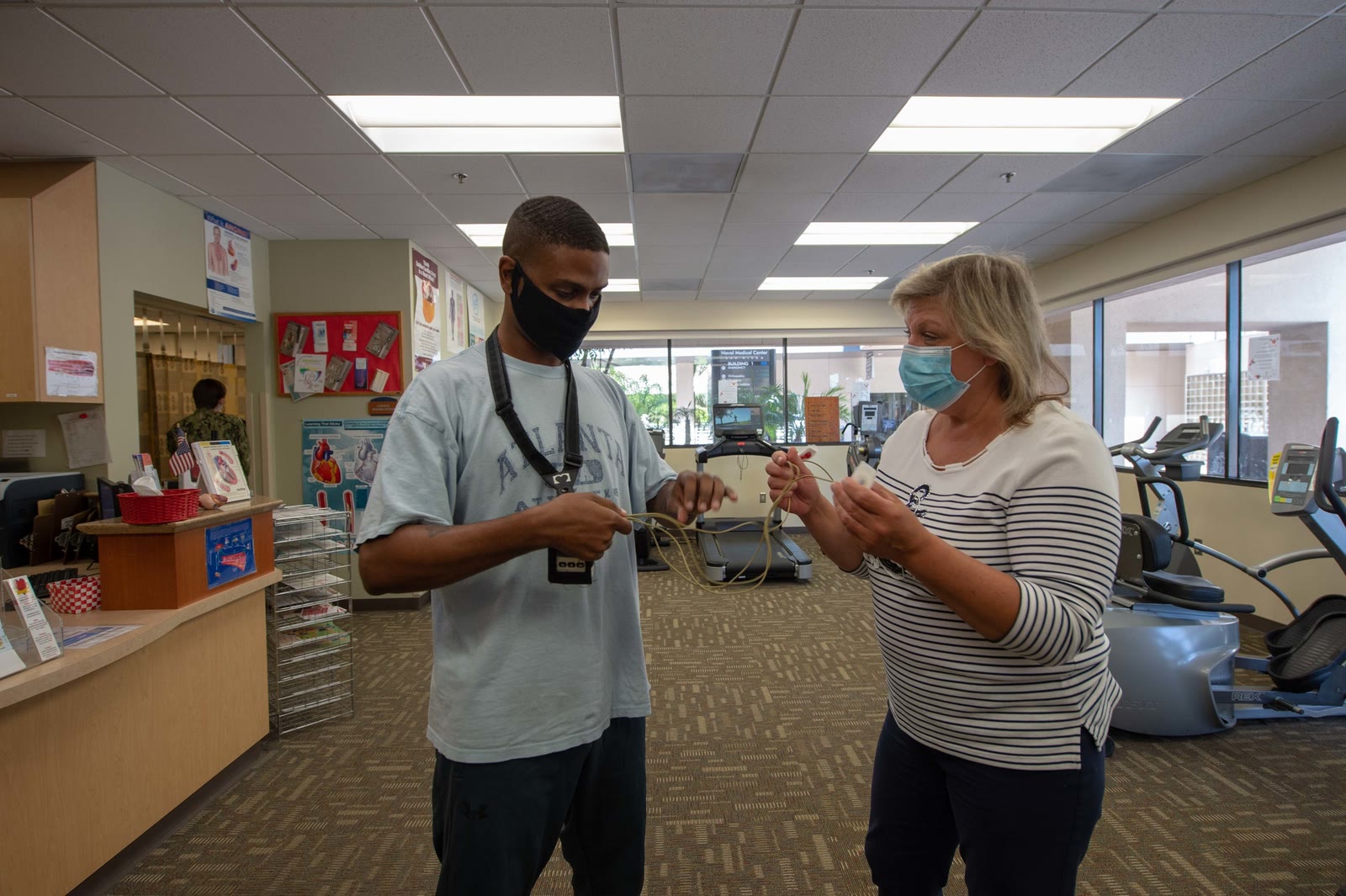
In the cover photograph, a nurse helps a patient fasten a telemetry monitor in a cardiac rehabilitation clinic. The scene, recorded at Naval Medical Center San Diego in 2020, is ordinary by design: attach the leads, watch the heart during exertion, and let recovery include movement.[8]
That ordinariness is historically new. In the first half of the twentieth century, surviving a myocardial infarction could mean lying flat for four, six, or more weeks. Sitting in a chair was not a small comfort. It could be treated as a threat to a damaged heart.
The familiar reversal story is irresistible: old doctors prescribed harmful bed rest; Samuel Levine and Bernard Lown put patients in chairs in 1952; modern cardiac rehabilitation began. The outline is true, but it compresses the evidence too aggressively. Prolonged rest had a physiological rationale, even when the prescription outran proof. The armchair regimen exposed the harms and assumptions hidden inside that prescription, but its first 81-patient series was not a randomized trial. Later comparisons supported shorter rest for selected, uncomplicated cases while leaving the optimal timing uncertain.[1][2][4][5]
The chair did not heal an occluded coronary artery. Its achievement was more exact: it broke immobility's monopoly on the meaning of safety.
Myth: prolonged bed rest was merely superstition
When James Herrick argued in 1912 that coronary thrombosis was not inevitably fatal, total rest was part of the possibility of survival. Clinicians understood an infarct as an injured area that needed time to organize into scar. Movement appeared capable of raising cardiac work or provoking rupture, aneurysm, arrhythmia, embolism, or sudden death. A later prescription summarized the logic as at least a month in bed so the infarct could heal.[6]
This was not knowledge manufactured from nothing. Physicians saw catastrophically ill patients before coronary-care units, continuous rhythm monitoring, defibrillation, thrombolysis, stents, beta blockers, or modern risk stratification. Rest reduced exertion at a moment when there were few direct ways to alter the underlying event.
The problem was the conversion of a plausible precaution into a universal duration. By the mid-twentieth century, some survivors remained confined to bed for more than six weeks, unable even to walk independently to the toilet. Restrictions could continue after discharge; one historical review describes stair climbing being forbidden for as long as twelve months in some cases.[6] The damaged heart was being protected, but the whole person was paying the price.
Complete bed rest carried its own physiology. It encouraged muscle loss and functional deconditioning, increased the risks of deep-vein thrombosis and pulmonary embolism, and worsened fear of activity.[5][6] The safety question was therefore never “rest or risk.” It was which set of risks a particular patient was being asked to bear.
Evidence: the armchair was a challenge, not a cure
Levine and Lown's paper appeared in JAMA on April 19, 1952, under the deliberately provocative title “Armchair Treatment of Acute Coronary Thrombosis.”[1] Their intervention did not resemble a modern exercise session. Patients received customary treatment but were allowed to sit out of bed for increasing portions of the day, often beginning with short intervals. A historical synthesis describes the initial prescription as roughly one to two hours in a chair.[6]
The upright posture was not symbolic. Levine and Lown reasoned that lying flat increased venous return to the heart, while sitting could shift fluid away from the chest and ease pulmonary congestion. The chair also let patients take meals and use a bedside commode outside strict recumbency. Physiology and morale were part of the same intervention.[1][6]
A 1954 follow-up described the original experience as 81 patients. Chair treatment had usually begun within 24 to 48 hours and always within a week. The authors reported favorable immediate courses and then asked the question their critics had raised: could early sitting weaken infarcted tissue and produce later ventricular aneurysm even if the hospital stay looked better? Among the survivors they were able to re-examine, they did not identify that feared aneurysm. This was focused observational reassurance, not comprehensive proof of long-term safety.[2]
Those observations mattered, but their design sets a boundary. Eighty-one consecutively treated patients can reveal feasibility, obvious danger, and clinical signals. They cannot, without a comparable allocation process, prove how much of an outcome came from the chair rather than patient selection, changing background care, or differences from an earlier reference group. Even the memorable mortality claims attached to the armchair story should be read as observations from an era of rapidly changing diagnosis and treatment, not as a modern causal estimate.[2][4][5]
The chair's strongest early result was therefore not “this object saves lives.” It was “compulsory recumbency is testable.” A rule that had presented itself as protection now had to defend its harms, duration, and eligible population.
Myth: one bold case series settled the argument
Evidence accumulated in steps. In 1954, Julian Beckwith, D. T. Kernodle, A. E. LeHew, and J. Edwin Wood Jr. reported an 80-patient comparison. Patients were assigned in alternation either to a chair regimen beginning between days two and five, if pain and shock were absent, or to prolonged bed rest. The Cochrane review later rated that allocation method at high risk of selection bias. The study gave the debate a contemporaneous comparison, but not the protection of concealed randomization.[3][4]
Trials in the 1970s moved the comparison from chair versus bed toward earlier versus later mobilization. Regimens varied: some patients got out of bed after roughly a week, while comparison groups waited nearly two or three weeks. The recurring finding was not a dramatic therapeutic benefit. It was the absence of evidence that a shorter period of rest caused more death, reinfarction, angina, or thromboembolic complications in uncomplicated cases.[4][5]
A Cochrane review eventually assembled 15 randomized or quasi-randomized trials. It included 2,958 participants: 1,487 assigned to shorter bed rest and 1,471 to longer rest. The median durations were 6 days and 13 days, respectively. Shorter rest was not associated with a clear increase in all-cause mortality, with a risk ratio of 0.85 and a 95% confidence interval from 0.68 to 1.07. Nor was there a clear difference in reinfarction, for which the risk ratio was 1.07 and the interval ran from 0.79 to 1.44.[4]
Those numbers correct two myths at once. They do not support prolonged bed rest as the safer default. They also do not establish that the earliest possible movement is a universal treatment. The trials were old, their reporting was often moderate or poor, their mobilization schedules differed, and most preceded coronary angioplasty, contemporary medications, and today's shorter admissions. The review's defensible conclusion was narrow: for uncomplicated myocardial infarction, bed rest lasting 2 to 12 days appeared as safe as longer periods, but the optimal duration remained unknown.[4]
That is less cinematic than a revolution led by a chair. It is better evidence.
What changed around the chair
Post-infarction care did not become safer simply because clinicians became less afraid of movement. The surrounding system changed. Coronary-care units brought rhythm surveillance and rapid treatment of dangerous arrhythmias. Later, thrombolytic drugs and percutaneous coronary intervention made it possible to reopen an occluded artery, changing acute survival and complications. Antiplatelet therapy, statins, beta blockers, and better risk assessment also changed recurrent-event risk and the population reaching rehabilitation.[5][6]
Cardiac rehabilitation also expanded the meaning of recovery. During the 1960s and 1970s, graded inpatient activity developed into supervised outpatient exercise, education, risk-factor management, and psychosocial support. The relevant unit was no longer a chair. It was a sequence: assess stability, restore function, build confidence, and reduce the risk of another event.[6]
This wider history prevents a false comparison between a patient in 1952 and one today. The earlier patient might have received morphine, oxygen, digitalis, and watchful waiting without a way to reopen the artery. A contemporary patient may reach a catheterization laboratory within hours and leave the hospital within days. “Early” movement cannot mean the same thing across those two clinical worlds.[5][6]
The remaining myth: movement is either forbidden or automatically good
The 2020 scoping review that reconstructed this history found a surprisingly thin contemporary evidence base. Most mobilization studies still came from the pre-revascularization era, and only one of seven major cardiovascular professional-society guidelines it examined explicitly recommended early mobilization after myocardial infarction.[5]
The same review described a 31-patient Canadian pilot study in which only about one quarter of patients walked during the first 48 hours of admission, while more than half had not walked by day four. Older age, arrhythmias, and treatment with inotropic drugs were associated with less walking. A study that small could not separate necessary delay from practice variation.[5] That distinction still matters. A stable patient kept in bed by institutional inertia is not the same as a patient whose shock, recurrent ischemia, dangerous rhythm, or another complication makes activity unsafe.
Current public guidance from the U.S. National Heart, Lung, and Blood Institute preserves that boundary. Many people can begin walking soon after a heart attack, but the schedule belongs to the person's condition and clinical team. Cardiac rehabilitation is supervised and combines exercise with education and counseling; it is not an instruction to prove recovery by pushing through symptoms.[7]
The photograph of telemetry in the clinic is therefore a better ending than a triumphant empty bed. The monitor does not make movement safe by itself, and the nurse is not reenacting Levine and Lown's exact regimen. Together they show what replaced the monopoly of rest: activity made visible, adjustable, and accountable to the patient in front of the team.
The old error was not caring too much about a damaged heart. It was allowing one precaution to become the whole theory of recovery. The chair mattered because it created a comparison. Once patients could sit, clinicians had to measure what happened next—and safety could no longer be defined as stillness alone.
Sources
- Samuel A. Levine and Bernard Lown, “‘Armchair’ Treatment of Acute Coronary Thrombosis.” JAMA 148(16), April 19, 1952 — PubMed record for the paper that formally challenged strict post-infarction recumbency.
- Avard M. Mitchell, James B. Dealy, Bernard Lown, and Samuel A. Levine, “Further Observations on the Armchair Treatment of Acute Myocardial Infarction.” JAMA 155(9), 1954 — follow-up of the original 81-patient experience and its long-range safety question.
- Julian R. Beckwith, D. T. Kernodle, A. E. LeHew, and J. Edwin Wood Jr., “The Management of Myocardial Infarction with Particular Reference to the Chair Treatment.” Annals of Internal Medicine 41(6), 1954 — PubMed record for the alternately allocated 80-patient chair-versus-bed comparison.
- Herkner et al., “Bed Rest for Acute Uncomplicated Myocardial Infarction.” Cochrane Database of Systematic Reviews — 15-trial synthesis of shorter versus longer bed rest, including effect estimates and evidence limitations.
- Munir et al., “Early Mobilization Post-Myocardial Infarction: A Scoping Review.” PLOS ONE 15(8), 2020 — historical trials, contemporary practice observations, guideline coverage, and the modern evidence gap.
- Redfern et al., “Historical Context of Cardiac Rehabilitation: Learning From the Past to Move to the Future.” Frontiers in Cardiovascular Medicine 9, 2022 — timeline from compulsory bed rest through armchair treatment and organized rehabilitation.
- U.S. National Heart, Lung, and Blood Institute, “Heart Attack Recovery” — current institutional guidance on individualized return to activity and medically supervised cardiac rehabilitation.
- U.S. Department of Defense Visual Information Distribution Service, “200805-N-VI515-1003” — source record for Erwin Jacob V. Miciano's 2020 photograph in the Naval Medical Center San Diego Cardiac Rehabilitation Clinic.