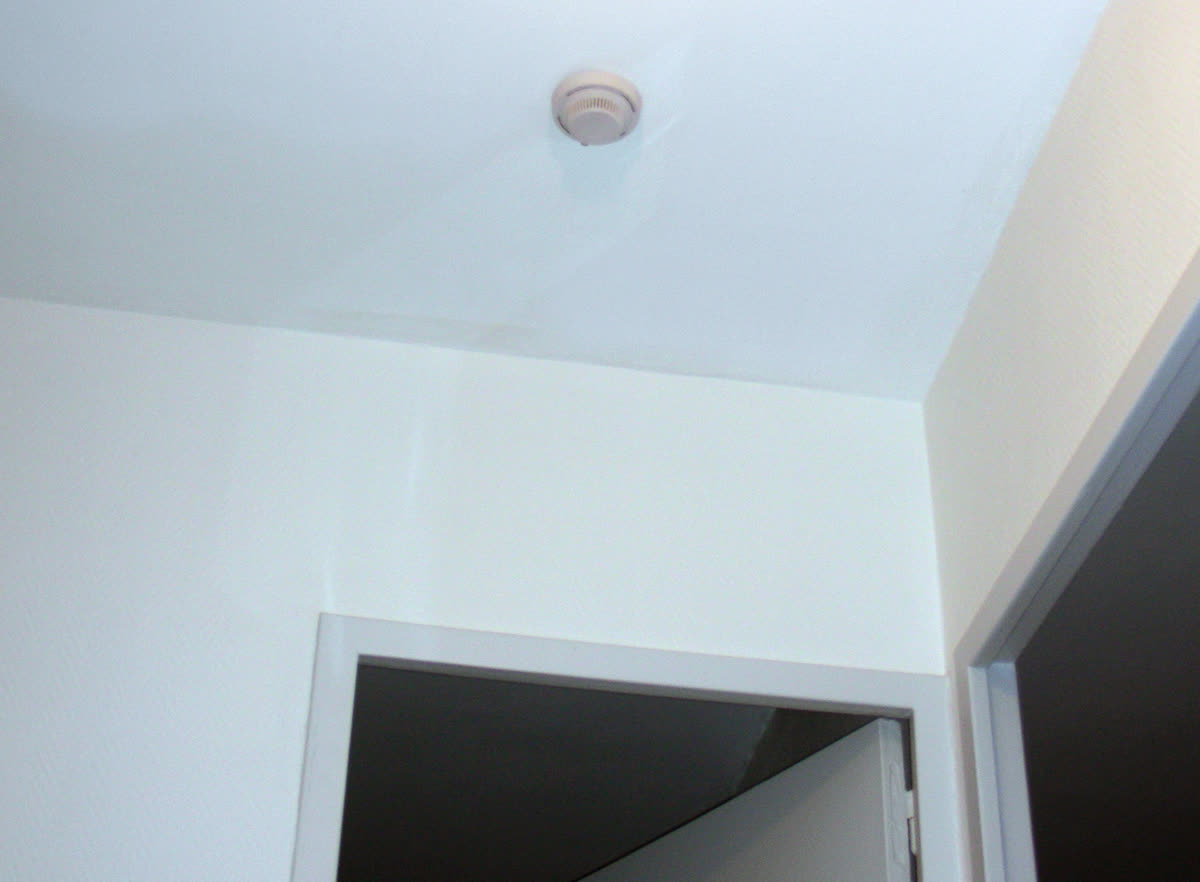
A smoke alarm is easy to underrate because it looks passive. It sits on the ceiling, usually ignored, until the one night when passivity becomes the point. The device does not stop a pan from igniting, a candle from reaching a curtain, a charger from failing, or a sofa from smoldering. Its job is narrower and more important: it converts early fire products into time while people are least able to interpret danger for themselves.
That is the causal mechanism. Home fire deaths often happen not because a household never had a chance, but because the chance arrived before waking, orientation, and movement did. A working smoke alarm moves the first warning out of the human senses and into a device that can watch the air continuously. NFPA's current research summary says the death rate per 1,000 reported home structure fires is about 60 percent lower in homes with working smoke alarms than in homes with no alarms or alarms that fail to operate.[1] The number is large because the alarm is not measuring comfort. It is measuring the beginning of an escape window.
The timeline is worth keeping concrete. In the 1970s, residential smoke alarms moved from specialty equipment toward ordinary home protection as compact electronic units became cheap enough to spread. By 2004, NIST's large home-smoke-alarm test program was asking a more precise question: how much warning time did different alarm technologies provide across realistic flaming and smoldering fire scenarios?[2] In 2026, the practical guidance is still bluntly domestic: install alarms in and near sleeping areas, interconnect them where possible, test them, and replace aging units because the system fails if the sound never reaches the person who needs to move.[4][5]
The sensor is only the first part of the intervention
NIST's home smoke alarm tests are useful because they pull the discussion away from the false idea that all fires announce themselves the same way. The agency's summary states that both ionization and photoelectric alarms consistently provided time for occupants to escape from most residential fires, while also noting a tradeoff: ionization alarms tended to respond somewhat faster to flaming fires, and photoelectric alarms often responded considerably faster to smoldering fires.[2] That distinction matters because a sleeping household does not get to choose its ignition pattern.
The practical lesson is not that the homeowner should become a fire chemist. It is that smoke detection is a response-time problem under uncertainty. A fast flaming fire, a slow smoldering fire, a bedroom door, a hallway turn, and the location of the alarm all change when the warning arrives. The alarm's value is therefore not simply "it detects smoke." Its value is that it can detect the right physical signal before the house has become too toxic, too hot, or too visually confusing for ordinary escape.
This is also why placement rules are not bureaucratic decoration. NFPA recommends alarms inside each bedroom, outside each sleeping area, and on every level of the home, including the basement; it also recommends interconnection so that when one alarm sounds, they all sound.[4] The reason is mechanical and behavioral at once. Smoke may start far from the sleeper. A closed door may slow smoke and heat, which is good for survival, but it can also muffle or delay perception of a distant alarm. Interconnection turns a local sensor into a whole-house warning system.
The weak link is often not detection theory but operability
A smoke alarm with no working power source is not a weakened alarm. It is no alarm at all. NIST's smoke alarm research page identifies missing or dead batteries and intentional power-source interruption as two main reasons alarms fail to work.[3] That failure mode is familiar because it is ordinary: a nuisance alarm near cooking, a chirp at night, a battery borrowed "for a minute," a hardwired unit disconnected during remodeling, or a device so old that nobody remembers its manufacture date.
The public-health problem is that these small acts happen long before the fire. When the emergency arrives, the household experiences them as fate. CPSC's fire-safety guidance makes the maintenance logic plain: install working alarms on every level, outside sleeping areas, and inside bedrooms; replace batteries yearly; and replace smoke alarms more than 10 years old because they do not last forever.[5] NFPA's maintenance guidance likewise emphasizes monthly testing and 10-year replacement.[4] Testing is not a ritual. It is a check that the warning chain still exists.
The same distinction explains why coverage statistics can be reassuring and misleading at the same time. A peer-reviewed analysis of U.S. survey data found that 95 percent of households reported at least one installed smoke alarm, but only 52 percent reported having a fire escape plan.[6] Those two numbers describe the gap between object ownership and usable rescue. One alarm somewhere in a home is not the same as alarms placed where sleeping people will hear them, kept powered, interconnected when possible, and attached to an escape route the household has already imagined.
The alarm buys time; the escape plan spends it
The most dangerous misunderstanding is to treat the alarm as the whole intervention. It is the first command, not the full sequence. Once the alarm sounds, the household still has to wake, recognize the signal, avoid investigating too long, move low if smoke is present, use a practiced exit, and know where to meet outside. A warning that produces debate instead of movement loses part of the time it was built to create.
This is why smoke alarms belong in health as much as home maintenance. They change the outcome of a predictable human limitation: people sleep, hesitate, misread weak cues, and underestimate how quickly smoke can make a familiar hallway unfamiliar. The device is valuable because it is less interpretive than a person. It does not wait to smell something "serious." It does not need to see flames. It does not assume the noise downstairs is harmless because the house was normal an hour ago.
The evidence also gives the device a clear boundary. A smoke alarm does not replace safer cooking, electrical safety, smoking-material control, sprinklers, closed bedroom doors, accessible exits, or help for people who may not hear or move quickly. NFPA's death-rate estimate shows the alarm's benefit, not its sufficiency.[1] NIST's testing shows that alarms often provide escape time, but not infinite time.[2] CPSC's safety framing keeps the operational message simple: working alarms save lives, but only when they are present, powered, and paired with the knowledge of how to leave.[5]
The honest way to read a smoke alarm is therefore as a time-transfer machine. It moves the first stage of fire recognition from a sleeping human body to a ceiling sensor. It moves warning from one room to the whole home when alarms are interconnected. It moves maintenance from a vague good intention into monthly tests and a 10-year replacement clock. And, if the household has practiced what the sound means, it moves fear into motion quickly enough for the minutes to matter.
Sources
- National Fire Protection Association, "Smoke Alarms in US Home Fires" - current NFPA research page on death-rate reduction and smoke-alarm performance in reported home fires.
- National Institute of Standards and Technology, "Home Smoke Alarm Tests" - NIST summary of ionization and photoelectric alarm response across residential fire tests.
- National Institute of Standards and Technology, "Smoke Alarm Research" - NIST overview identifying missing/dead batteries and intentional power interruption as major reasons for non-working alarms.
- National Fire Protection Association, "Installing and maintaining smoke alarms" - placement, interconnection, monthly testing, and 10-year replacement guidance.
- U.S. Consumer Product Safety Commission, "Fire Safety" - consumer fire-safety center with smoke-alarm placement, battery, replacement, and home-fire warning guidance.
- Marshall et al., "Prevalence of Residential Smoke Alarms and Fire Escape Plans in the U.S.," Journal of Community Health / PMC - survey analysis of smoke-alarm presence and escape-plan prevalence.
- Wikimedia Commons, "File:Smoke detector 02.jpg" - source page for the real apartment smoke-detector photograph used as the article image.