Cranberry sits in an awkward corner of health advice. It is too familiar to feel medical, too commercial to feel neutral, and too often presented as either a folk cure or a debunked superstition. The evidence is more interesting than either slogan. Cranberry products do not treat an active urinary tract infection, and they should not delay diagnosis or antibiotics when symptoms need clinical care.[4] But the best current evidence also does not support throwing the idea away. For selected people with recurrent UTIs, cranberry belongs in the prevention conversation, not the rescue kit.[1][2][4]
The mechanism is not that cranberry "cleans" the bladder. The plausible story is adhesion. Cranberries contain proanthocyanidins, often shortened to PACs, compounds studied for their ability to interfere with bacteria attaching to urinary-tract surfaces.[1][4] That mechanism already tells us what the myth gets wrong. A product that makes attachment less likely is not the same as a drug that clears an infection once bacteria have multiplied, inflamed tissue, and produced symptoms. Cranberry is a door-bolt story, not a fire-extinguisher story.
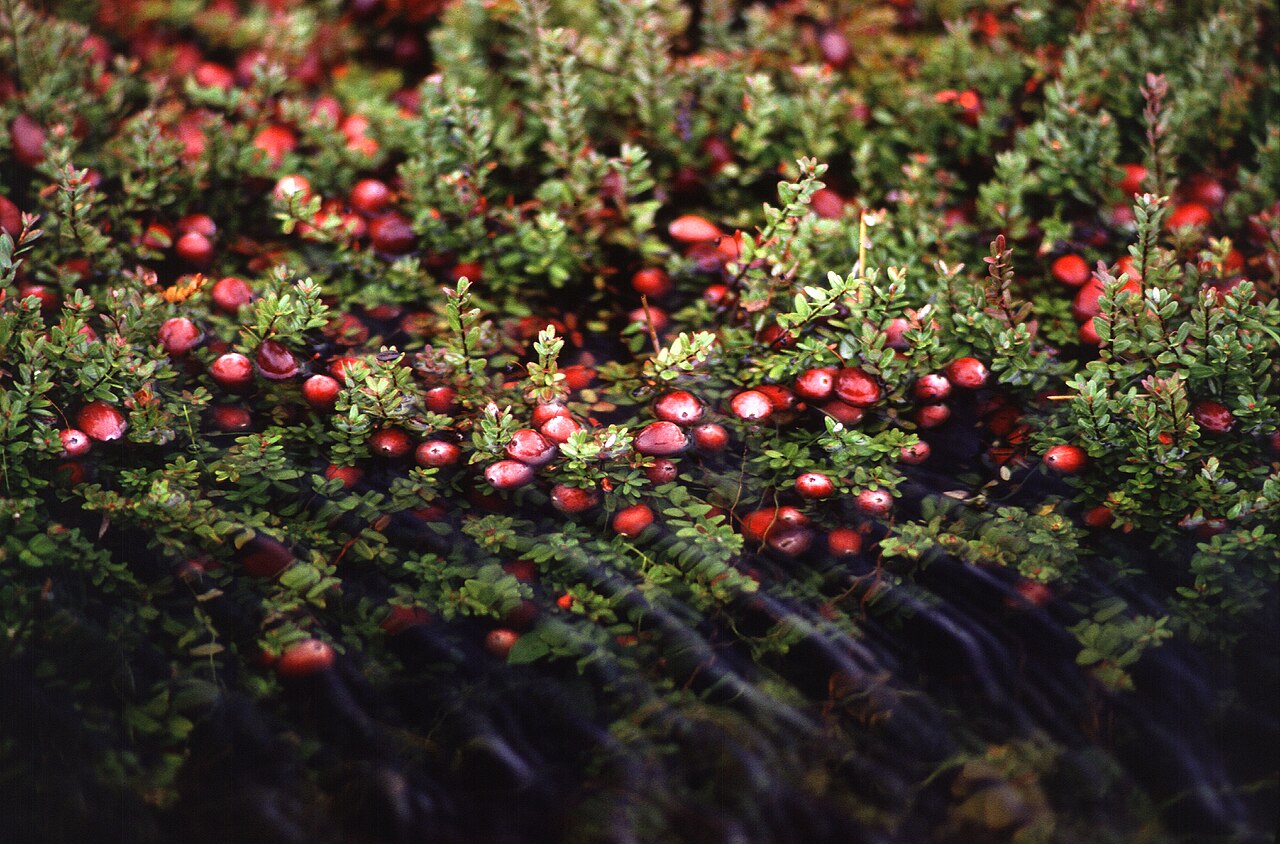
Image context: the cover uses a real USDA photograph of a cranberry bog in coastal Washington.[6] That matters because the article is not about a symbolic red juice in a glass. It is about how a real agricultural product became a regulated, studied, and still bounded health claim.
Myth: cranberry juice cures a UTI
This is the dangerous version of the cranberry story. Dysuria, urgency, fever, flank pain, pregnancy, male urinary symptoms, recurrent upper infection, and complicated urinary anatomy are not situations where a supermarket drink should stand in for clinical judgment. NICE explicitly treats recurrent UTI as a condition that may include lower or upper infection and names groups who need referral or specialist advice, including pregnant people, children, men, people with recurrent upper UTI, and people whose underlying cause is unknown.[3]
The National Center for Complementary and Integrative Health draws the clean boundary: cranberry may assist prevention in some women, but it is not recommended as treatment for existing UTIs in any population.[4] That statement should do a lot of work. It prevents the useful prevention signal from being inflated into first aid. It also protects the evidence from unfair dismissal. A parachute is not a ladder; failing as one tool does not prove failure as the other.
The timeline reinforces the boundary. In 2020, the FDA allowed qualified health claims for certain cranberry juice beverages and dietary supplements, but the claims were prevention claims for reducing recurrent UTI risk in healthy women with prior UTI, not treatment claims for acute infection.[5] The permitted language was deliberately cautious: juice claims had to carry the agency's "limited and inconsistent" evidence qualifier, and supplement claims were tied to 500 mg per day of cranberry dietary supplement.[5] That is regulatory hedging, not a miracle label.
Evidence: prevention has a measurable signal
The strongest single evidence anchor is the 2023 Cochrane update. It added 26 studies to the prior review, bringing the total to 50 randomized studies and 8,857 participants.[1] In the main meta-analysis of symptomatic, culture-verified UTIs, cranberry products reduced risk with a risk ratio of 0.70, based on 6,211 participants, with a 95% confidence interval from 0.58 to 0.84.[1] That is not trivial. In plain terms, the average trial signal favored cranberry for prevention.
The subgroup results explain why the headline should stay narrow. In women with recurrent UTIs, cranberry products probably reduced symptomatic, culture-verified UTIs, with 8 studies and 1,555 participants producing a risk ratio of 0.74.[1] In children, the estimated effect was stronger, but based on fewer participants: 5 studies and 504 participants, with a risk ratio of 0.46.[1] People susceptible to UTIs after interventions also showed benefit, with 6 studies and 1,434 participants and a risk ratio of 0.47.[1]
Those numbers are useful because they show pattern, population, and uncertainty together. Cranberry looks most defensible when the task is recurrent prevention in groups where adhesion biology and repeated exposure make sense. It looks much weaker when the question shifts to institutionalized older adults, pregnant women, or adults with neuromuscular bladder dysfunction and incomplete bladder emptying; Cochrane found little or no benefit in those groups, with low-certainty evidence for several of those estimates.[1] That is not a small footnote. It is the difference between an evidence-based option and a health-product slogan.
Myth: if cranberry helps, any cranberry product will do
The product problem is where the folk version of the advice falls apart. Juice, capsules, tablets, powders, sugar-sweetened blends, and foods containing cranberry are not interchangeable clinical exposures. Cochrane notes that there is no established PAC dose regimen and no formal health-authority regulation of cranberry products as a standardized prevention dose.[1] FDA's qualified claim did not cover every cranberry-containing food; it focused on specified cranberry juice beverages and dietary supplements, with defined daily-use language.[5]
NICE adds a practical warning that sounds mundane but matters: people taking cranberry products or D-mannose should be advised about sugar content because it counts toward daily sugar intake.[3] That is especially relevant when the consumer version of the advice defaults to juice. A person trying to prevent recurrent UTIs may end up taking a daily sugar load without knowing whether the product resembles what trials tested.
This is also why the AUA's 2025 recurrent uncomplicated UTI guidance matters. It does not say cranberry cures infection. It says clinicians should offer cranberry as an option for prophylaxis for women with recurrent UTIs, with a moderate recommendation and Grade B evidence.[2] In the same non-antibiotic prophylaxis cluster, the guideline tells clinicians to inform patients that D-mannose alone may not be effective, allows methenamine hippurate as an option with weaker evidence, and mentions increased water intake for women whose intake is below 1.5 liters per day.[2] Cranberry is one prevention option inside a broader recurrent-UTI plan, not a standalone identity.
Evidence: the boundary is clinical, not cultural
The best reading is not "cranberry works" or "cranberry does not work." It is: cranberry products probably reduce recurrent, symptomatic, culture-verified UTIs in some groups, but the claim depends on who is taking them, what product is used, whether the problem is prevention rather than treatment, and whether the person can adhere without unwanted tradeoffs.[1][2][3][4]
That makes cranberry a useful case study in how health myths should be corrected. The easy correction says, "Ignore home remedies." The better correction asks what the remedy is supposed to do, which outcome was measured, in which population, against what comparator, and with what strength of evidence. Cochrane's 50-study update makes cranberry too evidence-supported to dismiss as pure folklore.[1] NCCIH's treatment warning and NICE's self-care cautions make it too bounded to advertise as casual first aid.[3][4]
For someone with recurrent uncomplicated UTIs, the practical implication is a conversation, not a command. A clinician may reasonably discuss cranberry alongside culture-guided treatment plans, vaginal estrogen when appropriate, methenamine hippurate, antibiotic prophylaxis in selected cases, hydration if intake is low, and warning signs that need prompt care.[2][3] The evidence does not ask anyone to replace medicine with juice. It asks prevention advice to be precise enough that a small, plausible benefit is neither exaggerated nor lost.
The myth dies when the timing is fixed. Cranberry is not what you reach for once an infection is declaring itself. It is, at most, a prevention tool for a recurrent-risk pattern. That makes the claim less dramatic and more useful. The fruit did not turn out to be a cure. It turned out to be a boundary test: whether health advice can hold a modest benefit without letting it become a promise.[1][4][5]
Sources
- Williams G, Stothart CI, Hahn D, Stephens JH, Craig JC, Hodson EM, "Cranberries for preventing urinary tract infections," Cochrane Database of Systematic Reviews, 2023 - PubMed abstract with the 50-study update, subgroup results, and risk ratios.
- American Urological Association, "Recurrent Uncomplicated Urinary Tract Infections in Women: AUA/CUA/SUFU Guideline" - current guideline page including cranberry as an option for prophylaxis.
- NICE, "Urinary tract infection (recurrent): antimicrobial prescribing" - recommendations on recurrent UTI referral, prophylaxis options, self-care, cranberry products, sugar content, and review.
- National Center for Complementary and Integrative Health, "Cranberry: Usefulness and Safety" - prevention-versus-treatment boundary and evidence summary.
- Hyman, Phelps & McNamara, P.C., "FDA Finds Limited Evidence That Daily Consumption of Certain Cranberry Products Reduces The Risk of Recurrent UTIs in Healthy Women" - regulatory-law summary of FDA's 2020 qualified health claim decision and qualifier language.
- Wikimedia Commons, "File:Cranberry bog.jpg" - source page for the USDA Agricultural Research Service photograph by Keith Weller used as the article image.