The Belmont Report is often remembered as a three-word creed: respect for persons, beneficence, justice.[1][2] That memory is accurate as far as it goes, but it is also too flat. A close reading of the report shows that its real argument is procedural before it is inspirational. The document first asks where research begins and ordinary care ends; only then does it unfold the principles that should govern studies involving human subjects.[1] If you reduce Belmont to a poster of values, you miss the more demanding claim buried in its structure: ethics has to enter at the level of classification, protocol design, consent, risk review, and subject selection.[1][3]
That structure matters historically. The full text published on April 18, 1979, explicitly roots the report in the National Research Act signed on July 12, 1974, and in the National Commission's nearly four years of deliberation, including the intensive February 1976 meeting at the Belmont Conference Center that gave the document its name.[1][2] Later HHS guidance makes clear that Belmont did not remain a stand-alone statement of values. Its principles became part of the regulatory background for 45 CFR part 46 and, by 1991, for the Common Rule adopted across multiple federal agencies.[3][4]
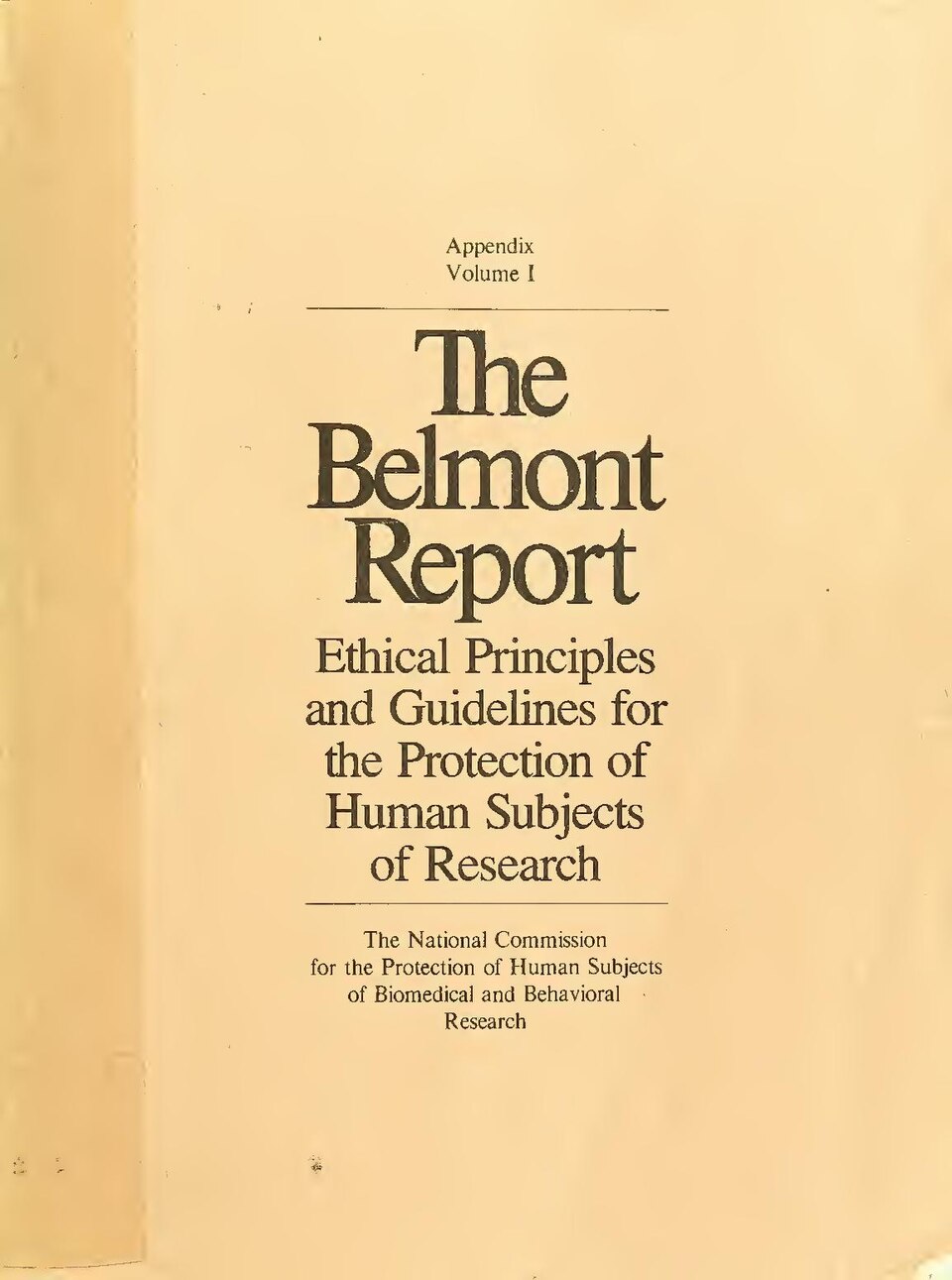
Image context: the cover uses a real scanned preview of the Belmont Report itself rather than a symbolic lab photograph. That choice keeps the essay anchored to the text under discussion. Belmont is a policy artifact before it is a slogan, and the page on the screen is part of the story.[5]
1) The report opens with boundaries, not slogans
The most underread section of Belmont is not the famous middle portion on ethical principles. It is Part A, "Boundaries Between Practice & Research."[1] There the Commission insists that the first protective move is conceptual. "Practice" refers to interventions designed solely to enhance the well-being of an individual patient or client; "research" is activity designed to test a hypothesis and contribute to generalizable knowledge.[1] That distinction sounds obvious until you notice how much work the report makes it do.
Belmont is careful here. It does not say every new or untested clinical move automatically counts as research. A clinician can depart significantly from standard practice without that innovation, by itself, becoming research.[1] But the report refuses to let that caveat become an escape hatch. When an activity contains an element of research, it should undergo review for the protection of human subjects.[1] In other words, Belmont is not trying to freeze medicine into routine. It is trying to prevent novelty from borrowing the moral shelter of ordinary care while still harvesting knowledge from human subjects.
This opening matters because it turns ethics into a problem of institutional sorting. Before an IRB weighs benefits or reads a consent form, someone has to decide what kind of activity is being proposed. Belmont's first move is therefore administrative in the deepest sense: it asks which human encounters belong inside the protective machinery at all.[1][3]
2) Respect for persons is a design standard, not a signature ritual
The report's best-known principle, respect for persons, is often collapsed into the modern paperwork image of informed consent.[1][3] Belmont's own wording is wider and stricter. It says respect for persons contains two demands at once: acknowledge autonomy and protect those with diminished autonomy.[1] The point is not simply that subjects sign after disclosure. The point is that they have the conditions required for considered judgment, and that people whose liberty or decisional power is constrained may require a different level of protection.[1]
That is why Part C on applications still reads fresher than many present-day compliance habits. Belmont breaks consent into information, comprehension, and voluntariness.[1] It warns that the manner and context of communication matter as much as the list of facts disclosed.[1] It even proposes the standard of the "reasonable volunteer," which is tougher than the ordinary clinical model because a research subject may want to know more about gratuitously undertaken risk than a patient seeking needed care.[1]
Read closely, that is a rebuke to checkbox ethics. Belmont does not treat consent as a single legal event that begins once the form appears. It treats consent as a communicative design problem: what must be said, in what setting, under what pressures, and with what opportunity to refuse or withdraw.[1][3] The language about prisoners is especially revealing, because the report does not resolve the issue through sentiment. It names the dilemma directly: respect can support the chance to volunteer, yet the same principle can also demand protection against coercion under prison conditions.[1]
3) Beneficence and justice push ethics into study architecture
Belmont's later principles are frequently summarized in ways that make them sound broad but vague. The report is more concrete than that. Beneficence is presented as an obligation, not as optional kindness, and it is operationalized through two rules: do not harm, and maximize possible benefits while minimizing possible harms.[1] Justice is posed through the harder question of distribution: who receives the benefits of research, and who bears its burdens?[1]
This is where the document's moral memory becomes unusually sharp. The justice section does not stay abstract. It names poor ward patients who historically carried research burdens while private patients reaped the gains, and it names the Tuskegee syphilis study as a domestic example of disadvantaged Black men being used to study the untreated course of a disease long after effective treatment existed.[1] That move matters because Belmont refuses to imagine research ethics as a matter of individual courtesy alone. Study populations, recruitment convenience, and downstream access are part of the ethical content of the protocol.[1][3]
The applications section turns that principle into operational questions. Subject selection must be scrutinized to see whether groups are being chosen because they are easily available, compromised, or manipulable, rather than because the science requires it.[1] Publicly funded research that yields therapies or devices should not advantage only those who can afford them while loading research burdens onto people unlikely to benefit from the results.[1] That is not a decorative appeal to fairness. It is a demand that protocol design and social distribution be read together.[1][4]
4) What Belmont changed, and what it could not do alone
One of the most revealing lines in the report is bureaucratically modest. Belmont says it does not make specific recommendations for administrative action; it is meant to offer basic ethical principles and guidelines that can help resolve problems in research with human subjects.[1] That limitation is part of its strength. The document was never a self-executing code. It was a framework that later regulations, IRB procedures, consent rules, and federal oversight had to translate into enforceable practice.[3][4]
That is why the later HHS materials are useful companions to the 1979 text. They show Belmont's afterlife in law and administration: 45 CFR part 46, the Common Rule, and the continuing use of the report as a foundational reference for IRBs and institutional oversight.[3][4] The report endured because it was abstract enough to travel and concrete enough to organize real decisions.
So the durable lesson of Belmont is slightly different from the way it is usually taught. Its core achievement was not only to identify three principles. It was to show how those principles have to be routed through boundaries, procedures, and institutional judgment. Read that way, Belmont is less a sainted ethics artifact than a working document about where human-subject protection actually starts: in naming an activity as research, designing consent for real comprehension, weighing risk against benefit, and asking which bodies are being asked to carry the burden of knowledge.[1][2][3]
Sources
- HHS Office for Human Research Protections, "Read the Belmont Report" (full text of the April 18, 1979 report).
- HHS Office for Human Research Protections, "The Belmont Report" (overview of the commission, the 1974 Act, and the report hub).
- HHS Office for Human Research Protections, "45 CFR 46 FAQs" (historical basis of the current human research regulations and Belmont's relationship to the Common Rule).
- HHS Office for Human Research Protections, "Belmont Report 25th Anniversary" (history of the report, the Belmont Conference Center, and its regulatory afterlife).
- Wikimedia Commons, "File:The Belmont report - ethical principles and guidelines for the protection of human subjects of research (IA belmontreporteth01unit).pdf" (scanned file page and image source used for the cover).
Editor’s Pick Review
This piece wins the 24-hour curation window because it does unusually hard work at the design layer: it re-centers Belmont from slogan-level principle recital to the operational chain that actually governs subject protection (classification, consent architecture, risk-benefit review, and burden distribution). The argument is source-anchored, historically time-bound, and structurally coherent from opening claim to close.[1][2][3][4]
It also clears the stricter image policy cleanly: the visual is a topic-grounded document scan tied directly to the essay’s object, with no analytical diagram substitute. Chinese translation quality is strong in rhythm, terminology consistency, and policy-language clarity, so the cross-language read preserves both legal nuance and narrative flow.