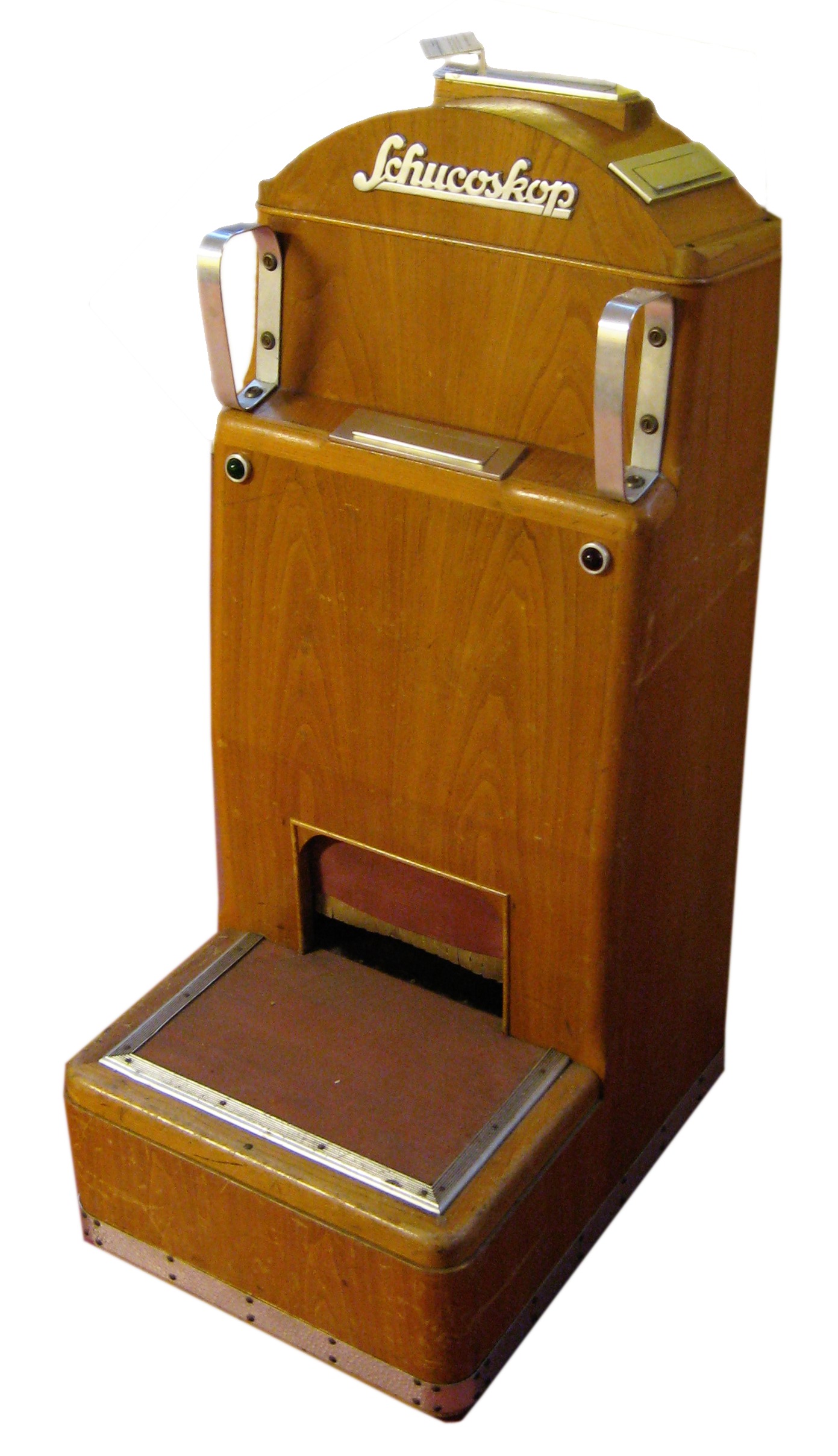
A shoe-fitting fluoroscope looks absurd only after the lesson has already been learned. In the store, it looked like certainty. A child placed both feet into the lower opening, a parent and salesperson looked through the upper viewers, and the bones appeared inside the outline of the shoe. The sales promise was simple: do not guess fit by touch when the machine can show it.
That is why the device is useful as a health story. The failure was not just that early retail X-ray machines emitted radiation. The deeper mechanism was that a hazardous exposure became an ordinary shopping step. Dose was converted into reassurance. A medical technology was stripped of clinical governance, placed beside shoe boxes, and framed as better parenting, better salesmanship, and better science.[1][2][3]
Image context: the cover image is a real photograph of a preserved pedoscope in the German Shoe Museum in Hauenstein. It is used here because the article is about the device's retail design: a wooden cabinet, a low foot chamber, and viewing ports that made radiation feel like a shared fitting demonstration rather than a medical procedure.[6]
Timeline anchors before the mechanism
- November 8, 1895: Wilhelm Roentgen discovered X-rays, and the new invisible light quickly entered both medical imaging and public fascination.[3]
- February 6, 1919: Jacob J. Lowe filed the U.S. patent for a method and apparatus to determine shoe fit by viewing the bones of the foot inside the shoe.[1]
- January 18, 1927: U.S. Patent 1,614,988 was published, assigning the invention to the Adrian Corporation.[1]
- 1948: surveys of shoe-store machines began turning retail novelty into an industrial-hygiene problem; ORAU cites Detroit measurements ranging from 16 to 75 roentgens per minute at foot position.[2]
- 1949-1950: medical warnings became more explicit, including Louis Hempelmann's 1949 warning and the 1950 California Medicine article cataloged by OSTI as The Shoe-Fitting Fluorscope as a Radiation Hazard.[2][4]
- 1957-1960: Pennsylvania became the first U.S. jurisdiction to ban the machines in 1957, and Wisconsin 101 reports that by 1960, 34 states had banned them.[2][5]
These dates keep the episode out of cartoon history. The problem did not emerge because everyone was simply ignorant of X-rays. Radiation injuries among early X-ray workers had been known for decades. The shoe-store fluoroscope survived because knowledge, measurement, regulation, insurance pressure, and consumer suspicion did not arrive in the retail aisle at the same time.
The machine made seeing feel safer than measuring
Lowe's patent is plain about the appeal. The apparatus placed an X-ray device below a support for the feet, a fluorescent screen above, and a viewing chamber with multiple observation openings.[1] The patent emphasized that the buyer could stand under weight-bearing conditions and see the bones, toes, and shoe outline together. The claim was not merely technical. It promised to settle a retail argument: if a shoe felt acceptable in the first few minutes but later pinched, the image would reveal crowding before the mistake left the store.[1]
That design changed the social meaning of the exposure. In a clinic, an X-ray image normally belongs to a chain of indication, operator training, shielding, interpretation, and record. In the shoe store, the same underlying physical principle became a demonstration. The device invited simultaneous looking: the child, the parent, and the clerk could all inspect the glowing evidence. A dose-producing act became a moment of shared visual confidence.
The Henry Ford's curator account captures the later weakness of that confidence: former clerks did not necessarily find that the machines improved fitting, and the device often worked as a marketing tool more than a precise sizing instrument.[3] Wisconsin 101 makes the same point from the trade-history side: the fluoroscope gave sales recommendations the aura of scientific verification, even though the view from above was limited and the selling value could exceed the fitting value.[5]
The exposure problem was cumulative, leaky, and badly assigned
The public often imagines radiation risk as one dramatic blast. The shoe-fitting fluoroscope was more mundane. Its danger came from repeated, short exposures; variable machine design; displaced or inadequate shielding; scattered radiation; and occupational use by clerks who might stand near the cabinet all day or put their hands into the beam to squeeze a shoe.[2]
ORAU's Museum of Radiation and Radioactivity summarizes late-1940s measurements that make the scale visible. Reported foot doses ranged from 7 to 14 roentgens for a 20-second exposure in one account, while a 1948 Detroit survey found 16 to 75 roentgens per minute at the position of the feet.[2] ORAU also notes that more than 60 percent of inspected machines exceeded an American Standards Association recommendation of 2 roentgens to the feet per five-second exposure.[2] The Henry Ford article gives the comparison that made regulators uneasy: the recommended maximum at the time was 0.3 roentgen per week, while a significant share of surveyed store machines produced far higher rates at the foot position.[3]
Those numbers do not translate neatly into a single population burden because customer records were not built for later epidemiology. A child might use a machine once, or many times. A clerk might operate it repeatedly over years. A machine might be well shielded, badly shielded, modified, or poorly maintained. The risk was therefore distributed unevenly. ORAU notes no reported customer injuries in its summary, while also describing serious operator-linked injuries, including dermatitis in a saleswoman after years of frequent operation and a severe radiation burn in a shoe model.[2] That asymmetry is part of the mechanism: the most exposed people were often the workers, while the sale was justified through the child's foot health.
The sales script hid the risk-benefit test
Every radiation use carries a risk-benefit question. The retail fluoroscope made that question hard to see because the benefit was expressed in moral and visual language. Parents were told that careful shoe fitting protected a child's feet. Children enjoyed seeing their bones. Store owners could advertise modern equipment. Clerks could use the image to turn a recommendation into proof.[3][5]
The problem is that "proof" was too strong a word for what the machine delivered. It showed a real image, but the image did not settle all the practical questions of fit: walking comfort, upper material, growth room, width, heel slip, foot asymmetry, and how a shoe behaved after use. The device made one hidden thing visible while hiding other relevant things. It made bones visible and dose invisible. It made the shoe outline visible and exposure frequency invisible. It made a clerk's recommendation look objective while leaving the clerk's own cumulative exposure largely outside the scene.
The patent's geometry helps explain why the experience was persuasive. The customer leaned into the viewer; the body position itself became part of the test.[1] The posture made the machine feel interactive and personal. It was not a distant medical apparatus operated by someone else. It was a cabinet that let the shopper see inside the purchase. That intimacy made the exposure feel less like radiation and more like service.
Regulation arrived when the machine became socially expensive
Professional concern built before the devices disappeared. ORAU lists warnings by professional organizations in the early 1950s and notes local restrictions that placed operation under licensed physiotherapists or physicians in some jurisdictions.[2] Wisconsin 101 adds the municipal and state sequence: Milwaukee regulated operation and location in 1950, Pennsylvania outlawed use in 1957, and by 1960 dozens of states had bans.[5]
The regulatory story is not simply that science defeated ignorance. It is that a small retail technology lost its protective story. Once customers associated the machine with radiation hazard instead of scientific care, the sales advantage weakened. Once insurers and regulators treated it as a liability, the store owner had less reason to keep a machine that did not clearly improve fit. In that sense, the fluoroscope vanished when the same image that once sold certainty began selling risk.
The durable lesson is about setting, not nostalgia
The shoe-fitting fluoroscope should not be read as a reason to distrust medical imaging. It is better read as a setting failure. Fluoroscopy still has legitimate medical uses when the indication is meaningful, the operator is trained, the equipment is controlled, the dose is managed, and the result changes care. The shoe-store version removed most of that governance while preserving the authority of the image.
That distinction matters for modern health technology. A device can produce a real measurement and still be poorly placed. It can create a vivid output while failing the harder questions: Who benefits? Who absorbs repeated exposure or downstream work? Is the measurement recorded and interpreted responsibly? Does the result change a decision that matters? Are incentives aligned with health rather than sales?
The old wooden cabinet answers those questions badly. It turned a child's foot into a retail screen, assigned confidence to anyone who could look through a viewer, and pushed dose accounting into the background. Its history is not merely a strange chapter in shoe shopping. It is a compact example of how health risk can hide inside a technology that feels objective, intimate, and helpful at the exact moment it should be governed.
Sources
- Google Patents, "US1614988A - Method and means for visually determining the fit of footwear" - Jacob J. Lowe's patent, filed February 6, 1919 and published January 18, 1927.
- Oak Ridge Associated Universities Museum of Radiation and Radioactivity, "Shoe-Fitting Fluoroscope (ca. 1930-1940)" - historical account, exposure measurements, warnings, injuries, and regulatory timeline.
- The Henry Ford, "Shoe-Fitting Fluoroscope: Scientific Advancement or Sales Tactic?" (July 21, 2025) - museum article on fluoroscopy, retail use, marketing claims, scientific motherhood, and Detroit survey figures.
- U.S. Department of Energy OSTI, "The Shoe-Fitting Fluorscope as a Radiation Hazard" - catalog record for Leon Lewis and Paul E. Caplan's 1950 California Medicine article.
- Wisconsin 101, "The Rise and Fall of Shoe-Fitting Fluoroscopes" - public-history account drawing on Duffin and Hayter, with the Milwaukee regulation, Pennsylvania ban, and 1960 state-ban count.
- Wikimedia Commons, "File:Hauenstein Pedoskop.jpg" - photographic source for the preserved pedoscope image used as the article cover.