
CDC HEADS UP's short "Concussion Signs & Symptoms" video works best when treated as a delayed-recognition drill rather than a sideline diagnostic tool.[1] The clip's basic task is public health communication: teach parents, coaches, teachers, and athletes to notice that concussion can show up through what a child reports, what an observer sees, and what changes over the next hours or days. That is a narrower and safer message than trying to decide, in the moment, whether a bump to the head was "serious enough."[2][3]
The distinction matters because concussion is both familiar and easy to mis-handle. CDC defines concussion as a type of traumatic brain injury caused by a bump, blow, or jolt to the head, or by a hit to the body that makes the head and brain move rapidly back and forth.[4] That movement can trigger chemical changes and sometimes stretch or damage brain cells, but the first public clue is usually not an image on a scan. It is a pattern of headache, dizziness, fogginess, light sensitivity, nausea, slower answers, mood change, sleep disruption, or a child simply acting unlike themselves.[2][4]
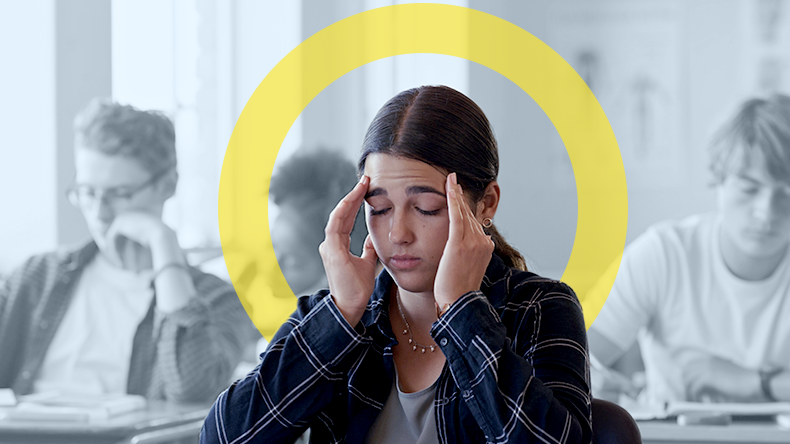
The cover photograph comes from CDC's own signs-and-symptoms page.[5] It is a useful image precisely because it is incomplete. A hand to the head is not a diagnosis. It is a cue to slow the scene down and ask what changed, what the child can report, what adults can observe, and whether any danger signs have appeared. The video earns its place in the article because it compresses that public script into a short, watchable sequence; the written guidance around it supplies the boundaries.
The first lesson is that symptoms can arrive late
The most important thing to watch for in the video is not a single symptom. It is timing.[1] CDC's written page states plainly that concussion signs and symptoms may not show up right away; they can take hours or days to appear or be noticed.[2] That point changes the job of the adult in the room. The task is not finished when the child stands up, says they are fine, and wants to keep playing or return to class.
In practice, a delayed symptom window creates a monitoring problem. Headache or nausea may be obvious early. Concentration trouble, mood change, sleep disruption, light sensitivity, slower answers, or behavior that is subtly different can become clearer after the adrenaline of the event fades.[2] Younger children and some children with disabilities may have a harder time communicating what feels wrong, so the observer has to compare the child's behavior with their usual baseline rather than wait for a perfect complaint.[2]
That is why the clip should be read as a memory aid for the next day as much as for the next minute. A good concussion response begins with recognition, but recognition has to stay open long enough to catch a changing picture. The safe public habit is to watch after the event, share changes with a health care provider, and resist the false reassurance that comes from an immediate "I'm okay."[2][4]
The second lesson is that signs and symptoms are different lanes
CDC separates symptoms from signs in a way that sounds simple but is clinically useful for non-clinicians.[2] Symptoms are what the child feels: headache, dizziness, tiredness, fogginess, trouble concentrating, sadness, irritability, sleep change, or sensitivity to light and noise. Signs are what someone else can observe: appearing dazed, answering slowly, seeming more clumsy than usual, changing mood or personality, vomiting after the injury, or struggling with memory and concentration in a visible way.[2]
The video is valuable because it lets those lanes sit beside one another.[1] A child may under-report symptoms because they want to stay in the game, avoid worrying a parent, or return to normal as fast as possible. An observer may over-focus on dramatic markers such as loss of consciousness and miss the quieter signs. CDC's public guidance reduces that error by asking adults to treat subjective complaints and observable changes as complementary evidence.[2][3]
That frame also keeps the article away from a common mistake: making concussion recognition depend on a single spectacular moment. Many concussions do not announce themselves with collapse. The concerning pattern can be a child who is slower to answer, suddenly less coordinated, unusually emotional, bothered by light, or unable to track schoolwork in the ordinary way.[2][4] The written guidance makes the video's public message stronger: do not wait for one cinematic sign when several ordinary changes already point in the same direction.
Danger signs are not watch-and-wait cues
The video and the CDC page both need the emergency boundary to be clear.[1][2] CDC says to call 911 or go to the nearest emergency department after a bump, blow, or jolt to the head if danger signs appear: convulsions or seizures, inability to recognize people or places, repeated nausea or vomiting, unusual behavior or increasing confusion, loss of consciousness with increasing drowsiness or inability to wake, slurred speech, weakness, numbness, decreased coordination, worsening headache, one pupil larger than the other, or double vision.[2]
That list is not just a severity scale. It is a decision rule. Concussion and more serious brain injury can be hard to distinguish from the outside, so danger signs move the situation out of ordinary monitoring and into emergency care.[2] For infants and toddlers, CDC adds a practical boundary: a child who will not stop crying and cannot be consoled, or will not nurse or eat, needs urgent attention in the same frame.[2]
This is the part of the annotation that matters most for public safety. Calm observation is useful only when the observed signs belong to the ordinary concussion-recovery lane. The moment danger signs appear, the correct behavior changes. The article's core claim follows from that switch: the public role is not to diagnose the injury with confidence; it is to sort the scene into immediate emergency care, medical evaluation, and later recovery monitoring.[2][3][4]
Sports removal is a safety step before it is a final answer
CDC's response guidance makes the sideline rule blunt: if an athlete has any signs or symptoms after a bump, blow, or jolt to the head or body, remove them from sports participation right away, check for danger signs, and keep them out the same day and until cleared by a health care provider.[3] The same page warns adults not to judge concussion severity themselves; return to sports is a medical decision.[3]
This matters because sports culture can turn recognition into negotiation. The athlete wants to go back in. The team needs a player. The hit did not look dramatic. The child insists nothing is wrong. CDC's sequence cuts through that pressure by making removal a provisional safety action. It does not require the coach to prove a concussion. It requires the coach to respect the possibility of one.[3]
The return side has the same structure. CDC's guidelines page says an athlete should return to sports only with health care provider approval and points to a staged return-to-play progression.[6] It also places school recovery in the same ecosystem: getting students back to school after concussion can shorten recovery and reduce the likelihood of mental health symptoms, but activities may need short-term adjustment.[6] That pairing is important. Recovery is not merely "sit in a dark room until normal." It is a managed return to ordinary cognitive, social, and physical load.
What the video gets right
The CDC clip is short, but its strongest lesson is structural. It teaches that concussion recognition belongs to a chain: notice symptoms and signs, remember that they can be delayed, identify danger signs that require emergency care, remove athletes from play when concussion is suspected, and use medical guidance for return.[1][2][3][6]
That chain is more useful than a checklist of isolated symptoms. A child with a concussion is not always the child who looks most injured in the first five seconds. The safer observer watches time, behavior, speech, balance, mood, sleep, school function, and escalation boundaries together. The video helps because it makes that watching easier to remember; the surrounding CDC guidance gives the watching a decision structure.[1][2][3][4][6]
Sources
- CDCFoundationTBI / CDC HEADS UP, "Get a Heads Up: Concussion Signs & Symptoms," YouTube video embedded from CDC HEADS UP materials.
- Centers for Disease Control and Prevention HEADS UP, "Signs and Symptoms of Concussion," public guidance updated September 15, 2025.
- Centers for Disease Control and Prevention HEADS UP, "Responding to a Sports-related Concussion," removal-from-play, danger-sign, and clearance guidance updated September 15, 2025.
- Centers for Disease Control and Prevention HEADS UP, "Concussion Basics," definition, mechanism, recovery, and repeat-impact context updated January 7, 2025.
- Centers for Disease Control and Prevention HEADS UP, "img-signs2x-cropped.png," photographic image used on the CDC signs-and-symptoms page and as this article's lead image.
- Centers for Disease Control and Prevention HEADS UP, "HEADS UP Guidelines and Recommendations," recovery, school, and return-to-sports guidance updated February 6, 2026.