


Home blood pressure advice often gets flattened into a shopping suggestion: buy a cuff, press start, write down the number.[1][4][5][6][7] The three institutional videos below are more useful than that because they keep pushing in the opposite direction. American Heart Association, American Medical Association, and British Heart Foundation all present self-measured blood pressure as a small protocol rather than a gadget habit. The useful reading does not begin when the machine inflates. It begins a few minutes earlier, when the body is quiet, the chair is doing its job, the cuff actually fits the upper arm, and the measurement is about to be repeated instead of treated as a one-off verdict.[1][2][3][4][5][6][7]
That distinction matters because blood pressure is unusually easy to disturb. The number can move with conversation, crossed legs, a badly positioned arm, an undersized cuff, or the simple fact that many people tense up around measurement itself.[4][5][6][7] Home monitoring therefore has value not because the kitchen table is magically truer than the clinic, but because repeated home readings can reduce white-coat distortion and show a more ordinary pressure pattern when the method is consistent.[4][5][6][7] Consistency is the hard part. A home cuff without protocol can produce extra numbers and extra anxiety at the same time.
Watched together, the three videos reveal a shared logic. First, they shrink the setup into something ordinary enough to repeat.[1][2][3] Second, they insist on bodily control points that make the number more trustworthy: back supported, feet flat, arm at heart level, no talking, and a short quiet rest before starting.[1][2][3][4][5][6] Third, they treat the second reading as part of the first, not as an optional bonus. A single home reading can be noisy; a pair of readings, taken properly and logged over days, starts to behave more like evidence.[4][5][7]
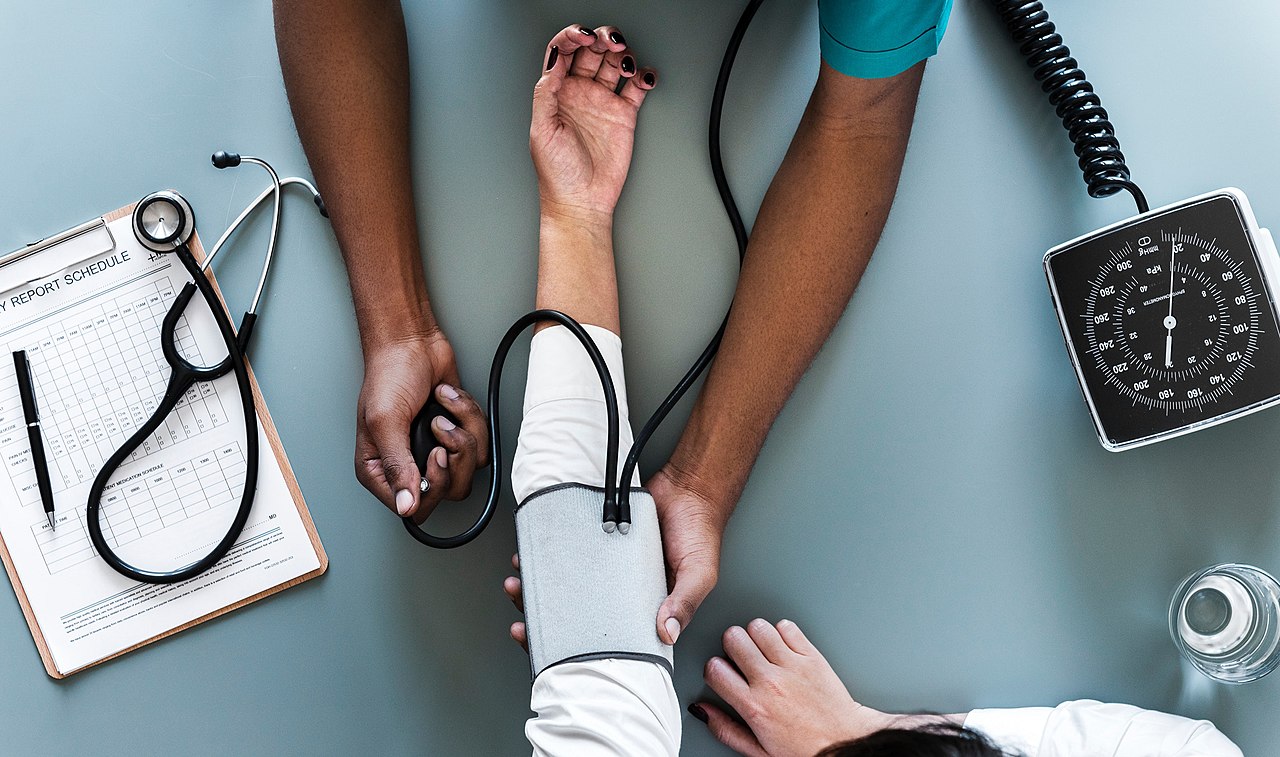
Image context: the cover uses a Wikimedia Commons documentary photograph of blood pressure monitoring in progress. Although it is a clinical scene rather than a kitchen-table one, it fits this article because the central lesson is mechanical before it is interpretive: cuff placement, supported posture, and a still upper arm are part of the reading itself.[8]
Video 1: AHA makes the pre-reading quiet feel like part of the measurement
The American Heart Association video is strong because it slows down the part many people rush through.[1] Instead of treating blood pressure as a button press, it starts by organizing the room and the body: sit correctly, place the cuff on a bare upper arm, keep the arm supported at heart level, and let a few quiet minutes pass before the machine starts.[1][4] That sequence sounds almost trivial until you notice what it is doing. It moves measurement away from impulse and toward ritual. The body is not background interference here. The body is the instrument stand.
That is the video's real value. AHA's written home-monitoring guidance pairs the same practical elements with a validated upper-arm monitor and warns against letting posture drift into convenience.[4] If the cuff slides over clothing, if the arm hangs below heart level, if the back is unsupported, or if the reading is grabbed immediately after movement, the machine may still print a number, but the number is no longer anchored to a stable method.[1][4] The video therefore does something more important than instruction-by-checklist. It teaches the viewer to treat stillness as part of measurement fidelity.
The AHA clip also helps because it normalizes repetition without making it sound obsessive.[1] That matters. Many patients interpret a second reading as distrust of the first, as if repeating the measurement were an emotional response rather than a standard part of technique. The AHA framing is cleaner: a single reading is an event, while paired readings begin to form a pattern.[1][4] That is the shift the whole collection keeps making. Good home monitoring is not about chasing the "right" number in one dramatic moment. It is about creating conditions under which the number is less distorted by the scene.
Video 2: AMA turns self-measurement into a workflow rather than a wellness gesture
The American Medical Association video is the most useful on cadence.[2] It still covers the familiar physical basics, but it places them inside a repeatable workflow: measure at consistent times, use the same general conditions, and treat the log as something that belongs in a clinical conversation rather than in a private notebook of worries.[2][5] That shift is subtle but important. AMA is not selling self-measurement as self-sufficiency. It is presenting it as structured out-of-office data.
This is where home blood pressure monitoring gets clearer. The point is not simply that repeated readings exist. The point is that they are produced under a reproducible protocol and then averaged or reviewed in a way that clinicians can actually use.[2][5] AMA's patient guidance reinforces the same idea in prose: choose a validated upper-arm device, sit with back supported, rest before measuring, take readings at the times your care team asks for, and understand that home measurements can help sort white-coat effect from a more durable pressure pattern.[5] The home cuff, in other words, is valuable when it narrows ambiguity. It becomes less valuable when it invites improvisation.
The AMA video also carries an understated warning against casual convenience.[2] A rushed standing reading before work, a measurement taken while talking, or a cuff pulled from a drawer and strapped on without checking placement all feel efficient. They are also exactly the sort of shortcuts that weaken the reason to monitor at home in the first place.[2][5][6] The workflow framing corrects that. Useful self-measurement is a small act of standardization. It asks the same body to meet the same conditions often enough that comparison becomes meaningful.
Video 3: BHF shows that the log matters because the reading is supposed to travel
The British Heart Foundation video completes the set by making home measurement look portable in the best sense: not portable as a gadget, but portable as information.[3] The clip is concise, and that economy helps. It shows the bodily setup, reminds viewers to stay quiet and seated, and then treats the result as something that belongs in a diary rather than in memory.[3][7] That final move matters because home blood pressure is almost never interpreted from one isolated value. The number has to leave the moment of measurement and join a series.
BHF's accompanying diary guidance makes the logic explicit by organizing readings across days, often morning and evening, so the record shows more than one mood, meal, or stressful errand.[7] That is a useful counterweight to the emotional way people often experience blood pressure. Many readers encounter the number as a personal judgment: good today, bad today, alarming today. The diary format pulls the measurement back into a cooler register. A reading is not a verdict. It is one point in a deliberately assembled series.[3][7]
This is also why the BHF video works so well as the third piece in the collection. AHA stresses pre-reading control.[1][4] AMA stresses repeatable workflow and clinical usability.[2][5] BHF stresses carry-through: once the reading exists, it should be recorded in a form that can be averaged, compared, and discussed.[3][7] The value of home monitoring does not end at cuff deflation. It ends when the reading has been turned into a pattern someone can interpret responsibly.
What the three videos reveal together
Taken together, the collection argues for a stricter and calmer understanding of self-measured blood pressure.[1][2][3] The home cuff is not a truth machine that rescues readers from technique. It is a measuring device that becomes more useful as the protocol around it becomes more boring and more repeatable.[4][5][6][7] Cuff validation matters because bad hardware or the wrong cuff size corrupts the process early.[4][5] Seated rest matters because blood pressure is labile and the body needs a quiet baseline.[1][4][6] Arm position matters because the reading is partly hydrostatic, not just electronic.[1][3][4] The second reading matters because one number can wobble while a pair starts to settle.[4][5][7]
That is the practical correction worth keeping. Home monitoring should lower drama, not amplify it. A good protocol gives patients and clinicians something steadier than a single office snapshot and something more defensible than a hurried reading grabbed at random.[4][5][6][7] If the videos are read only as tutorials, they are helpful. If they are read together, they say something harder and better: a useful home blood pressure number is manufactured by method before it is interpreted by medicine.
Sources
- American Heart Association, "How To Monitor Your Blood Pressure at Home," YouTube video.
- American Medical Association (AMA), "Self-measured Blood Pressure (SMBP) Training Video," YouTube video.
- British Heart Foundation, "How to measure your blood pressure at home," YouTube video.
- American Heart Association, "Home Blood Pressure Monitoring" - validated upper-arm device guidance, quiet seated rest, arm position, and repeat readings.
- American Medical Association, "What doctors wish patients knew about home BP measurement" - device validation, positioning, timing, and white-coat context.
- MedlinePlus, "Measuring Blood Pressure" - how body position, recent activity, and technique affect readings.
- British Heart Foundation, "Blood pressure chart and diary" - why repeated morning/evening logging matters for home monitoring.
- Wikimedia Commons, "File: Blood pressure monitoring.jpg" - photographic file page for the cover image used in this article.