George Papanicolaou is often remembered as the man who gave cervical cancer screening its nickname. That memory is too tidy. The Pap smear did not become historically important because one physician saw one revealing slide. It mattered because Papanicolaou helped turn exfoliated cervical cells into a repeatable warning system, then handed that system to laboratories, clinics, and eventually national screening programs.[1][2][3]
That distinction is what makes the story worth revisiting in 2026. Many medical discoveries live or die on whether a drug works or a procedure succeeds. The Pap test had a different career. It succeeded when three layers locked together: a microscope method that could notice abnormal cells before symptoms, a reporting language that other clinicians could use consistently, and a follow-up chain strong enough to bring people back for repeat testing, colposcopy, biopsy, and treatment when the smear turned abnormal.[2][3][4][5]
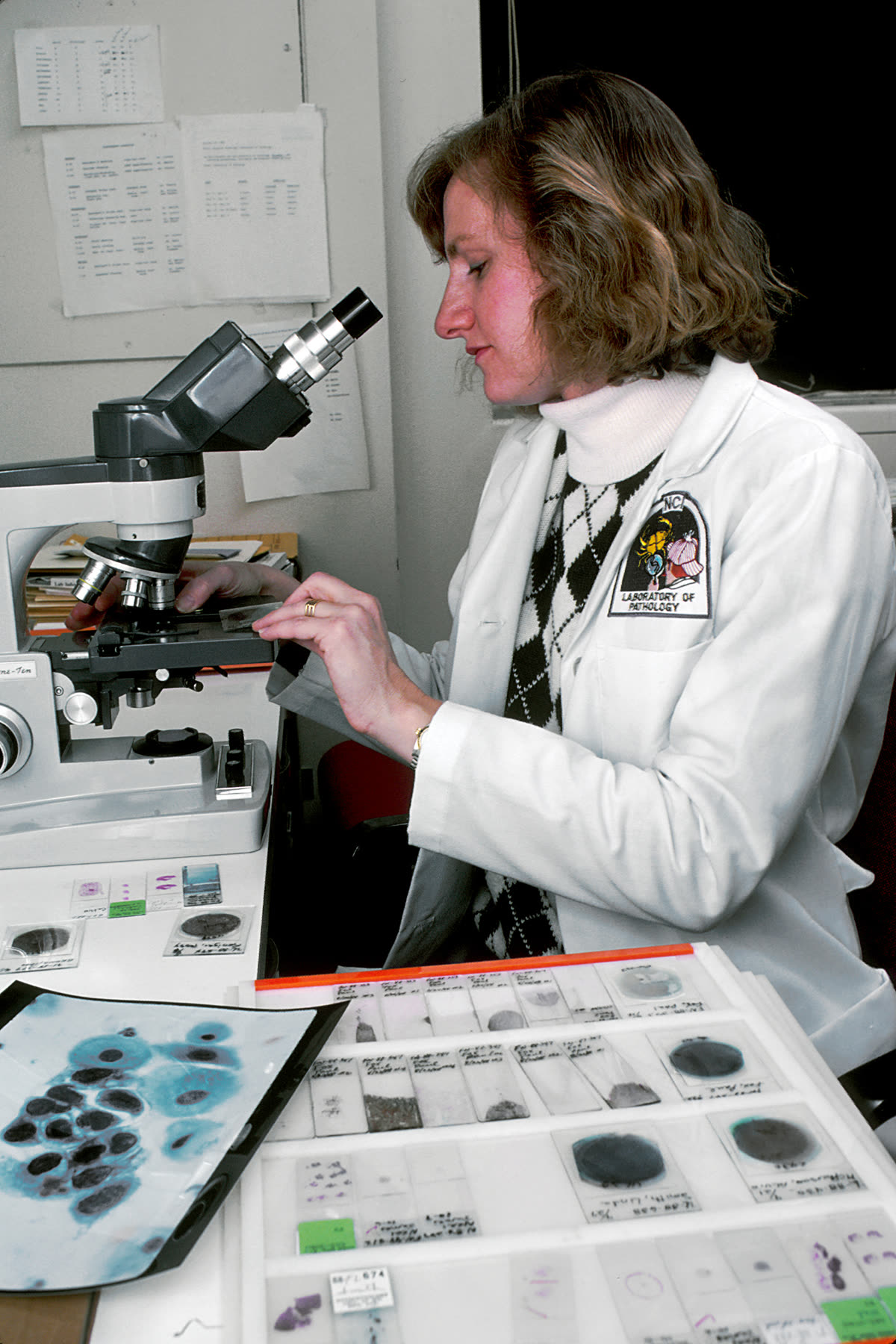
Image context: the cover uses a real National Cancer Institute laboratory photograph of a scientist reading pap smears. That is deliberate. This article is about screening as disciplined, repeated interpretation, and the image keeps the breakthrough anchored in laboratory routine rather than heroic legend.[6]
Timeline anchors before the interpretation
- 1928: Papanicolaou presented evidence that uterine cancer cells could be detected in vaginal smears, but the claim was met with skepticism in a clinical culture that trusted tissue biopsy more than exfoliated cells.[2]
- 1943: George Papanicolaou and Herbert Traut published Diagnosis of Uterine Cancer by the Vaginal Smear, the book that made the method teachable beyond one laboratory.[2]
- 1946: a favorable JAMA reception helped move the smear from specialist curiosity toward broader professional legitimacy.[1]
- 1991: after about 40 years of widespread Pap-smear use, the Bethesda System standardized cytology reporting language for the modern era.[5]
- 2025: NCI's public screening guidance still lists Pap testing every 3 years as an acceptable route for many adults, even in an HPV-testing era.[4]
Those dates show why this is a microhistory rather than a simple invention story. The central event is not only discovery. It is the slow conversion of a microscopic sign into a durable public-health habit.
Before the Pap smear was a program, it was a wager about what loose cells could mean
Papanicolaou's core insight sounds almost modest when stated plainly: cells shed from the cervix could be collected, stained, and read for pathologic change before an invasive cancer announced itself clinically.[1][2] The significance lay in the time shift. A biopsy usually arrived after a lesion had already become suspicious enough to sample directly. Cytology promised an earlier, lighter-touch warning.
That was not automatically persuasive. The skepticism of 1928 mattered because it exposed the method's initial weakness. Physicians were used to architecture in tissue, not scattered cells on a slide.[2] A smear looked indirect. It could suggest; it could not settle. Even the later summaries of the 1943 book are careful on this point: the vaginal smear was valuable as an accessory procedure, but not a replacement for biopsy and histologic sections.[2] That limitation is easy to misread as a flaw. It was actually part of the test's long-term shape. The Pap smear survived because it was good at triage and serial warning, not because it could do the whole diagnostic job alone.[2][3][4]
This is the first correction worth making. The Pap test did not conquer cervical cancer by rendering every other procedure unnecessary. It created an earlier checkpoint. Its achievement was to move the clinical question from "Is there already a visible cancer?" toward "Are precancerous or malignant cell changes showing up early enough to trigger the next step?"[3][4]
Why 1943 matters more than the origin myth
The decisive year in this history is not necessarily the first presentation. It is 1943, when Papanicolaou and gynecologist Herbert Traut published a full monograph that described smear preparation, staining, normal and pathologic appearances, and the diagnostic logic of the method.[2] That publication changed the social life of the discovery. It turned a laboratory finding into a portable method.
That portability is the real hinge. A test becomes infrastructure only when strangers can repeat it. Papanicolaou's breakthrough therefore depended on more than eyesight. It depended on codification: how to collect the sample, how to stain it, how to compare cell forms, and how to teach others what counted as suspicious.[2] The Pap smear's history is full of microscope labor, but it is equally full of instruction.
The Weill Cornell archive captures the next stage. By 1946, the method was receiving strong professional attention, and over the following decades it became the first cancer screening test to be widely used at population scale.[1] That scale shift is what made the Pap smear historically unusual. Most medical tools improve care one patient at a time. Cytology also reorganized calendar time. Instead of waiting for symptoms, medicine could ask women to return at intervals, repeat the sample, compare changes, and intervene before invasion.[3][4]
The Pap smear's real power came from serial screening, not one clever slide
This is where the biography widens into program design. The National Cancer Institute's PDQ summary states the point bluntly: regular Pap screening decreases cervical-cancer incidence and mortality by at least 80% in an appropriate population.[3] That number did not appear because one stained smear had magical accuracy. It appeared because the test fit the natural history of cervical precancer unusually well. Cell changes often arrive years before invasive cancer. A screening tool that can sample those changes repeatedly gains strategic advantage from time itself.[3][4]
Yet the same official sources also explain the boundary. Screening is not perfect. False positives generate anxiety and extra procedures; false negatives can delay care; follow-up quality matters as much as the initial sample.[4] That is the second important correction. The Pap smear was never just a laboratory triumph. It was a systems test. It needed specimen quality, skilled interpretation, recall systems, and confirmatory steps such as colposcopy or biopsy.[2][4]
Seen this way, Papanicolaou's historical role changes. He did not simply invent a slide-based answer to cervical cancer. He helped create a technology that only became transformative once laboratories and clinics learned to live by repetition. The Pap smear belongs to the same family as vaccination registries and blood-pressure follow-up loops: tools whose outcome depends on program discipline, not only on scientific brilliance.
Why the afterlife matters: from free-text judgment to Bethesda and HPV
A screening test that spreads widely eventually collides with its own ambiguity. Decades of Pap-smear use produced enormous benefit, but also variability in how borderline findings were named and managed. The National Cancer Institute's Division of Cancer Prevention describes the 1991 Bethesda conference as a turning point that followed about 40 years of Pap-smear use and brought a shared vocabulary to cytology reporting.[5] That mattered because a screening program cannot run cleanly on idiosyncratic adjectives. It needs reproducible categories that tell the next clinician what sort of follow-up is justified.
The HPV era did not erase the Pap smear so much as reveal its true place. NCI's current screening page now presents three main routes: HPV testing, Pap testing, and cotesting.[4] For people aged 21 to 29, Pap testing every 3 years remains the standard USPSTF path; for many aged 30 to 65, Pap every 3 years remains acceptable even as HPV-based strategies gain ground.[4] In other words, the Pap test has moved from sole anchor to one component inside a more layered screening system.
That is a sign of success, not obsolescence. Technologies that endure usually stop pretending to do everything. The Pap smear's mature role is to function inside a broader prevention architecture that includes HPV biology, interval design, triage, and treatment of precancerous lesions.[3][4][5]
The strongest two interpretations
Interpretation A: the Pap smear was mainly a brilliant individual discovery
This interpretation preserves an important truth. Without Papanicolaou's cytologic imagination, there would be no Pap test at all.[1][2] It also explains why his name stuck to the method. The test begins with a person's unusually fertile way of seeing cells.
Interpretation B: the Pap smear's true breakthrough was the conversion of cell reading into a serial public-health system
This interpretation fits the evidence better. The early skepticism, the 1943 codification with Traut, the later standardization through Bethesda, and NCI's emphasis on interval screening plus follow-up all point in the same direction.[2][3][4][5] The test became world-changing only when it stopped being one scientist's trick and became a repeatable institution.
Interpretation A explains the name. Interpretation B explains the mortality effect.
Why this microhistory still matters
The Pap smear remains one of the clearest reminders that prevention is often built from ordinary-looking routines. A brush, a slide, a stain, a report, a return visit, another report, and only then a procedure. Nothing in that chain looks dramatic by itself. Together, the chain changed the expected life course of cervical cancer in countries able to organize screening well.[3][4]
That is why Papanicolaou still belongs in modern health history. He helped medicine learn that early warning can be lightweight, repeatable, and population-scalable. The test that bears his name did not eliminate diagnostic uncertainty, and it did not remove the need for follow-up judgment. It did something structurally smarter. It inserted time between cellular change and invasive disease, then taught health systems to use that time.
Sources
- Weill Cornell Medicine Samuel J. Wood Library, "George Papanicolaou: Development of the Pap Smear" — Cornell timeline, early publications, and the 1946 reception arc.
- R. K. Choudhary and N. Singh, "George Papanicolaou (1883-1962): Discoverer of the Pap Smear" (Journal of Obstetrics and Gynecology of India, 2018) — 1928 skepticism, the 1943 Traut collaboration, and the method's early history.
- National Cancer Institute, "Cervical Cancer Screening (PDQ) - Health Professional Version" — evidence summary that regular Pap screening reduces cervical-cancer incidence and mortality by at least 80%.
- National Cancer Institute, "Cervical Cancer Screening" — current Pap/HPV screening pathways, age intervals, and screening harms.
- National Cancer Institute Division of Cancer Prevention, "Diane Solomon, M.D." — the 1991 Bethesda System and the standardization of Pap-smear reporting after roughly 40 years of use.
- Wikimedia Commons, "File:Pap smear.jpg" — National Cancer Institute archival photograph used as the article image.