
The most useful thing about the Epilepsy Foundation's short basketball-team video is that it removes seizure first aid from the register of heroics.[1] Public medical emergencies are often taught badly because the teaching begins with fear: the collapse, the crowd, the body moving in a way bystanders do not control. This video does the opposite. It begins with confusion on the court, then very quickly reduces the response to a sequence ordinary people can remember under stress: make room, stay calm, protect the person from injury, get them onto their side, time the seizure, and call 911 only when the event crosses a clear emergency boundary.[1][2][5]
That is an important public-health correction because seizures are both common enough to matter and variable enough to confuse people. CDC estimates that about 2.9 million U.S. adults had active epilepsy in 2021 and about 456,000 U.S. children had active epilepsy in 2022.[3] At the same time, CDC emphasizes that seizures do not always look like the media version of collapse and violent shaking; some people may stare, seem confused, wander, or make unusual movements.[3] MedlinePlus adds the broader medical frame: epilepsy is a brain disorder involving recurring seizures caused by abnormal signaling among clusters of neurons, and people may lose consciousness, behave strangely, or have muscle spasms depending on seizure type.[4] The value of a first-aid script is that it keeps bystanders from improvising wildly inside that uncertainty.
That is why this video deserves an annotated viewing.[1] It is not a comprehensive neurology lesson, and it does not try to be one. Its achievement is narrower and more durable. It turns the response into choreography. The Epilepsy Foundation's school toolkit condenses the same logic into three words, "Stay. Safe. Side.," which is memorable precisely because each word points to an action rather than a vague wish to help.[5]
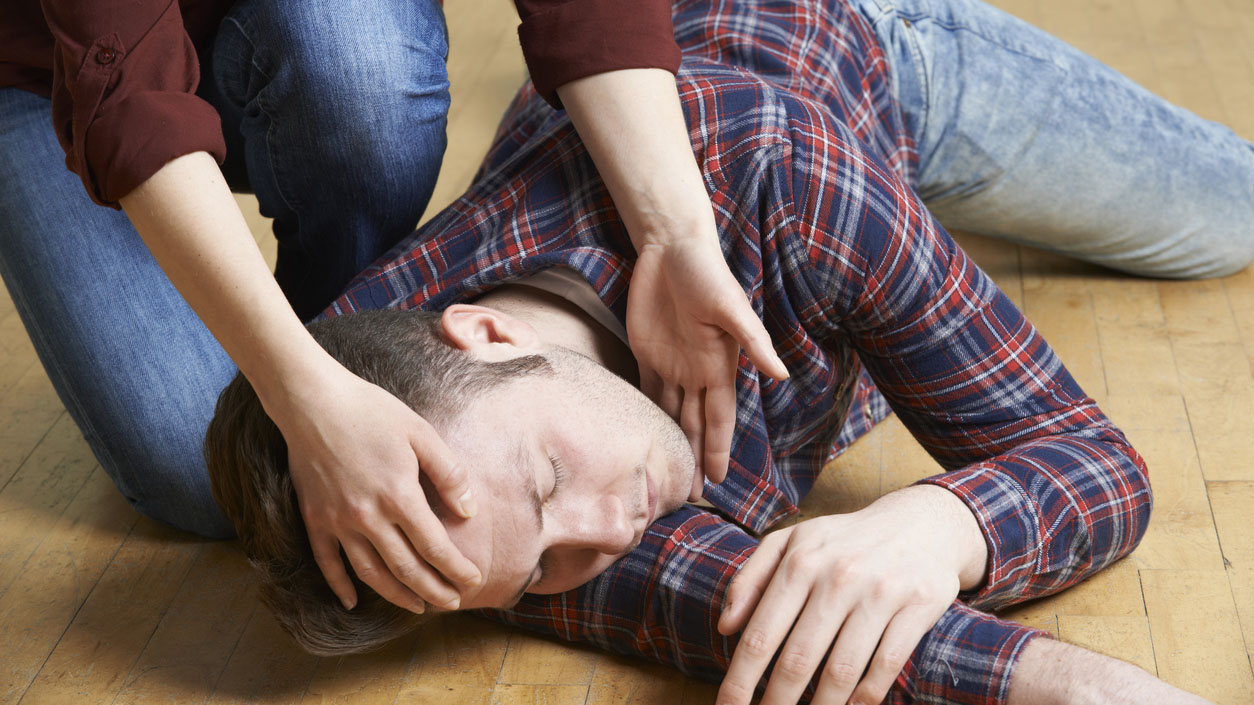
Image context: the lead image uses CDC's seizure recovery-position photograph. It fits this essay because the image captures the article's core threshold. Public seizure care is not about forcing the seizure to stop; it is about protecting the person from the floor, the crowd, blocked airways, and unnecessary bystander mistakes while the episode runs its course.[2]
At 0:26, the first move is social before it is medical
The coach's first useful instruction is not to grab Michael's arms or to shout for a miracle. He tells the others to give him room.[1] That matters because panic crowds the body before it helps it. In real life, the first danger is often not the seizure itself but everything around it: hard flooring, stray objects, classmates leaning in, people trying to hold the person upright, and the general confusion of a scene that suddenly has too many hands in it.[1][2]
CDC's written guidance lines up exactly with that opening choice. The agency tells bystanders to stay with the person, keep them safe, and move harmful objects away.[2] The apparent simplicity is the point. Public first aid often works by subtraction. Before anyone can become useful, the crowd has to stop making the scene more dangerous. The video gets that right by making space the first act. It is a quiet instruction, but it resets the whole event.
There is also a dignity question inside that opening. A seizure in public can make the person seem like an emergency object rather than a teammate, classmate, or stranger whose social world is still intact. The video's choice to clear space without turning Michael into spectacle matters for that reason too.[1] It makes the first aid relational rather than theatrical.
Around 1:06, disclosure turns fear into obligation
The middle section changes the tone of the video by letting Michael speak.[1] He says his seizures can be scary for him too, and that what is even scarier is when people do not know what to do. This is more than narrative warmth. It changes first aid from generic emergency behavior into a compact social contract. If someone with epilepsy shares that condition with a team, a classroom, or a household, then preparedness becomes part of ordinary mutual responsibility.[1][5]
That shift matters because the public often treats seizure response as rare specialist knowledge. CDC's epilepsy basics page pushes the other way by stating that seizure first aid is easy to learn and to give.[3] The Foundation toolkit does the same thing by designing material for schools rather than for neurologists.[5] Inference from those sources: the institutional goal is not to produce mini-clinicians. It is to make bystanders reliable enough that they do not worsen the event while waiting for the seizure to end or for higher-level help when needed.
The video therefore works best when watched as a lesson in burden reduction. It does not ask teammates to diagnose seizure subtype, explain electroencephalography, or determine medication strategy. It asks them to take charge of the immediate environment and the short time window the seizure opens.[1][2][3] That is exactly the right scale for public training.
Around 1:50, the script becomes bodily: stay, safe, side
This is the video's strongest stretch.[1] The coach begins to name the sequence clearly: stay calm, keep others calm and out of the way, protect the person, get him lying down, clear harmful objects, turn him on his side, support his head, never put anything in his mouth, do not hold him down, and time the seizure until the very end.[1] The power of the scene is that it refuses both passivity and overreach. Bystanders are not told to do nothing. They are told to do a small number of concrete things and to stop there.
CDC's first-aid page makes the same boundary explicit. Turn the person gently on one side with the mouth pointed toward the ground to help keep the airway clear. Do not hold the person down. Do not put anything in the mouth. Do not give food or water until fully alert.[2] Those prohibitions matter because some of the oldest seizure myths are still physically dangerous. Restraining the limbs can injure the person or the helper. Putting objects in the mouth can damage teeth and jaw. Offering food or drink too soon creates a choking risk.[2]
What the video adds is tempo.[1] On paper, these steps can look like a checklist. On screen, they read as timing and touch. The side position is not decorative. Supporting the head is not symbolic. Clearing space is not an optional courtesy. Each movement narrows a specific avoidable harm. That is why the "Stay. Safe. Side." mnemonic works so well.[5] It is not cute branding. It is a compressed body map.
Around 2:23, the clock becomes the escalation tool
The most disciplined part of the video is the way it treats calling 911.[1] Many public-health videos either underplay escalation or turn emergency calls into the first reflex. This one does neither. It says to time the seizure to the very end and to call 911 if it lasts more than five minutes.[1] CDC's guidance sharpens the threshold further: call 911 if the seizure lasts longer than five minutes, if another seizure starts soon after the first one, if the person has trouble breathing or waking afterward, if the person is injured, if the seizure happens in water, or if the person is pregnant, has diabetes and loses consciousness, or has never had a seizure before.[2]
That is good first-aid design because it replaces panic with criteria. A bystander does not need to guess whether the scene "feels bad enough." The clock and the exception list do the judgment work.[2] The video is therefore teaching a public version of triage: support first, observe carefully, escalate on specific triggers.[1][2]
This is also the point where the article's central claim comes into focus. Seizure first aid works when the bystander understands that not every seizure is automatically a 911-at-second-zero event, but neither is every seizure a wait-and-see routine.[2][5] The response has to be steady enough to avoid unnecessary intervention and structured enough to recognize the boundary where ordinary support is no longer enough.
Why this video still works
What the basketball framing finally accomplishes is cultural rather than clinical.[1] It puts seizure first aid inside an ordinary American setting where competence is supposed to mean speed, toughness, and command. Then it quietly redefines competence as calm sequencing. The person who helps most is the one who can create room, protect the head, remember the side position, avoid harmful myths, and keep track of time.[1][2][5]
That is why the video still holds up as health communication. It does not promise mastery over the seizure itself. It teaches a disciplined response to the part bystanders can control.[1][2] For public medical training, that is the right ambition. The body may be outside the helper's command for a short interval. The room, the floor, the crowd, the airway posture, and the clock are not.
Sources
- Epilepsy Foundation, "#StaySafeSide: Michael's Basketball Team Learns Seizure First Aid," YouTube video.
- Centers for Disease Control and Prevention, "First Aid for Seizures" - steps for keeping someone safe, when to call 911, and what to avoid.
- Centers for Disease Control and Prevention, "Epilepsy Basics" - prevalence, seizure presentation, and the note that seizure first aid is easy to learn and give.
- MedlinePlus, "Epilepsy" - NIH/NLM overview of recurring seizures, causes, diagnosis, and treatment basics.
- Epilepsy Foundation, Seizure Safe Schools Teacher's Toolkit - school-facing seizure-first-aid materials built around the "Stay. Safe. Side." mnemonic.