Sauna has picked up a modern health aura that often sounds stronger than the evidence behind it. In one version of the pitch, regular sauna use is treated as a near-equivalent to cardio exercise: a passive route to lower blood pressure, cleaner arteries, longer life, and general metabolic improvement. In another, it becomes a softer claim, framed as "good for the heart" in a way that seems too obvious to interrogate.[1][2][3]
The literature does support something real. Repeated heat exposure is not nonsense. The problem is that several different evidence layers get merged into one sentence. Long-term observational cohorts, short randomized trials, symptom reports, and exercise guidance all answer different questions. Once those layers are separated, the strongest defensible conclusion becomes narrower: sauna may complement a health routine, and it may carry a modest blood-pressure signal in some settings, but the evidence does not justify treating it as exercise by other means.[1][2][3][4][5]
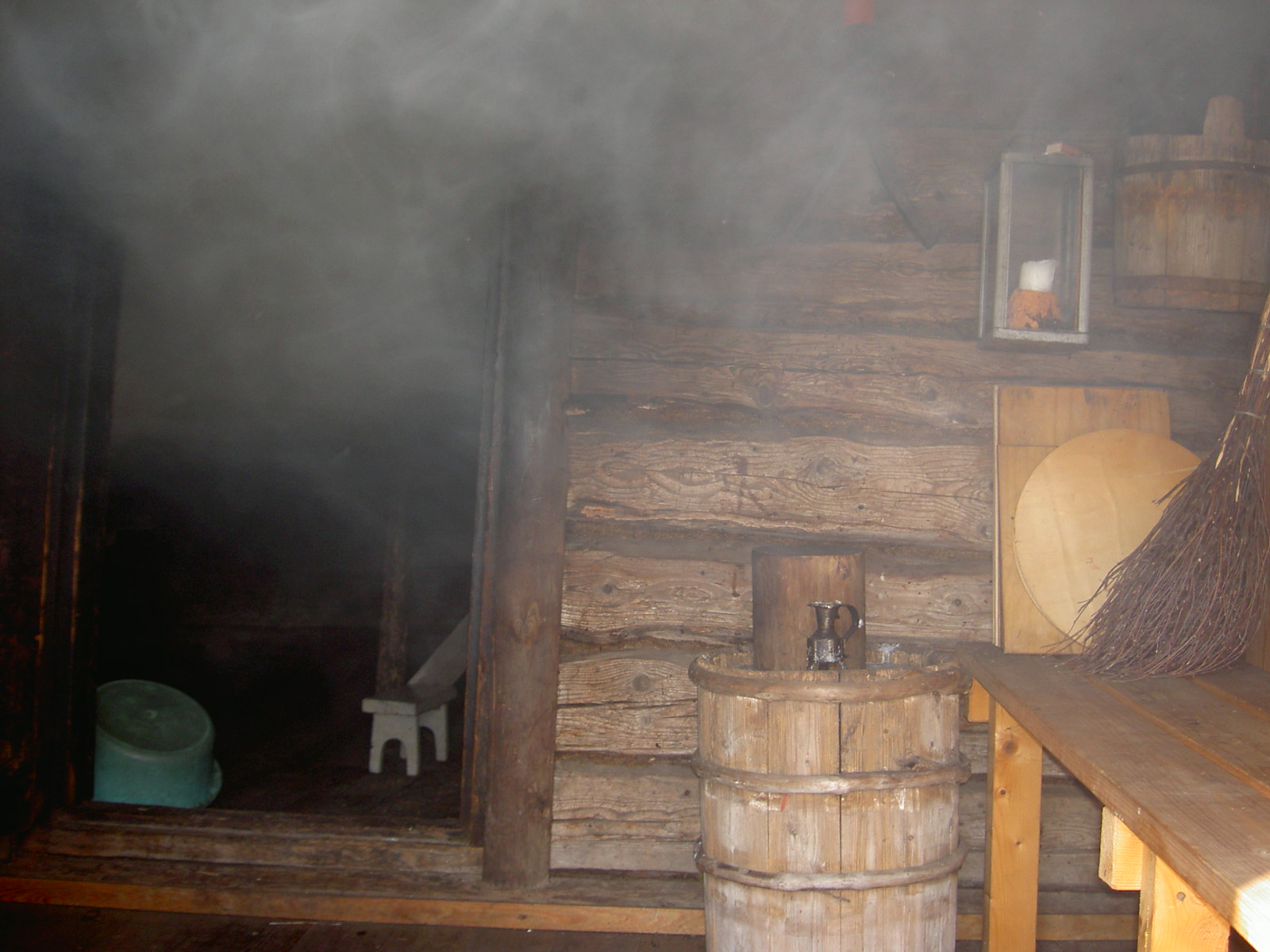
Image context: the cover uses a real photograph of a smoke sauna interior in Finland. That choice matters because the article is about the physiology and evidence boundary of repeated whole-body heat exposure, and the room itself is the intervention more than any lifestyle slogan.[6]
Timeline anchors before the claim
- 2015: a prospective Finnish cohort of 2,315 men followed for a median of 20.7 years reported lower sudden cardiac death, fatal coronary heart disease, fatal cardiovascular disease, and all-cause mortality among men who used sauna more frequently.[1]
- 2018: a systematic review of regular dry sauna bathing identified 40 clinical studies with 3,855 participants, but only 13 randomized controlled trials, most of them small.[2]
- 2018: a second prospective cohort including 1,688 adults from Eastern Finland, with a median follow-up of 15.0 years, again found lower cardiovascular mortality among more frequent sauna users after multivariable adjustment.[3]
- 2024: a randomized-trial meta-analysis covering 20 RCTs with intervention lengths of 2 to 15 weeks found no significant pooled effect for most cardiometabolic and vascular outcomes, with the blood-pressure signal shrinking to selected subgroups.[4]
- 2023: CDC guidance still defines adult health-promoting activity around 150 minutes of moderate-intensity movement per week plus 2 days of muscle-strengthening work.[5]
Those dates matter because they show why the sauna argument keeps drifting. The most impressive results are long-horizon cohort associations. The more controlled randomized evidence is shorter, smaller, and much less sweeping.
Myth 1: "Sauna has already proved a broad longevity effect"
The best-known study behind the modern sauna boom is the 2015 JAMA Internal Medicine paper from the Kuopio Ischemic Heart Disease Risk Factor Study.[1] It is easy to see why it traveled so far. Compared with men who took one sauna session per week, men reporting 4 to 7 sessions per week had an adjusted hazard ratio of 0.37 for sudden cardiac death, and men whose sessions lasted more than 19 minutes had an adjusted hazard ratio of 0.48 for sudden cardiac death compared with men whose sessions lasted less than 11 minutes.[1] Those are not trivial effect sizes.
The 2018 BMC Medicine cohort made the picture look even sturdier by extending the question to men and women together. During 15.0 years of follow-up, the adjusted hazard ratio for cardiovascular mortality was 0.75 for those taking sauna 2 to 3 times per week and 0.23 for those taking sauna 4 to 7 times per week, compared with once-weekly users, even after adjustment for physical activity, socioeconomic status, and incident coronary heart disease.[3]
That is evidence for association. It is not proof that sauna itself is the full cause. The difference matters. These cohorts come from Finland, where sauna use sits inside a broader cultural pattern that can correlate with income, routine, social life, recovery habits, alcohol use, and baseline health status in ways statistical adjustment only partly captures.[1][3] Both studies adjust for major confounders, which strengthens them, but neither can convert self-selected habit into randomized proof.[1][3]
So the myth is not that the mortality signal is fake. The myth is that an observational signal, even a strong one, has already settled the causal story.
Myth 2: "Trials already show the same whole-body cardiometabolic gains"
This is the point where the evidence narrows sharply. The 2018 dry-sauna systematic review is useful precisely because it is less dramatic than the headlines. It found 40 clinical studies and 3,855 participants, but only 13 randomized trials, with most studies enrolling fewer than 40 people.[2] The review's own conclusion is careful: regular dry sauna bathing has potential health benefits, but better-quality data is still needed on both efficacy and adverse effects.[2]
That caution looks even more justified after the 2024 meta-analysis of randomized controlled trials on passive heating.[4] Across 20 RCTs, the pooled results were not statistically significant for most of the outcomes readers often assume are already settled: flow-mediated dilation, pulse-wave velocity, resting heart rate, heart-rate variability, fasting glucose, HbA1c, LDL and HDL cholesterol, triglycerides, and C-reactive protein.[4] The overall pooled estimate for systolic blood pressure was -2.46 mmHg, but the confidence interval crossed zero (95% CI -5.02 to 0.10), which means the main pooled result itself was not conventionally significant.[4]
Where did the signal remain? In subgroup analysis, systolic blood pressure fell by -4.11 mmHg in systemic whole-body heating interventions and by -2.52 mmHg in populations with underlying coronary risk or cardiovascular disease.[4] That is interesting. It is also narrower than the public story. It suggests that heat exposure may help some people in some formats, not that sauna has already demonstrated a broad exercise-like remodeling of cardiometabolic health in the average adult.
The adverse-effect side is also thinner than the sales language suggests. The 2018 review found only one small study reporting an adverse outcome, a reversible disruption of male spermatogenesis in 10 participants after ceasing sauna activity.[2] That does not make sauna dangerous in general. It does show that the harm literature is comparatively sparse rather than exhaustively reassuring.[2]
Myth 3: "If it helps the heart, it can stand in for exercise"
This is where the evidence boundary matters most for actual behavior. CDC's adult guidance remains built around movement: at least 150 minutes of moderate-intensity activity per week, or 75 minutes of vigorous activity, plus 2 days of muscle-strengthening work.[5] That recommendation is not just a cultural preference for effort. It comes from a much broader evidence base linking physical activity to cardiorespiratory fitness, glucose handling, musculoskeletal adaptation, function, mood, and mortality across multiple kinds of study.[5]
Sauna does not test the body in the same way. It raises temperature, changes hemodynamics, and can feel restorative, but it does not train coordination, maintain muscle force, preserve balance, or build aerobic capacity through repeated external work. The fact that the Finnish cohorts still found inverse associations after adjustment for physical activity is actually the useful clue here: sauna may be an additional exposure with its own signal, not a substitute for the movement dose already known to matter.[1][3][5]
The randomized evidence points in the same direction. If sauna were simply "exercise without moving," the trial literature would be expected to show broad pooled improvement across blood pressure, glucose control, lipids, vascular function, and inflammatory markers. The 2024 meta-analysis does not show that pattern.[4] What it shows is a more modest and more believable possibility: repeated whole-body heat can be a helpful adjunct, particularly for blood pressure in some higher-risk groups, without reproducing the wider physiological portfolio of exercise.[4][5]
What the evidence can honestly support
The most defensible reading in 2026 is narrower than the wellness slogan and more useful than the dismissal. Frequent sauna use is associated with lower cardiovascular mortality in long-term Finnish cohort data.[1][3] Randomized trials do not show broad cardiometabolic improvement across most measured outcomes, but they do leave room for a modest blood-pressure effect in systemic heating settings and in adults with underlying cardiovascular risk.[4] The smaller clinical literature also suggests symptom and quality-of-life benefits in some settings, while still suffering from heterogeneous protocols and small samples.[2]
That leaves sauna in a credible place. It can be a recovery ritual, a pleasurable routine, and a possible adjunct for blood pressure or symptom management. What the current evidence does not justify is turning it into a passive replacement for exercise or a universal longevity machine. The room may be hot. The claim should stay cooler.
Sources
- Laukkanen T, Khan H, Zaccardi F, Laukkanen JA. "Association between sauna bathing and fatal cardiovascular and all-cause mortality events" (JAMA Internal Medicine, 2015) - prospective cohort of 2,315 Finnish men with 20.7-year median follow-up and hazard ratios by sauna frequency and duration.
- Hussain J, Cohen M. "Clinical Effects of Regular Dry Sauna Bathing: A Systematic Review" (Evidence-Based Complementary and Alternative Medicine, 2018) - 40 studies, 3,855 participants, small-trial limitations, and adverse-effect boundary.
- Laukkanen T et al. "Sauna bathing is associated with reduced cardiovascular mortality and improves risk prediction in men and women: a prospective cohort study" (BMC Medicine, 2018) - men-and-women cohort with 15-year follow-up and adjusted cardiovascular-mortality estimates by sauna frequency.
- Mogensen NJ et al. "Non-acute effects of passive heating interventions on cardiometabolic risk and vascular health: systematic review and meta-analysis of randomized controlled trials" (American Journal of Preventive Cardiology, 2024) - 20 RCTs showing mostly null pooled effects with a narrower systolic-blood-pressure signal in subgroup analysis.
- Centers for Disease Control and Prevention, "Adult Activity: An Overview" - current U.S. adult physical-activity guidance used here to mark the exercise boundary.
- Wikimedia Commons, "File:Interior of a smoke sauna, Uusikaupunki, Finland - 20030510.jpg" - source page for the article image.