The story is easiest to misunderstand if it starts with the boardwalk. Premature babies in glass boxes, paying visitors, Coney Island lights, barkers outside, nurses inside: the scene can look like a public-health scandal rescued later by respectable hospitals. That reading is too tidy. Martin Couney's incubator baby shows were ethically awkward, commercially theatrical, and medically consequential at the same time. Their force came from the fact that they built a working care system for infants whom many hospitals were still not ready to receive.[1][2][3]
Couney's lesson was not that spectacle is a good substitute for medicine. It was that a device becomes medicine only when it is attached to labor, money, trust, and routines. The incubator itself warmed a fragile infant. The exhibit paid for nurses, wet nurses, cleaning, feeding schedules, transport, and public persuasion. Visitors thought they were looking at a marvel. Parents, physicians, and hospital administrators were being shown a more difficult fact: premature infants could survive if the system around the machine treated survival as worth organizing.[1][2]
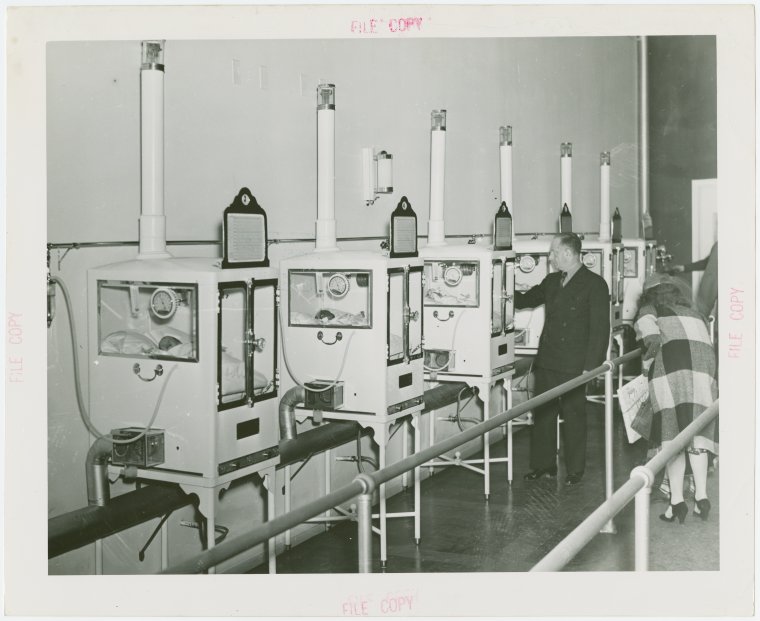
Image context: the cover image is an archival NYPL photograph of visitors looking at premature babies in incubators at a New York World's Fair exhibit. It fits the article because Couney's work always sat at that uneasy border: care was real, but visibility was part of the payment and persuasion machinery.[6]
The heat problem came before the hospital system
By the late nineteenth century, the infant incubator had already moved through European medical experimentation. The core problem was physiological before it was institutional. Premature infants lose heat easily, feed poorly, and can be overwhelmed by ordinary nursery conditions. Incubators promised a controlled environment: warmth, relative protection from drafts and contamination, and a way to keep very small infants alive long enough for feeding and growth to matter.[4]
The French line is central. Stephane Tarnier adapted incubator ideas in Paris in the 1880s, and Pierre Budin helped turn premature-infant care into a more disciplined program of temperature control, feeding measurement, and maternal instruction.[3][4] Couney placed himself inside that lineage. Some biographical accounts present him as a German-trained physician who studied with Budin; later researchers have complicated parts of his identity and credentials, noting name changes and inconsistent records.[1][3] That uncertainty matters because Couney's authority was built less through a conventional hospital appointment than through a public machine that kept producing living graduates.
The machine alone was never the whole intervention. William Silverman's historical account of incubator-baby side shows emphasizes that the serious work depended on people and procedures: trained nurses, attention to feeding, weighing, bathing, and environmental control.[3] The exhibit format made the incubator visible, but the care process made it meaningful. That distinction is the hinge of the microhistory.
Coney Island supplied the missing payment model
Couney's permanent Coney Island story began in 1903, when an infant incubator attraction opened at Luna Park. Dreamland followed in 1904.[1][2] The location looks perverse only until the financing problem is placed beside it. Hospitals in the early twentieth century had limited specialized capacity for premature infants, and families often could not pay for extended high-touch care. Couney charged visitors rather than parents. The Coney Island History Project states that he did not charge families for the infants' care, while reporting that by 1939 he had treated more than 8,000 babies and saved 6,500.[1]
Those figures should be read as part of the exhibit's public memory rather than as a modern trial registry. Even so, they point to scale. The show was not a one-week demonstration. It became a durable institution, running at Luna Park from 1903 until 1943, with a Dreamland branch from 1904 until the 1911 fire.[1][2] In public-health terms, Couney had solved a neglected implementation problem: how to keep an expensive, labor-intensive service open before reimbursement, hospital departments, and professional consensus had caught up.
Brooklyn Public Library's account of the Dreamland material makes that gap concrete. The infant incubator exhibit appeared beside mechanical amusements and commercial attractions, yet contemporary newspaper coverage also framed it as educational and philanthropic.[2] The same account notes trained nurses, public controversy, legal scrutiny, and the practical rescue of infants when Dreamland burned in May 1911.[2] The spectacle cannot be washed out of the story. Neither can the care.
The ethical discomfort was part of the evidence
It is tempting to clean the story by making Couney either a hero or a huckster. The evidence resists both simplifications. Putting infants on public display created legitimate discomfort. Brooklyn Public Library cites early objections from child-protection authorities and newspaper writers who found the setting incongruous, even repellant.[2] Silverman's historical reconstruction also preserves the medical profession's suspicion of incubator shows, especially when infant care seemed too close to ordinary amusement commerce.[3]
The discomfort was not a side issue. It was one of the ways the health system revealed its own unreadiness. If the proper place for premature infants was the hospital, the obvious question was why so many could not get comparable hospital care. If the show was morally troubling because visitors paid to look, the next question was why that payment mechanism could support nursing and equipment when ordinary institutions could not. Couney's show did not resolve the ethics. It exposed the system failure that made those ethics harder.
This is why the details inside the exhibit matter. The point was not only the glass box. Couney's operation needed nurses who could work continuously, feeding plans that fit tiny infants, strict hygiene, temperature management, and a persuasive public front that reassured parents enough to hand over babies whom others had written off.[1][2][3] That mix is recognizable today as implementation infrastructure. In the Coney Island setting, it wore the costume of entertainment.
What the show proved
The strongest claim for Couney is narrow and important: he helped make premature infant survival believable at scale in the United States. He did this by joining a visible technology to a repeatable care routine. The public saw incubators. The deeper intervention was continuity. Infants needed day-and-night attention, feeding support, warmth, cleaning, and staff who believed that small size was not an automatic death sentence.[1][3][4]
The show also changed the audience for the evidence. A hospital demonstration would have spoken mainly to physicians. A fairground exhibit spoke to parents, newspaper readers, donors, nurses, civic officials, and skeptical doctors at once. The admission fee made the care financially possible, but the crowd also functioned as a public-relations engine. A visitor who paid a quarter did not leave with a randomized trial result. They left having seen a premature infant alive in a machine that looked modern, tended by nurses who made the treatment feel orderly.
That kind of evidence is weak by the standards of clinical research and powerful by the standards of adoption. Health systems often move only when a technology becomes imaginable as a service. Couney made the incubator into a service before American hospitals had broadly built the service around it.[1][3][5]
How hospitals caught up
The hospital path was already developing, but slowly. The American Academy of Pediatrics' historical overview notes that incubators were used at Chicago Lying-In Hospital beginning in 1898, and that Julius Hess opened a premature-infant unit at Sarah Morris Hospital in 1914.[5] Hess later became one of the central figures in American premature-infant care, and his work helped place specialized newborn care inside hospital medicine rather than on the midway.[3][5]
That transition did not erase Couney's strange contribution. Silverman's account links Couney's later decline to the moment when hospital-based premature care finally became more available. After the first premature infant station opened at Cornell's New York Hospital, Couney closed his show in 1943.[3] The Coney Island History Project frames the closure similarly: by the time the Luna Park exhibit ended, Couney's methods were being used in mainstream hospitals.[1]
The timeline is the lesson. In 1903, the boardwalk could provide what many hospitals could not: equipment, labor, payment, and a public argument for saving premature infants. By 1943, that argument had moved into hospital practice. Couney's exhibit was no longer the future. Its best case had been absorbed.
The health lesson after the lights go down
Couney died in 1950, and the later memory of his work often turns into a paradox: a sideshow that saved babies.[1][3] The sharper lesson is about systems. A medical device does not become standard care merely because it exists. It has to be placed somewhere, paid for somehow, staffed by people with relevant skills, and defended against disbelief. Premature-infant care needed warmth, milk, cleaning, measurement, nursing, transport, parental trust, and institutional legitimacy. Couney supplied an imperfect version of that bundle in the place where he could make it run.[1][2][3]
Modern neonatal intensive care should not romanticize the boardwalk. The public display of vulnerable infants remains ethically jarring. But dismissing the shows as only exploitation misses why they mattered. They made visible a survival claim that the health system had not yet fully organized itself to honor: a very small newborn was not a lost cause by definition. The incubator baby show was awkward because it put medicine in the wrong room. It was consequential because, for a time, that wrong room held a fuller care system than the right rooms did.
Sources
- Coney Island History Project, "Dr. Martin Couney" - local-history summary of Couney's Coney Island exhibits, staffing, reported infant outcomes, parent fee policy, and closure timeline.
- Brooklyn Public Library, "Infant Incubators at Dreamland" - archival photographs, newspaper context, legal controversy, Dreamland fire account, and Coney Island exhibit chronology.
- William A. Silverman, "Incubator-Baby Side Shows," Pediatrics 64(2), reproduced by Neonatology on the Web - historical reconstruction of Couney's exhibits and their place in premature-infant care.
- Embryo Project Encyclopedia, "The Infant Incubator in Europe (1860-1890)" - background on Tarnier, Budin, and the incubator's European medical development before Couney's American exhibits.
- American Academy of Pediatrics, "Historical Perspectives on Neonatology" - overview of early U.S. premature-infant care, including Chicago incubator use and Julius Hess's premature-infant unit.
- New York Public Library Digital Collections, "Infant Incubator - Men and women looking at babies in incubators" - source page for the archival photograph used as the article cover.