Samoa's measles outbreak is often summarized as a cautionary tale about low vaccine coverage. That is true, but it is too flat to explain why the collapse was so fast and the recovery so labor-intensive. The more exact sequence runs through trust, interruption, accumulation, and emergency improvisation. A national immunization program did not merely dip. It lost credibility at the very moment when measles still needed almost universal coverage to stay out.[1][2][3]
The decisive break came in 2018. After two Samoan children died soon after receiving the measles, mumps and rubella vaccine, WHO and UNICEF said the government had suspended all MMR vaccination as a precaution while an investigation proceeded.[1] A later CDC summary stated that vaccine confidence then fell further because the deaths were caused by an error in MMR administration, not by an inherent flaw in the vaccine itself.[3] That distinction mattered medically, but it did not soften the public effect. In practice, a technical administration error still shattered trust in the system delivering the shot.
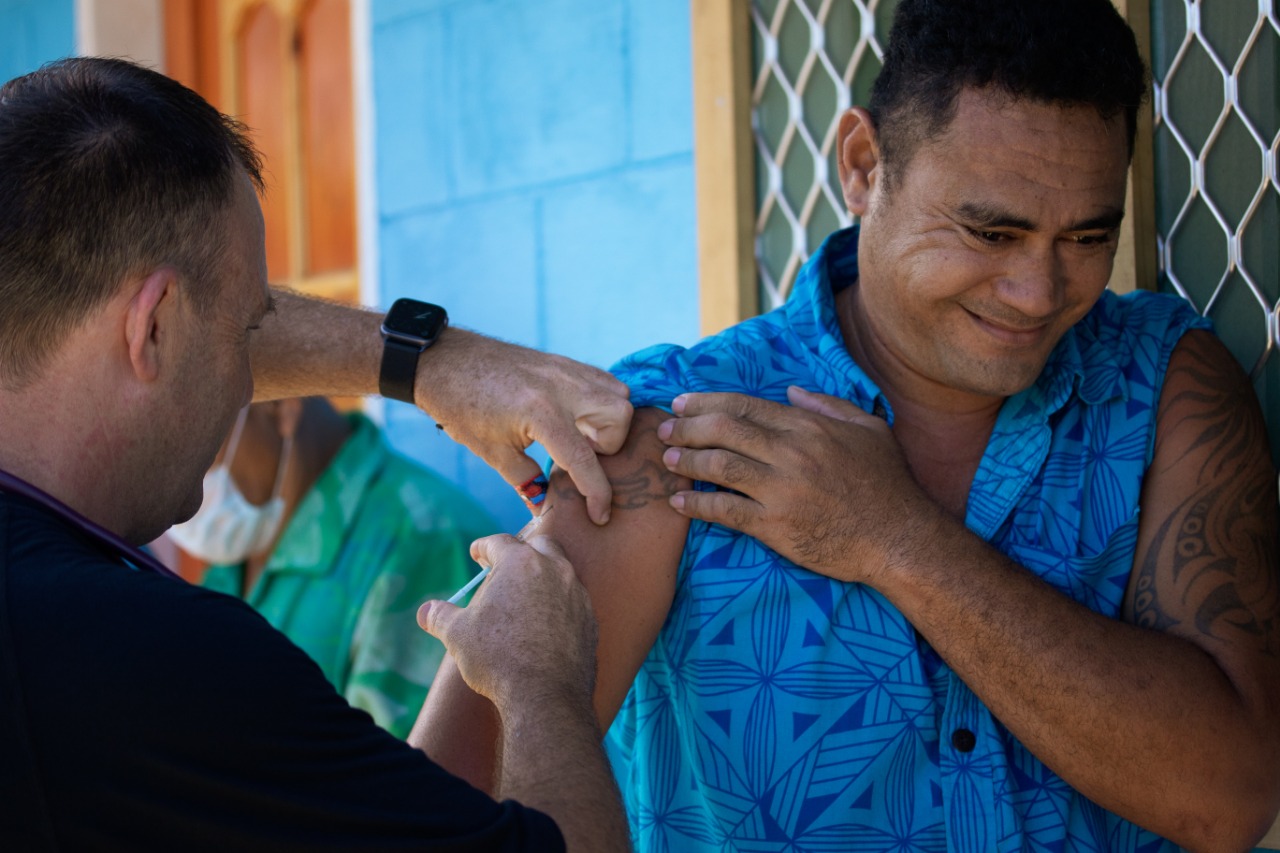
Image context: the cover photo from WHO shows emergency vaccination in Samoa during the measles response. It captures the article's central reversal: after confidence failed, protection had to be rebuilt person by person, in public view, through visible clinical work rather than abstract messaging alone.[5]
2018: the rupture arrives before the outbreak does
The July 2018 WHO-UNICEF statement is restrained in tone, and that restraint is revealing.[1] It affirms that the deaths were a tragedy, notes the government investigation, and emphasizes that Samoa had suspended all MMR vaccinations pending the outcome. It also restates the vaccine's global safety and the importance of robust immunization programmes.[1] The statement reads like crisis containment. What it cannot do is restore ordinary confidence on the spot.
That is the hidden interval in this story. Measles does not need a dramatic ideological movement to return. It only needs enough susceptible people to accumulate while transmission waits for an opening. The CDC's global elimination review later described Samoa's outbreak as the result of a steady decline in first-dose and second-dose coverage from 2014 through 2018, worsened by the post-2018 collapse in confidence after the infant deaths and the administration error.[3]
By the time WHO published its Pacific outbreak update on 15 December 2019, the official 2018 coverage estimate for Samoa had sunk to 31% for MCV1 and 13% for MCV2.[2] Those are not marginal slips. Those are conditions in which measles can move faster than a health system can comfortably absorb.
2019: susceptibility turns into an outbreak
The outbreak was declared on 16 October 2019. A state of emergency followed on 15 November 2019.[2][6] Once that happened, the problem changed scale. WHO's Disease Outbreak News reported that from 1 January through 4 December 2019 Samoa had already logged 4,217 confirmed and suspected cases and 62 measles-associated deaths, with most cases occurring in children under five.[2] The event was no longer about routine primary care or a damaged vaccine programme. It had become an acute national emergency centered on very young children.
This is the point where the narrative usually becomes arithmetic: coverage fell, cases rose, children died. But the chronology matters because measles punishes delay unevenly. By the time the numbers become nationally legible, the pool of susceptible infants and children has often been building quietly for months or years. The outbreak reveals a structural deficit that already existed.
The Western Pacific Surveillance and Response Journal article on the emergency medical team response makes the next step plain. Samoa's government declared the emergency because the outbreak was rapidly worsening and had overwhelmed the country's health system.[6] That word, overwhelmed, should be taken literally. The article says 18 emergency medical teams from around the world deployed to Samoa, bringing more than 550 additional clinical, public health, and logistics personnel into the response.[6] Countries ask for that level of outside help when the ordinary system is no longer enough.
The emergency campaign had to become physical, visible, and local
Measles control sounds straightforward in policy shorthand: vaccinate hard, isolate cases, protect the vulnerable. In reality, Samoa's emergency campaign had to become a form of visible civic choreography. WHO's feature story on the crisis describes mobile vaccination teams, urgent treatment for critically ill patients, and a practical public marker: households with unvaccinated people were asked to place red flags outside so teams could find them quickly.[5]
That detail matters because it shows what rebuilding trust looked like on the ground. It was not only a matter of issuing correct information. The campaign had to create a map of need across neighborhoods and villages, then move clinical labor through that map at speed. Risk communication, triage, logistics, and vaccination all had to operate at once.[5][6]
The WHO-UNICEF situation report dated 3 January 2020 gives a picture of the response once it had started to bend the curve.[4] As of 29 December 2019, Samoa had recorded 5,675 measles cases and 81 measles-related deaths. The report says 1,847 measles admissions had occurred in total, while approximately 95% of all eligible people in Samoa had been vaccinated against measles by that stage.[4] Those figures belong together. The emergency campaign did eventually drive coverage upward, but it did so after the health system had already carried a severe burden of illness, hospitalization, and grief.
The later WPSAR review extends the frame slightly and shows the tail of that burden. Covering hospitalized patients from 30 September 2019 to 13 January 2020, it reports 1,867 hospitalized measles patients treated and 83 measles-related deaths recorded.[6] That small numerical shift from the late-December situation report is also instructive. Even after the peak had passed, the aftermath was still moving through wards, families, and records.
Why the story is about trust mechanics, not only vaccine mechanics
It is tempting to read Samoa's disaster as a simple morality play in which good science encountered bad beliefs. That framing misses the mechanism that actually failed. Confidence did not erode in a vacuum. It was damaged by a concrete clinical catastrophe in 2018, and the catastrophe involved the delivery system, not the underlying vaccine formula.[1][3] For parents, that distinction is thinner than public-health professionals sometimes imagine. A programme can be scientifically right and operationally discredited at the same time.
Once that happens, recovery cannot be reduced to fact correction. It requires visible proof that the system itself can safely do what it claims. Samoa's 2019 response had that character. The work was public, repetitive, local, and embodied: vaccination drives, bedside care, international surge staff, and community markers outside homes.[4][5][6] The country was not only chasing measles. It was trying to make protection believable again.
That is why the outbreak still reads differently from a generic coverage chart. The numbers matter, but the causal chain matters more:
- a lethal administration failure ruptured trust in 2018;[1][3]
- routine immunization coverage collapsed to levels measles could exploit;[2]
- the outbreak then forced a much more costly, emergency-scale effort to rebuild immunity quickly enough to save lives.[4][5][6]
In that sequence, the price of broken trust is paid twice: first in lost confidence, then in emergency response.
After the emergency, routine protection still had to be rebuilt
The 2019 campaign was not the end of the story. WHO's 2024 Samoa feature says the country launched a vaccination catch-up campaign in 2023 that improved measles-containing-vaccine coverage to 87% for MCV1 and 74% for MCV2.[7] The same piece ties later training and programme strengthening to recommendations that came out of the review of the 2019 measles epidemic.[7]
Those figures show progress, but they also show how long recovery takes. Emergency vaccination can shut an opening. It does not instantly recreate a stable routine system or erase the memory of how confidence broke. The post-epidemic work therefore moved into colder, slower tasks: training vaccinators, improving cold-chain storage, tightening logistics, and rebuilding data management.[7] In a chronicle like this, those administrative repairs belong inside the story, not in a footnote. They are how a health system tries to prevent a trust rupture from becoming a second one.
What Samoa's measles chronicle changes in 2026
The durable lesson is narrower and harder than "vaccines matter," though vaccines do matter. Samoa shows that public-health protection depends on the integrity of the delivery system as much as on the biological efficacy of the product.[1][3] When delivery fails catastrophically, the damage propagates forward into confidence, coverage, outbreak risk, and response cost.
That is why the 2019 measles campaign in Samoa deserves to be remembered as more than an emergency mobilization. It was a national effort to reverse the consequences of one earlier rupture under conditions measles had already made brutally unforgiving. Once routine trust failed, protection had to be rebuilt house by house, team by team, and ward by ward.[4][5][6][7]
Sources
- World Health Organization and UNICEF Pacific statement on the deaths of two children in Samoa after MMR vaccine (11 July 2018).
- World Health Organization, Measles - Pacific Island Countries and Areas (Disease Outbreak News, 15 December 2019).
- CDC MMWR, Progress Toward Regional Measles Elimination - Worldwide, 2000-2019 (2020).
- WHO and UNICEF, Measles Outbreak in the Pacific - Situation Report No. 9 (3 January 2020 PDF).
- World Health Organization, Measles: fighting a global resurgence (feature story, image source and Samoa field reporting).
- Western Pacific Surveillance and Response Journal, The roles of emergency medical teams in response to Samoa's 2019 measles outbreak (2023).
- World Health Organization Western Pacific, Samoa strengthens its vaccination programme (4 July 2024).