The Salk vaccine is often remembered through one sentence. On April 12, 1955, Thomas Francis Jr. stood in Ann Arbor and delivered the line that entered public memory: the vaccine was "safe, effective, and potent."[1] That announcement mattered, but the primary record reads less like a victory speech than like an argument about method. The stronger question inside the 1954 field trial was not whether the public wanted a vaccine. Parents wanted one desperately. The harder question was how to make a result believable enough to survive fear, political pressure, and the memory of earlier vaccine disappointments.[1][4]
Francis's own 1955 article states the problem with unusual bluntness. The undertaking, he wrote, meant accepting "a public and scientific trust" to produce "objective analysis and unprejudiced appraisal" across many study areas.[2] That language is worth slowing down for. The field trial did not present trust as a mood or a slogan. It treated trust as something that had to be manufactured from comparability, uniform procedure, delayed code-breaking, and diagnostic discipline.[2][3]
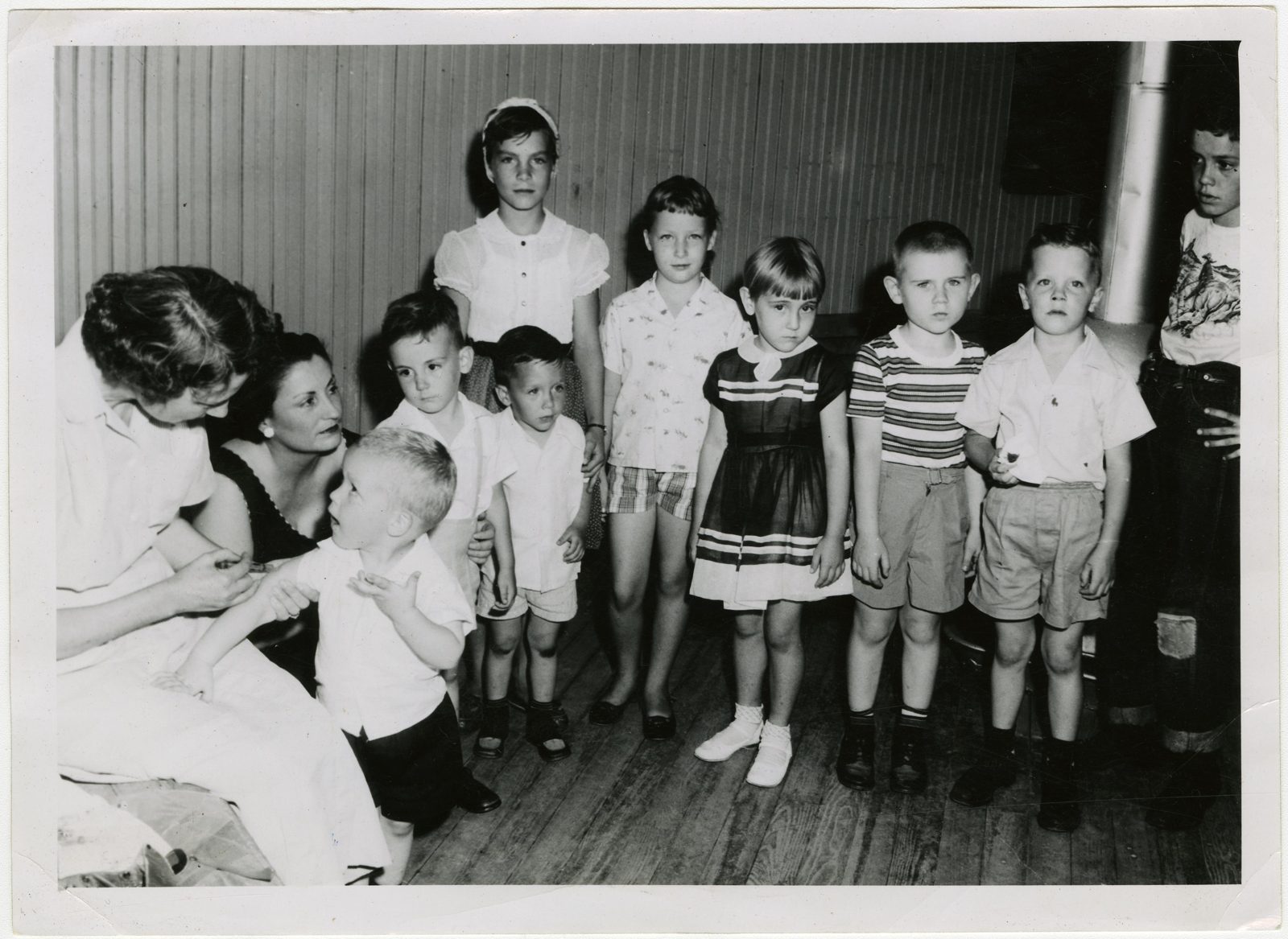
Image context: the cover uses a real 1956 Mississippi archival clinic photograph from Wikimedia Commons.[5] It fits this essay because the field trial was never only a laboratory story about Jonas Salk. It was a civic scene built from waiting children, nurses with syringes, anxious parents, and the organized promise that mass medicine would be handled in the open rather than by rumor.
Timeline anchors before the famous sentence
- 1952: the United States recorded roughly 58,000 polio cases in the peak epidemic year that sharpened public demand for a vaccine.[4]
- Spring 1954: the national field trial enrolled about 1,829,916 children, making it the largest vaccine experiment yet attempted.[2][3]
- April 12, 1955: Francis announced the result in Rackham Auditorium and the University of Michigan press release carried the line "The vaccine works."[1]
- June 7, 1955: Francis presented his further summary of the field-trial evaluation to the American Medical Association, sharpening what the data did and did not show.[2]
1. Francis wanted a design that could survive suspicion
One of the most revealing features of the 1955 summary is that it keeps returning to control groups. Francis says the evaluation program embraced two distinct plans.[2] In the "observed areas," second-grade children whose parents requested participation were vaccinated, while first- and third-grade children were followed as controls.[2] That plan was large and practical, but Francis spells out its weaknesses almost immediately: volunteers and nonvolunteers are not the same population, age groups do not perfectly correspond, and once a child's status is visible, later judgment can be influenced.[2]
That is why the article treats the placebo areas as the real methodological core. In those areas, children in grades one through three whose parents requested participation entered a coded system in which about half received vaccine and about half received placebo, with the allocation known only through a code held at the evaluation center.[2] The scale was enormous. Francis reports 749,236 total children in the placebo areas, including 200,745 with a complete vaccine series and 201,229 with a complete placebo series.[2] What mattered, though, was not scale by itself. It was the creation of counterpart groups that could be compared without the obvious self-selection problem built into simple volunteer-versus-nonvolunteer contrasts.[2]
The article becomes especially sharp when Francis explains what not to do. The uninoculated children who did not participate were followed, but he insists they were "not an integral part of the evaluation" because they formed a different population.[2] That warning sounds technical; it is actually the ethical center of the document. A frightened public could easily have accepted a quick before-and-after story or a loose comparison between eager participants and everyone else. Francis refused that shortcut. He wanted the claim to survive hostile reading.
2. The report is really a defense of comparability
This is why the field trial looks so statistical on the page. The point was never only to produce a big number of injections. The point was to produce an interpretable comparison. Francis notes that the observed study could recommend itself administratively because it was easier to carry out, yet he repeatedly circles back to bias: knowledge of vaccination status could influence later consideration, age distributions were not identical, and the "nonrequesting" population was demonstrably different in social composition.[2]
The Bentley historical guide adds the infrastructural scale behind that insistence. It summarizes the field trial as involving about 1.8 million children across 217 areas in the United States, Canada, and Finland, and notes that the evaluation center ultimately generated some 1,800,000 IBM punch cards containing roughly 144,000,000 pieces of information.[3] Those numbers are more than colorful logistics. They show that the trial's credibility depended on converting a mass of local events into one disciplined analytic object.
Seen this way, the famous phrase "Polio Pioneers" captures only half the story.[4] The other half is bureaucratic. Parents and children volunteered into a machine that had to prove it could classify them correctly, keep their assignments hidden, and compare like with like. The deeper achievement of the field trial was not simple public enthusiasm. It was the ability to turn public enthusiasm into standardized evidence.
3. Trust sat inside the reporting chain
The article grows even more interesting when it leaves allocation and turns to case finding. Francis describes a chain that now reads almost like an operations manual.[2] Basic records had to be collected and verified for all 1,829,996 children in the study population.[2] More than 40,000 children also gave serum samples before injection, then again about two weeks after the clinics, and again five months later.[2] Every one of those steps mattered because efficacy could not be inferred from one classroom visit.
The case-investigation sequence was even stricter. Francis lays it out step by step: physician diagnosis and local reporting, telegraphic notice to the evaluation center, clinico-epidemiological investigation, shipment of laboratory specimens, physical-therapy muscle evaluations at 10 to 20 days and again at 50 to 70 days, laboratory typing, and then final diagnostic integration at the center.[2] Most importantly, he says the classification of each case was made without knowledge of vaccination status so that objectivity could be maintained.[2]
The Bentley guide fills in the social labor behind this pipeline. According to the university material it cites, more than 300,000 people participated in the field operation, including 20,000 physicians and public-health officers, 40,000 registered nurses, 14,000 school principals, 50,000 teachers, and 200,000 volunteer workers.[3] The trial's authority therefore did not rest on laboratory purity alone. It rested on an enormous distributed workforce trying to make every local report legible in the same language.
4. The narrowness of the result is the strongest part
The most important payoff in Francis's summary is also the one public memory tends to blur. The article does not claim that every category of illness was cleanly transformed by vaccination. It says the decisive difference lies in paralytic poliomyelitis.[2] In the placebo control areas, Francis reports 82 total reported cases among vaccinated children and 162 among placebo recipients; once doubtful and non-polio cases were sorted out, the accepted poliomyelitis totals became 57 versus 142.[2] But the strongest split sat inside the paralytic cases: 33 in the vaccinated group versus 115 in the placebo controls.[2]
The same pattern reappeared in the observed-control analysis. Francis says there was no significant difference in nonparalytic cases, but the rates for paralytic cases were 17 and 46 per 100,000 respectively, again favoring the vaccinated group.[2] That is a much more exact claim than the broad afterlife of the Salk story often remembers. The trial's first robust public meaning was not that all poliovirus infection had been eliminated. It was that the vaccine showed its clearest power against the catastrophic tail of the disease: paralysis.[1][2]
This is also why the University of Michigan press release's "up to 80-90 percent effective" line should be read with the report beside it, not in isolation.[1] The press release gave the world a headline. The Francis article gave the headline its boundaries. The narrowness is not a weakness to apologize for. It is the reason the claim held.
5. What the primary record still teaches
The durable lesson from the 1954 field trial is that public confidence did not appear after science was finished. Confidence was built inside the design itself. Francis did not ask the reader for gratitude. He asked the reader to inspect the controls, the code, the diagnostic criteria, the reporting forms, and the refusal to treat nonrequesting children as equivalent controls.[2][3]
That is why the trial still feels modern in 2026. Its real subject is not only a vaccine. It is the administrative shape of credibility under pressure. A frightened country wanted a quick answer after the epidemics of the early 1950s.[4] The field trial answered with something slower and more durable: counterpart groups, blinded classification, standardized follow-up, and a willingness to let the strongest claim be the one the data could actually carry. The line in Ann Arbor became famous for a reason. But the deeper achievement sat underneath it, in the procedures that made the line believable.
Sources
- University of Michigan School of Public Health, "1955 Polio Vaccine Trial Announcement" - April 12, 1955 press release with Francis's "safe, effective, and potent" line and the contemporaneous summary of the result.
- Thomas Francis Jr., "Evaluation of the 1954 Poliomyelitis Vaccine Field Trial: Further Studies of Results Determining the Effectiveness of Poliomyelitis Vaccine (Salk) in Preventing Paralytic Poliomyelitis" (JAMA, 1955) - Francis's own methodological summary of controls, reporting workflow, and paralytic-case findings.
- Bentley Historical Library / Center for the History of Medicine, Poliomyelitis and the Salk Vaccine: A Subject Guide - University of Michigan archival guide summarizing trial scale, punch-card data handling, and staffing footprint.
- Anita Guerrini, "Fighting through the Fear" (Science History Institute, 2023) - historical account of 1952 disease burden, parental fear, placebo design politics, and the social meaning of the Polio Pioneers.
- Wikimedia Commons, "File:Polio vaccine, 1956 (16635529011).jpg" - source page for the archival Mississippi clinic photograph used as the article image.