Rotavirus vaccination has one of the strangest success stories in modern child health. The first U.S. vaccine, RotaShield, was licensed in 1998 and then pulled back within a year after post-licensure surveillance linked it to intussusception, a bowel obstruction that can become a surgical emergency.[1][2][3] In many medical stories that would have been the end of the category. Here it was not. Oral rotavirus vaccination returned, and it is now ordinary enough that many parents know it mainly as the drops given at the 2-month visit.[3][4]
That sequence matters because it clarifies what kind of technology a vaccine is. A treatment used on already sick patients can tolerate a different level of hazard than a routine product given to healthy infants. Rotavirus vaccination survived its first failure because the field did not wave the failure away. It treated the failure as a measurement of the threshold. RotaShield showed that an infant vaccine could not carry an intussusception signal anywhere near 1 case per 10,000 recipients and still remain acceptable in a country where rotavirus, though heavy, was not usually fatal on the scale seen in poorer settings.[2][3] Later vaccines were built and judged under a stricter bargain.
The comparative claim of this essay is straightforward. RotaShield and the later oral vaccines were answers to the same disease, but they belonged to different public-health risk regimes. The first product proved that prevention by mouth was immunologically plausible. The later products lasted because they accepted surveillance, bigger trials, narrower age windows, and a much smaller residual risk in exchange for a still very large reduction in hospital care.[2][3][4][5][6]
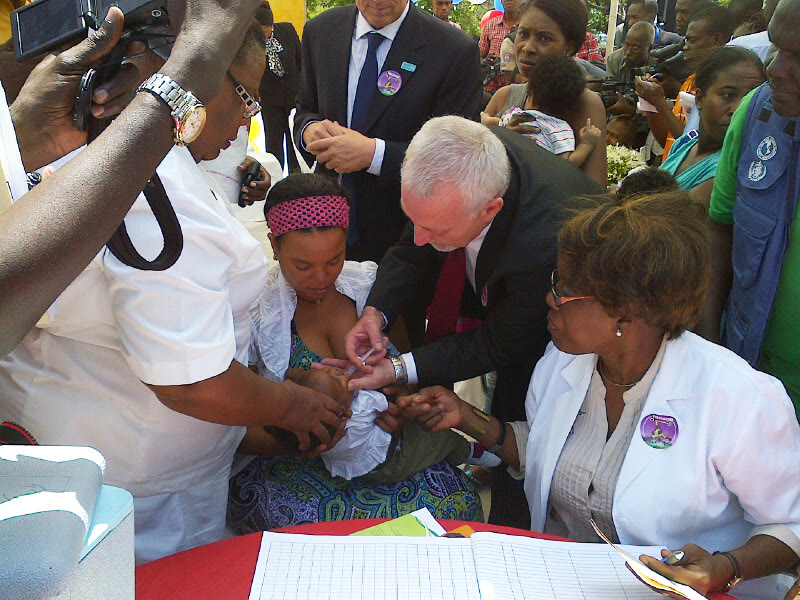
Image context: the cover uses a 2014 CDC photograph from Haiti showing oral rotavirus vaccine delivery in the field.[7] It belongs here because the long-term story is not only about one withdrawn product. It is about whether a vaccine can be given repeatedly, at routine scale, to healthy babies, while public health remains honest about a rare but serious bowel event.
Timeline anchors for the two vaccine eras
- 1973: Ruth Bishop and colleagues identified rotavirus in intestinal tissue from children with diarrhea, making visible the pathogen behind a large share of severe childhood gastroenteritis.[3]
- August 31, 1998: RotaShield, a rhesus-based tetravalent vaccine, was licensed in the United States.[1][3]
- July 1999: after reports of intussusception, CDC recommended pausing use of the vaccine while the signal was investigated.[1][2]
- October 22, 1999: ACIP withdrew its recommendation for RotaShield after concluding that intussusception occurred with significantly increased frequency, especially after dose one.[2]
- 2006 and 2008: second-generation oral vaccines were licensed in the United States, reopening rotavirus prevention under a redesigned evidentiary standard.[3][5]
- 2021: WHO's updated rotavirus position paper still treated global use as warranted, but only after years of post-licensure safety work and continued attention to intussusception risk.[5]
1. What the first vaccine got right, and why that still was not enough
The first thing worth recovering is that RotaShield did not fail because rotavirus was trivial.[2][3] CDC's Pink Book describes the prevaccine United States as a place with an estimated 2.7 million infections every year, 410,000 physician visits, more than 200,000 emergency department visits, 55,000 to 70,000 hospitalizations, and 20 to 60 deaths annually in children younger than five.[3] Improved sanitation had never solved the problem cleanly; rotavirus remained highly transmissible and nearly universal by age five in the prevaccine era.[3] The disease burden was real.
The early vaccine also was not worthless in efficacy terms. The withdrawal notice states that prelicensure trials had shown RotaShield to be safe and effective by the standards then available, preventing at least 50% of rotavirus diarrhea cases and almost all hospitalizations.[2] That is the awkward part of the history. The product did useful immunologic work. It was not pulled because it did nothing. It was pulled because its safety problem sat in the wrong place: healthy infants receiving a routine preventive product.[1][2]
The July 1999 MMWR notice described 15 reported intussusception cases among vaccine recipients during the first months after rollout.[1] The October withdrawal recommendation then made the policy boundary explicit: intussusception occurred with significantly increased frequency in the first 1 to 2 weeks after vaccination, especially after dose one, and the recommendation had to go.[2] Pink Book later summarized the overall first-dose risk at about 1 case per 10,000 recipients.[3]
That number explains why the category survived only by changing form. One excess bowel emergency in ten thousand healthy infants is a very different social and ethical object from one severe adverse event in a rescue drug used on already endangered patients. Vaccines are judged in advance of illness. Their benefit is population-wide and partly invisible; their harms are concentrated and narratable. Rotavirus vaccination's first lesson was therefore not simply "watch for side effects." It was that routine infant prevention lives under a tighter tolerance ceiling than many other medical interventions.
2. What the later vaccines had to prove before the program could restart
The second generation did not arrive into innocence. It arrived into memory.[3][5] WHO's 2021 position paper states the design consequence directly: because RotaShield had been associated with an intussusception risk estimated at 1:10,000, large trials with 60,000 or more participants were conducted for Rotarix and RotaTeq so investigators could evaluate that exact hazard more seriously before broad rollout.[5] That is the hinge of the comparative history. The first vaccine did not only fail. It rewrote what later evidence had to look like.
Those later trials did not find an increased risk in trial participants, and second-generation vaccines were licensed in the United States in 2006 and 2008.[3][5] But the field still did not return to a zero-risk story. CDC's current vaccine-safety page says studies from the United States and other countries show a small increased risk of intussusception after rotavirus vaccination, usually within a week of the first or second dose, on the order of about 1 in 20,000 to 1 in 100,000 U.S. infants vaccinated.[4] That is small, but it is not rhetorical. Public health kept the warning in the file.
The schedule itself reflects that memory. Pink Book keeps a maximum age of 14 weeks and 6 days for the first dose and 8 months and 0 days for any dose in the series.[3] Those age boundaries are not clerical trivia. They are a policy expression of comparative risk. A vaccine category that once lost an argument over bowel obstruction now tries to confine use to the infant period in which its benefit is highest and its evidence base is clearest.
This is why later rotavirus vaccines should not be described as if they simply disproved the first signal. They did something harder. They accepted that the signal mattered, then showed that a new product could live inside a much narrower danger margin.
3. Why the later bargain held
The later bargain held because the remaining risk stayed much smaller than the disease burden being prevented.[3][4][6] Pink Book estimates that routine vaccination in the United States averts about 280,000 clinic visits, 62,000 emergency department visits, and 45,000 hospitalizations each year.[3] Patel and colleagues' benefit-risk model made the same point in more formal terms. For a U.S. birth cohort of 4.3 million infants, they estimated that a fully implemented vaccine program would avert 14 rotavirus-associated deaths, 53,444 hospitalizations, and 169,949 emergency department visits, while the hospitalization benefit-risk ratio would still sit around 850:1 for each vaccine-associated intussusception case.[6]
That arithmetic does not erase the bowel event. It places it. The proper comparison is not between a perfect vaccine and an imperfect vaccine. It is between a very common dehydrating disease and a rare, time-clustered adverse event attached to a product that sharply reduces severe care use.[3][4][6] In lower-income settings, the disease side of that equation is even heavier, which is why WHO continued to endorse use globally after the RotaShield episode instead of treating the whole category as permanently disqualified.[2][5]
This is also why the story is different from a generic pharmaceutical scandal. The system actually did what critics often say systems never do. Post-licensure surveillance picked up a rare event after real-world rollout. The recommendation was paused, then withdrawn. Later products were forced through larger trials and then continued under ongoing safety review.[1][2][4][5] The category survived because the surveillance state worked, not because it failed.
4. The stronger interpretation
One interpretation says the history proves rotavirus vaccination was always too dangerous and only survived because institutions became desensitized to risk. That reading captures one important truth: public health should never become casual about a serious adverse event in healthy babies.[1][4] But it misses the central comparison. The later program is not the same product defended harder. It is a new program architecture built after the first one broke.
The stronger interpretation is narrower and more useful. RotaShield taught the field what an unacceptable preventive threshold looked like in practice. Later oral vaccines endured because they were tested at larger scale, carried a much smaller residual risk, and kept producing benefits large enough to justify routine use under continuing surveillance.[3][4][5][6] In that sense, rotavirus vaccination did not survive its first disaster by escaping history. It survived by being redesigned through history.
That is why this episode still matters in 2026. The durable lesson is not optimism about vaccines in the abstract, nor cynicism about regulators in the abstract. It is that preventive medicine remains legitimate only when it can distinguish a promising idea from an acceptable public bargain. Rotavirus vaccination became durable the moment the field learned that those are not the same thing.
Sources
- Centers for Disease Control and Prevention, "Intussusception Among Recipients of Rotavirus Vaccine -- United States, 1998-1999" (MMWR, July 16, 1999) - the first national safety signal report describing 15 early intussusception cases after RotaShield rollout.
- Centers for Disease Control and Prevention, "Withdrawal of Rotavirus Vaccine Recommendation" (MMWR, November 5, 1999) - ACIP's withdrawal notice, including the first-1-to-2-week risk concentration, the October 22, 1999 decision, and the burden of severe rotavirus disease in the United States.
- Centers for Disease Control and Prevention, "Chapter 19: Rotavirus" (Pink Book, updated April 25, 2024) - CDC's consolidated history of rotavirus disease burden, RotaShield's roughly 1-in-10,000 first-dose risk, the 2006/2008 second-generation vaccines, and the current infant schedule.
- Centers for Disease Control and Prevention, "Rotavirus Vaccine Safety" - current CDC estimate that the newer vaccines carry a small intussusception risk of roughly 1 in 20,000 to 1 in 100,000 vaccinated U.S. infants.
- World Health Organization, Rotavirus vaccines: WHO position paper - July 2021 - WHO's global policy synthesis, including the statement that RotaShield's withdrawal led to later trials with 60,000+ participants and continuing review of intussusception risk.
- Patel MM, Clark AD, Sanderson CF, Tate J, Parashar UD, "Potential Intussusception Risk Versus Benefits of Rotavirus Vaccination in the United States" (Pediatrics, 2013; PMC full text) - benefit-risk modeling estimating 14 deaths and 53,444 hospitalizations averted in a U.S. birth cohort, with an approximately 850:1 hospitalization-to-intussusception benefit ratio.
- CDC Public Health Image Library, "ID# 19702" - public-domain 2014 field photograph of oral rotavirus vaccine administration in Haiti, used here because it shows the population-scale delivery context of the later vaccine era.
Editor's Pick Review
This article takes today’s merged standard/add-on editor-pick slot because it is the strongest 24-hour candidate on evidence quality, public-health reasoning, bilingual readability, and the stricter image-policy gate. The piece turns a familiar vaccine-safety story into a precise comparative history: RotaShield is not treated as a scandal footnote, but as the event that reset the acceptable safety threshold for routine infant prevention.
It also clears the updated visual standard cleanly. The cover is an immersive, topic-grounded CDC field photograph of oral rotavirus vaccination in Haiti, not an analytical chart or symbolic medical graphic. The Chinese edition preserves the argument’s causal sequence with natural rhythm, stable clinical terminology, and low translationese, so the risk-benefit logic remains legible across both language surfaces.