Osteoporosis screening is often flattened into a sentence that sounds simpler than the actual evidence: get a bone-density scan, read the T-score, and find out whether a fracture is waiting for you. That is not what the screening pathway really does. A DXA scan measures bone mineral density, which is valuable and often decisive, but fracture risk is larger than bone density alone. Age, prior fracture, smoking, glucocorticoid exposure, body weight, menopause status, and fall risk all change the downstream probability that a weak bone will actually break. The useful modern frame is therefore narrower and more operational. DXA classifies bone density. FRAX estimates 10-year fracture probability. Screening recommendations decide who should enter that pathway in the first place.[1][2][3][4][5]
That distinction matters because the stakes are not small. The January 14, 2025 USPSTF recommendation notes that only 40% to 60% of people with a hip fracture recover their prefracture level of mobility and ability to perform activities of daily living.[1] Screening is not trying to predict every broken wrist in advance. It is trying to find the people whose fracture risk is high enough that diagnosis, counseling, fall prevention, and medication can change an ugly outcome curve before the hip or spine has already declared the problem.[1][3]
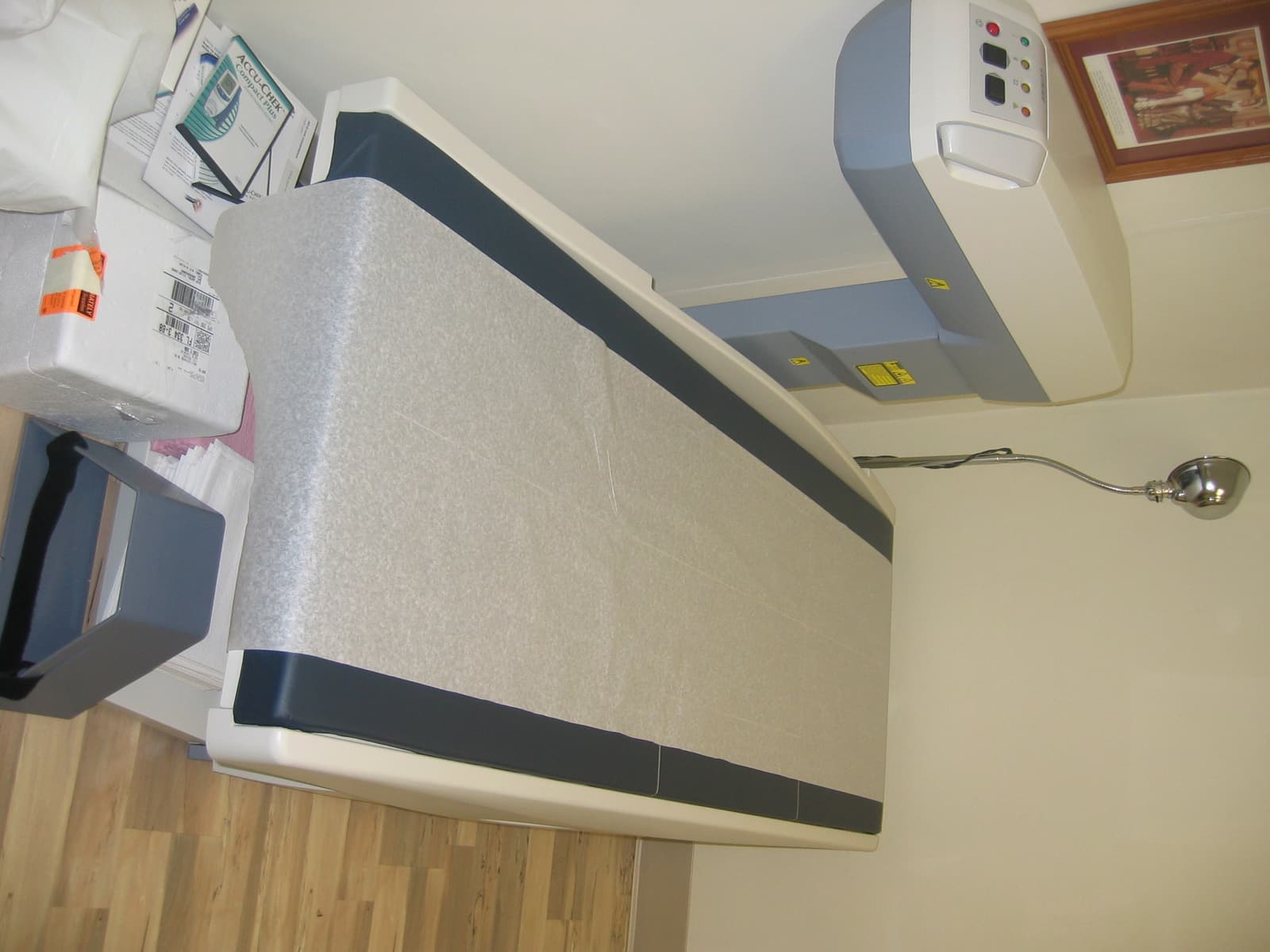
Image context: the lead image uses a real photographic view of a bone-density scanner from Wikimedia Commons. It belongs here because the article is about screening as a physical care process, not as a generic aging metaphor or a symbolic skeleton graphic.[6]
Time anchors before the myths
- 2018: the prior USPSTF osteoporosis-screening recommendation established the same broad logic still in force now: screen women 65 years or older and younger postmenopausal women at increased risk, but do not pretend the evidence in men is already settled.[1]
- 2008: the University of Sheffield's FRAX tool launched after international cohort development and validation work, giving clinicians a way to estimate 10-year hip and major-osteoporotic-fracture probability instead of treating bone density as the only usable input.[4]
- January 14, 2025: USPSTF updated the recommendation and explicitly stated that screening includes DXA bone mineral density, with or without fracture risk assessment, while keeping an I statement for men because current evidence is still insufficient to judge population-screening benefit.[1]
- February 2025: NIAMS's patient explainer restated the practical diagnostic grammar: central DXA remains the most common bone mineral density test, and fracture risk rises by about 1.5 to 2 times with each 1-point drop in T-score.[2]
Those dates keep the topic from drifting into vague preventive piety. Osteoporosis screening is an evidence-built pathway with separate layers: who to test, what the test measures, what counts as diagnosis, and what additional risk calculation does after the scan.[1][2][4][5]
Myth 1: "A DXA scan tells you whether you are going to break a bone"
It does not. It tells you something narrower and clinically powerful: how much mineral is present in specific bones, usually the hip and spine, and therefore how much skeletal strength reserve you appear to have at those sites.[2][3]
NIAMS explains the classification clearly. A T-score of -1.0 or higher is considered healthy bone density. A T-score from -1.0 to -2.5 indicates osteopenia, or low bone mass. A T-score of -2.5 or lower suggests osteoporosis.[2] Those are important thresholds because they standardize diagnosis. They are not a complete biography of fracture risk. The same NIAMS page states that the risk of broken bones rises by about 1.5 to 2 times with each 1-point drop in T-score.[2] That is strong gradient information, but it is still gradient information, not destiny.
This is why the more careful NIAMS disease page uses slightly different language. DXA at the hip and spine is "generally considered the most reliable way to diagnose osteoporosis and predict fracture risk," but the page immediately places those results alongside age, prior fractures, clinical history, and other fracture-risk factors.[3] The scan is strong. The scan is not the whole model.
FRAX exists because bone density alone leaves too much out. The Sheffield overview describes FRAX as the first internationally applicable fracture-risk calculator and says the tool was built precisely because bone mineral density by itself is insufficient to identify all people at high future fracture risk.[4] A person with modestly low bone density plus advanced age, low body weight, glucocorticoid use, smoking, and a parental hip-fracture history may be more fragile than a younger person with the same T-score and none of those extras.[4][5]
So the correction is simple: DXA is a diagnostic anchor and a risk input, not a crystal ball.
Myth 2: "The T-score alone decides who gets screened and who needs treatment"
That overstates the role of one number at two different moments.
Before treatment comes the screening decision, and the January 14, 2025 USPSTF recommendation is explicit about who benefits from entering the pathway. The Task Force gives a B recommendation to screen women 65 years or older and postmenopausal women younger than 65 who are at increased risk based on clinical assessment.[1] It also states that screening can be done with DXA BMD, with or without fracture risk assessment.[1] That language matters. It treats risk assessment as part of screening logic, not as an afterthought once the scan is done.
After screening comes diagnosis and treatment triage, which is where the T-score stops being the only gate. The Bone Health and Osteoporosis Foundation notes three different ways osteoporosis may be diagnosed: a DXA T-score of -2.5 or below, a qualifying fragility fracture after age 50, or a FRAX estimate high enough to cross treatment-relevant risk territory.[5] On the BHOF page, a 10-year probability of major osteoporotic fracture of 20% or more or hip fracture of 3% or more can establish osteoporosis-level concern even when the T-score sits above the formal -2.5 line.[5]
That is the part public shorthand usually loses. The T-score classifies bone density. FRAX converts density plus clinical risk factors into an absolute probability estimate. A prior spine or hip fracture can outrank both because it proves fragility the hard way.[5] If those three jobs are collapsed into one, screening starts to look either magical or pointless. It is neither. It is a sorting system.
Myth 3: "If osteoporosis is real in men, the evidence must already support routine population screening for men too"
The disease burden is real. The proof standard for screening benefit is the unsettled part.
USPSTF's 2025 statement says the current evidence is insufficient to assess the balance of benefits and harms of screening for osteoporosis to prevent fractures in men.[1] That is not the same as saying osteoporosis in men is unimportant. The same recommendation notes that among U.S. adults 65 years or older, osteoporosis prevalence is 27.1% in women and 5.7% in men.[1] Men are less affected on average, but they are not outside the disease.
The correct reading of the I statement is methodological. A screening recommendation asks whether testing asymptomatic people improves outcomes at population level through a full chain: test performance, risk stratification, treatment effect, adherence, and harm balance.[1] For women, the evidence is good enough for a population recommendation. For men, the evidence base is still thinner, so USPSTF tells clinicians to use judgment rather than pretending certainty exists.[1]
That judgment caveat matters because the recommendation does not apply to adults with known osteoporosis, a history of fragility fractures, or secondary osteoporosis from another disease or from medications such as glucocorticoids.[1] An older man with a prior low-trauma fracture or long-term steroid exposure does not disappear into an evidence gap. He moves out of the population-screening frame and into direct clinical evaluation.[1][3]
What osteoporosis screening actually sorts
The cleanest evidence-backed summary looks like this:
- DXA tells you whether bone density at the hip or spine is normal, low, or osteoporotic by standardized thresholds.[2][3]
- FRAX tells you how that density, plus clinical risk factors, translates into a 10-year fracture probability.[4][5]
- Screening recommendations tell you which asymptomatic populations have enough evidence behind testing to justify entry into that pathway at scale.[1]
That is a more modest claim than "the scan tells your future." It is also a more useful one. Osteoporosis screening works best when it is understood as risk sorting before catastrophe, not as a prophecy machine after a number prints on a report. The machine measures. The clinician interprets. The surrounding risk factors decide how much the number means. And the treatment decision belongs to the whole package rather than to the T-score by itself.[1][2][3][4][5]
Sources
- United States Preventive Services Task Force, "Recommendation: Osteoporosis to Prevent Fractures: Screening" (January 14, 2025) - current recommendation for women 65 and older, younger postmenopausal women at increased risk, and the insufficiency statement for men.
- National Institute of Arthritis and Musculoskeletal and Skin Diseases, "Bone Mineral Density Tests: What the Numbers Mean" (reviewed February 2025) - central DXA overview, T-score thresholds, and the 1.5 to 2 times fracture-risk increase per 1-point T-score drop.
- National Institute of Arthritis and Musculoskeletal and Skin Diseases, "Osteoporosis: Diagnosis, Treatment, and Steps to Take" - DXA at the hip and spine as the most reliable diagnostic route and the broader clinical context around fracture risk.
- University of Sheffield, "FRAX: a tool to assess fracture risk in osteoporosis" - overview of the 2008 FRAX launch, why bone density alone is insufficient, and how the calculator estimates 10-year fracture probability.
- Bone Health and Osteoporosis Foundation, "Evaluation of Bone Health/Bone Density Testing" - DXA workflow, T-score interpretation, fracture-based diagnosis, and FRAX thresholds of 20% major osteoporotic fracture or 3% hip fracture.
- Wikimedia Commons, "File: Bone density scanner.jpg" - source page for the photographic DXA scanner image used for the article cover.