Rosalyn Yalow is easy to flatten into a Nobel shape: a physicist enters medicine, invents a brilliant assay, wins the prize in 1977, and leaves a famous acronym behind. That version keeps the honor and loses the operating problem. Yalow mattered because she helped change what a blood test could be. Before radioimmunoassay, insulin was often approached indirectly, through biological effects, animal tissue responses, and approximate activity estimates. After Yalow and Solomon Berson's work at the Bronx Veterans Administration Hospital, insulin could be read as a minute circulating signal with a reproducible scale.[1][2][3]
That shift sounds technical, but it changed medical reasoning. Once tiny hormone concentrations became measurable, disease categories no longer had to rest so heavily on symptoms, coarse physiology, or therapeutic guesswork alone. Yalow's breakthrough first clarified insulin; then the same assay logic spread across peptide hormones and much of modern clinical endocrinology.[1][2][4]
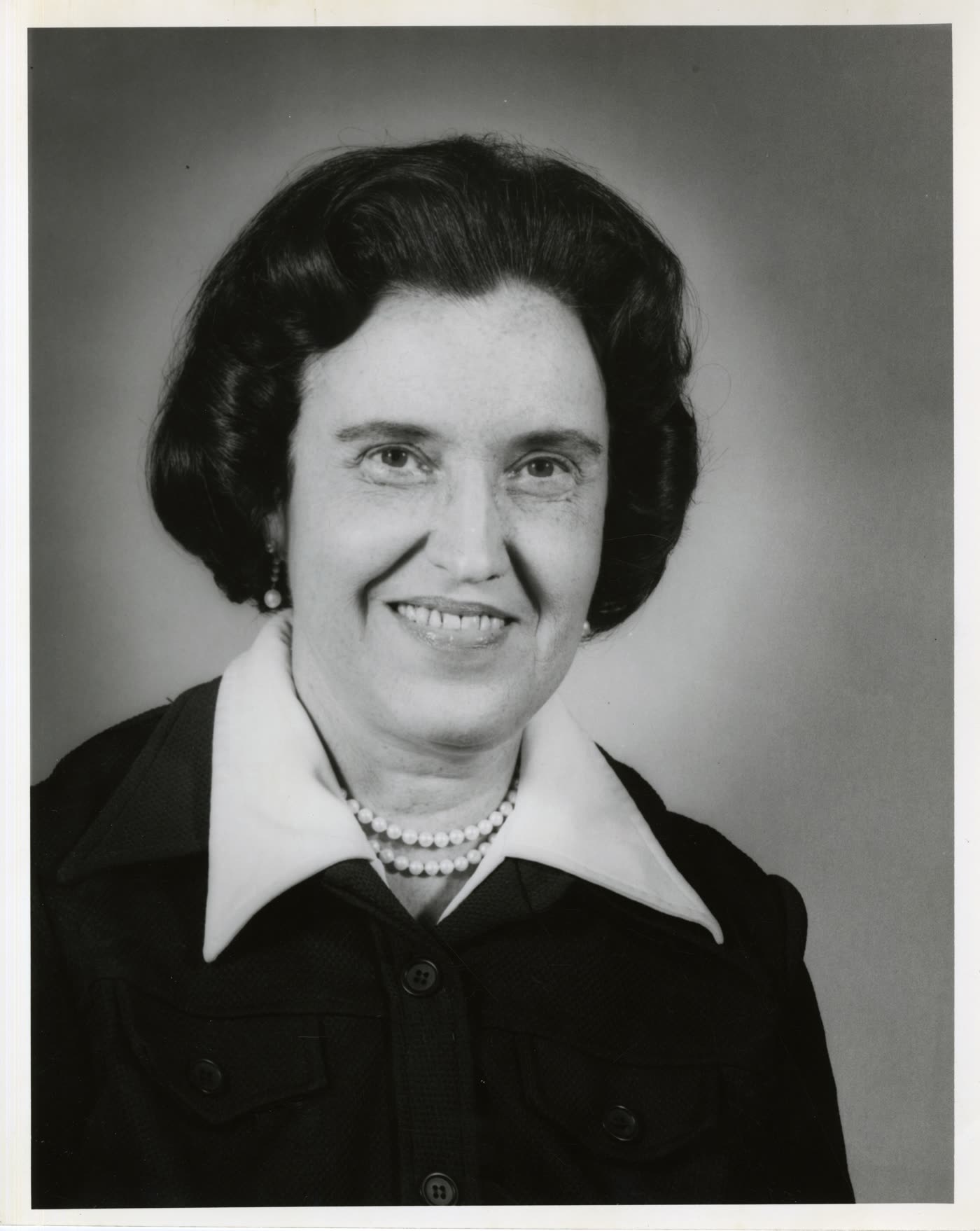
Image context: the cover uses a real National Library of Medicine portrait of Rosalyn Yalow from the 1970s. It belongs here because this article is not about an abstract method detached from the people who built it. It is about a laboratory worker whose career ran from a part-time Bronx VA appointment to a measuring technique that reshaped clinical medicine.[5]
Timeline anchors before interpretation
- December 1947: Yalow joined the Bronx Veterans Administration Hospital as a part-time consultant while still teaching physics at Hunter College.[1]
- January 1950: she left full-time teaching and joined the VA full time.[1]
- July 1950: Solomon A. Berson joined the same radioisotope service, beginning a 22-year research partnership that lasted until his death in 1972.[1]
- 1956: Berson and Yalow published work showing insulin-binding antibodies in insulin-treated subjects, a finding that became the conceptual springboard for later assay work.[2][3]
- 1959: Yalow later dated the practical beginning of the radioimmunoassay era to this period, after several years of turning the antibody concept into a workable measurement tool.[1][4]
- July 1960: "Immunoassay of Endogenous Plasma Insulin in Man" appeared in the Journal of Clinical Investigation.[2]
- October 1977: Yalow was awarded the Nobel Prize in Physiology or Medicine for the development of radioimmunoassays of peptide hormones.[4]
These dates matter because they keep the story from becoming pure retrospect. Radioimmunoassay did not arrive as a clean one-day invention. It emerged from a service built with limited means, years of isotope work, a specific partnership, and an initially awkward observation about antibodies that had to be converted into an instrument.[1][2][3]
1. Before Yalow's breakthrough, insulin was more visible as effect than as concentration
The prehistory of radioimmunoassay is not a blank. The JCI retrospective on Berson and Yalow lays out an earlier world in which investigators tried to estimate insulin in blood through bioassays such as rat-diaphragm or adipose-tissue responses and through approximate measures of "insulin-like activity."[3] Those methods were ingenious, but they were also burdensome and often indirect. They did not easily give clinicians a stable, specific, high-sensitivity reading for the tiny quantities circulating in human plasma.[2][3]
That distinction is the first reason Yalow's biography belongs in health history rather than only in physics history. Medicine already knew insulin as a therapeutic substance and as a physiological idea. What it lacked was a dependable way to compare small differences in circulating hormone levels across patients, conditions, and time points. In practical terms, insulin often appeared as consequence before it appeared as number: glucose changed, symptoms changed, tissue responded, but direct measurement remained hard.[2][3]
The historical point is subtle and important. A disease concept can stay coarse when its key variable is difficult to read. Once measurement sharpens, the concept itself can split, refine, and reorganize. That is the threshold Yalow and Berson approached in the 1950s.[2][3]
2. The Bronx VA partnership turned an inconvenient antibody into a measuring instrument
Yalow's Nobel autobiography is unusually good at restoring the material setting. She did not begin in a grand institute already built for prestige science. She joined a Bronx VA service that started with little more than a janitor's closet and a small grant, then helped equip and expand it while still carrying a teaching load at Hunter.[1] This is not decorative biography. It tells us the method came out of service work at the edge of hospital routine, where isotopes were being pushed into clinical questions rather than kept inside disciplinary prestige.
The decisive partnership began when Berson joined the service in July 1950.[1] Their early work ranged across blood-volume determination, thyroid disease, iodine metabolism, and serum proteins. From there they moved toward smaller peptides and then toward insulin, which Yalow described as the hormone most readily available in highly purified form.[1] That sequence matters because radioimmunoassay was not born from an abstract plan to revolutionize endocrinology. It came from serial problem-solving inside one hospital laboratory.[1][4]
The key observation first looked like a nuisance rather than a triumph. In insulin-treated patients, Berson and Yalow found that radioactive insulin disappeared more slowly from the circulation because antibodies were binding it.[1][2][3] In an earlier framework, antibodies might simply have been filed as interference. Their real breakthrough was to realize that the reaction between hormone and antibody could be stabilized, quantified, and ultimately turned into a measuring system.[1][3][4]
That move is the center of the whole microhistory. Yalow did not discover insulin. She changed the epistemic status of insulin in blood. The hormone stopped being something clinicians mostly inferred from downstream effects and became something that could be detected at very small scale through competitive binding logic.[2][4]
3. The 1960 paper changed the unit of comparison in diabetes research
By 1960, the conceptual tool had become a practical assay. The paper "Immunoassay of Endogenous Plasma Insulin in Man" gave investigators a way to measure endogenous human plasma insulin directly enough to compare normal, obese, and diabetic subjects on the same quantitative surface.[2] Read together with Yalow's later Nobel materials, the paper marks a change in what could count as evidence. Blood no longer had to be interpreted only through broad physiologic aftermath; it could be sampled for minute hormone concentrations themselves.[1][2][4]
The Nobel Prize's official facts page makes the downstream consequence explicit. Because the method was so sensitive, Yalow and Berson helped show that what we now call type 2 diabetes could not be explained simply as a lack of insulin; inefficient use of insulin had to enter the picture.[4] That does not mean radioimmunoassay solved diabetes in one stroke. It means the assay altered the explanatory map. Once plasma insulin could be measured better, "diabetes" stopped looking like one flat deficiency story.[2][4]
This is why the article's title insists on human scale. Yalow's breakthrough was not only analytical sensitivity in the laboratory sense. It was the creation of a clinically usable measurement scale that let medicine distinguish between absence, presence, excess, binding, resistance, and response with far more discipline than older methods allowed.[2][3][4]
4. The method quickly outgrew insulin because the measuring logic was portable
Yalow's own Nobel autobiography and lecture both stress that insulin was the opening proof rather than the final destination.[1][4] Once the assay architecture worked, it could be extended to many biologically active substances. In her autobiographical account, she wrote that radioimmunoassay was being used to measure hundreds of substances in thousands of laboratories in the United States and abroad.[1] The Nobel lecture similarly presents radioimmunoassay as a tool whose sensitivity and simplicity made previously inaccessible measurements routine across peptide hormones and broader biologic systems.[4]
That afterlife is the second reason her biography matters. Some scientific careers produce one famous result. Yalow's produced a measuring regime. A regime travels because it can be repeated, taught, standardized, and adapted. The JCI retrospective says the 1960 insulin paper only superficially looks like a methods paper; in effect, it marked a revolution in biology and medicine.[3] That judgment fits the evidence. The real inheritance was not one disease insight alone, but a new relationship between trace substances and clinical knowledge.[2][3][4]
The Nobel story therefore needs one correction. Yalow did not merely move from physics into medicine and receive recognition for doing so. She helped enlarge the class of things medicine could know from a blood sample. That is a larger accomplishment than prize memory usually permits.[1][4]
5. The harder historical lesson is about infrastructure, not genius alone
Yalow's life also shows how scientific authority accumulates through institutional stubbornness. She entered graduate physics in a period of open bias against women, then built a medical-research career through war-time openings, technical competence, and one hospital service willing to back isotope work.[1][4] The Bronx VA mattered because it gave durability to the partnership and the laboratory. Berson mattered because the method was genuinely joint even if the Nobel Prize could not be awarded posthumously after his death in 1972.[1][4]
This matters because modern readers often romanticize breakthrough science as a solitary leap. The record here points elsewhere: one under-resourced service, a long collaboration, years of failed or partial inference, a stubborn technical problem, and eventually a measuring system robust enough to travel.[1][2][3] That is a much better history of how health knowledge usually changes.
Why this microhistory still matters
Rosalyn Yalow still matters because medicine keeps being remade whenever a previously blurry variable becomes measurable enough to reorganize diagnosis. Radioimmunoassay was one of those moments. It made insulin newly legible, helped refine how diabetes could be interpreted, and then widened into a general assay logic for peptide hormones and beyond.[2][3][4]
If her story is reduced to a prize citation, the main lesson disappears. What changed health care was not honor after the fact. It was the conversion of an invisible, low-concentration signal into a repeatable number that other laboratories could trust. Yalow's microhistory belongs to the long history of medicine learning that measurement is never merely descriptive. Once the scale changes, the disease can change with it.[1][2][3][4]
Sources
- Rosalyn Yalow, "Biographical" - Nobel autobiographical account covering the Bronx VA appointment in 1947, full-time move in 1950, Berson partnership, the insulin-antibody finding, and Yalow's own description of radioimmunoassay's spread.
- Rosalyn S. Yalow and Solomon A. Berson, "Immunoassay of Endogenous Plasma Insulin in Man" (Journal of Clinical Investigation, 1960; PMC) - the core paper that made direct quantitative plasma-insulin measurement clinically usable.
- Jesse Roth, "Berson, Yalow, and the JCI: the agony and the ecstasy" (Journal of Clinical Investigation, 2004) - historical retrospective on pre-RIA insulin assays, the 1956 antibody finding, and the wider methodological revolution.
- Nobel Prize Outreach, "Rosalyn Yalow - Facts" and Nobel lecture context - official Nobel materials on the 1977 prize motivation, the radioimmunoassay breakthrough, and its implications for understanding type 2 diabetes and peptide hormones.
- National Library of Medicine Digital Collections, "(Rosalyn S. Yalow)" - archival portrait source used for the article image.