Alexander Fleming is usually remembered through one scene: a messy bench, an overdue stack of plates, a contaminating mold, and the sudden birth of the antibiotic age.[2][3] That scene is real, but the 1929 paper is sharper and narrower than the legend wrapped around it. Read closely, "On the Antibacterial Action of Cultures of a Penicillium" is not yet the story of a finished miracle drug descending into medicine.[1][2] It is the story of a bacteriologist turning one odd plate into a disciplined argument about selective toxicity, bacterial spectrum, and laboratory use.
That distinction matters because it restores the actual scale of Fleming's contribution. The paper does not say, in effect, "Here is the complete therapeutic future." It says something more rigorous and in some ways more impressive. A mold culture is producing a substance that diffuses through agar, lyses some bacteria, leaves others untouched, shows low apparent local toxicity, and may therefore be useful in mixed-culture work and perhaps in local infection settings.[1][2] The later revolution depended on that argument, but it did not yet exist in full inside the 1929 document.
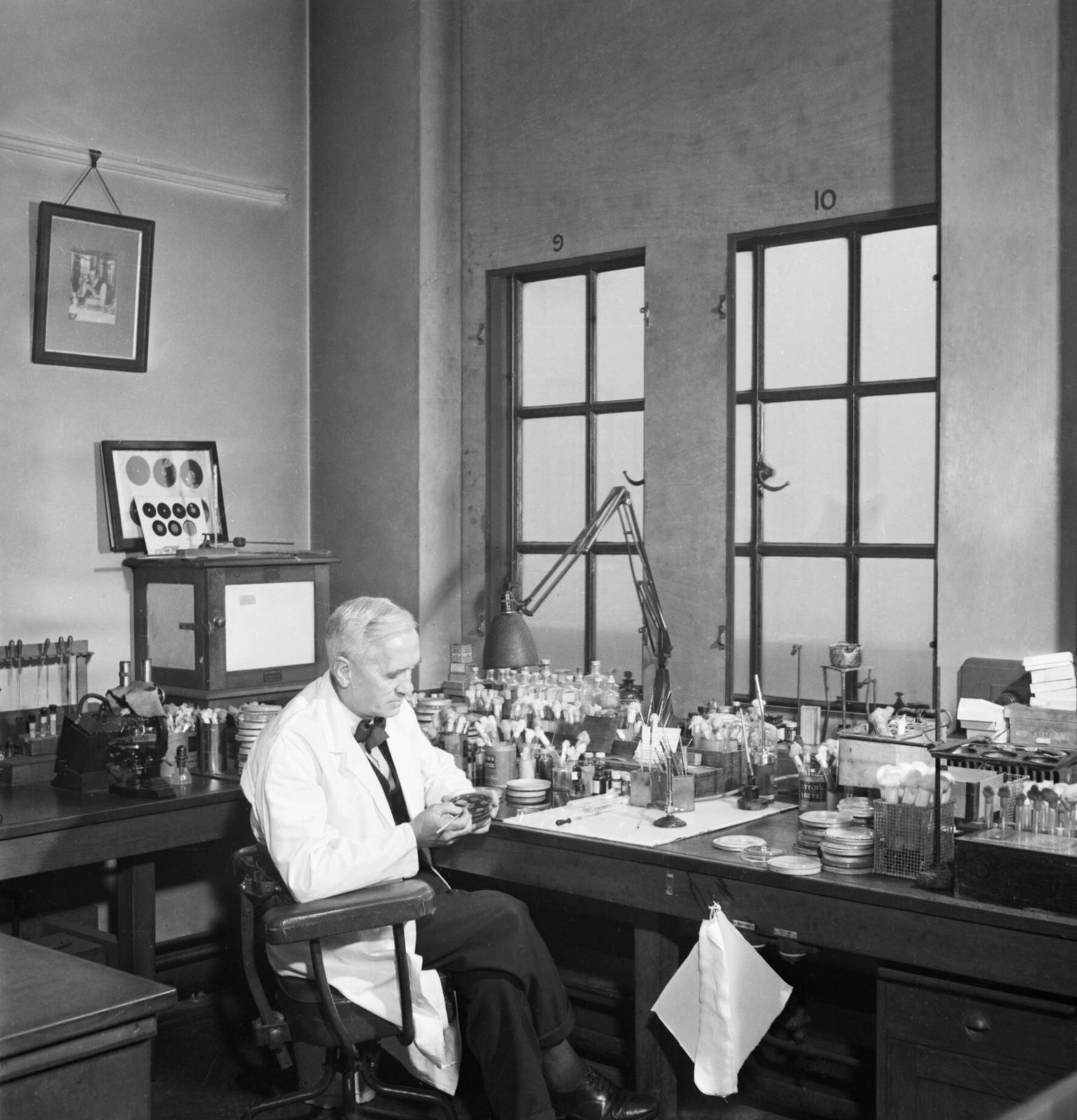
Image context: the cover uses a real archival photograph of Fleming at work in his St Mary's laboratory during the Second World War.[5] That is the right image for this essay because the paper's real drama is not a fairy-tale accident. It is bench work: plates exposed to air, broth left at room temperature, serial dilution, spectrum testing, and a scientist patient enough to turn contamination into evidence.
Timeline anchors before the myth hardens
- September 1928: Fleming noticed that a contaminating mold on a staphylococcal plate had left a clear bacteria-free zone around itself.[2][3]
- May 10, 1929: the paper was received for publication in the British Journal of Experimental Pathology.[1]
- June 1929: the article appeared in print, naming the mold filtrate "penicillin" and emphasizing its antibacterial action and mixed-culture usefulness.[1][2]
- 1939-1941: Howard Florey, Ernst Chain, and colleagues at Oxford began the work that turned penicillin from a laboratory curiosity into a usable systemic treatment.[2]
- 1945: Fleming, Chain, and Florey shared the Nobel Prize in Physiology or Medicine for penicillin and its curative effect in infectious disease.[3]
Those dates matter because they separate three different events that public memory often compresses into one: an observation in 1928, a paper in 1929, and a therapeutic-industrial breakthrough more than a decade later.[2][4]
1. The title already tells you Fleming's paper is more technical than the legend
The title does not announce the conquest of bacterial disease.[1] It announces an antibacterial action "with special reference to" the isolation of B. influenzae.[1] That phrase is easy to skip, but it is the article's first important clue. Fleming is not presenting penicillin primarily as a general cure narrative. He is presenting it as a selective bacteriological tool.
The American Chemical Society's historical account makes the same point in plainer hindsight. Fleming's 1929 publication, it says, contained only a passing reference to penicillin's therapeutic potential, and at that stage its main practical application looked like the isolation of penicillin-insensitive bacteria from penicillin-sensitive ones in mixed culture.[2] That is not a minor footnote. It is the paper's original scale.
Read that way, the famous accident becomes less cinematic and more interesting. Fleming saw not only that the mold killed nearby staphylococci, but that the effect could be turned into a differential instrument.[1][2] The paper belongs as much to bacteriological method as to pharmacological prophecy.
2. The first move after the contaminated plate is measurement
Fleming begins with the now-famous observation: culture plates exposed to air became contaminated, and around a large mold colony the staphylococcal colonies turned transparent and were "obviously undergoing lysis."[1] But he does not leave the event in anecdotal form. He subcultures the mold, grows broth, and starts testing properties.[1]
That shift from story to method is the core of the article. Fleming describes broth cultures grown at room temperature for one or two weeks, then asks what the filtrate does, how quickly it diffuses through agar, how to titrate it in serial dilution, what heat does to it, what solvents do to it, and which organisms it inhibits.[1] He even explains why staphylococcus is a useful test organism: it is hardy, grows rapidly, and is very sensitive to penicillin.[1]
The numbers matter because they show how quickly the paper leaves folklore behind. Fleming reports that a good sample grown at about 20 C could completely inhibit staphylococci at 1 in 500 or even 1 in 800 dilution after 6 or 7 days of culture growth.[1][3] That is not the language of lucky contamination. It is the language of assay.
This is why the Nobel biography's brief note that Fleming found mold culture could prevent staphylococcal growth "even when diluted 800 times" is so revealing.[3] The discovery entered history through observation, but it stayed alive through quantification.
3. The paper's real intellectual hinge is selectivity
Fleming's article becomes most modern when it moves from "does it kill?" to "what does it spare?"[1] Penicillin is not described as a universal germicide. Fleming says the coli-typhoid group is unaffected, as are several other intestinal bacilli and B. influenzae itself, while the action is strongest on the pyogenic cocci and the diphtheria group.[1]
That spectrum is the heart of the paper. It means penicillin is not merely another harsh antiseptic poured indiscriminately over living tissue. It is a substance with differential action.[1][2] Some bacteria are hit hard. Others are not. In mixed material from sputum or nasal mucus, that selectivity becomes operationally useful because common obscuring bacteria can be suppressed while the harder-to-isolate organism is allowed to appear.[1]
This is where the essay's title phrase about B. influenzae stops sounding eccentric. It names a concrete bacteriological use-case. Fleming shows plates on which penicillin-treated areas suppress staphylococci and diphtheroids while leaving B. influenzae visible.[1] The 1929 paper therefore sits at a junction between antimicrobial discovery and diagnostic technique.
That is a stronger achievement than the simplified origin story usually allows. The important step was not just noticing a clear halo around mold. It was realizing that the halo implied a usable boundary between susceptible and resistant organisms.
4. Fleming also saw the limits
Another reason the paper deserves a close reading is that it is less triumphalist than later memory. Fleming records instability, sensitivity to longer heating, and the difficulty of sustaining antibacterial strength as cultures age at room temperature.[1] He also notes that penicillin acts slowly as a bactericidal agent: staphylococci may continue to grow for some hours before being killed off, even at concentrations far higher than those needed to inhibit growth in broth.[1]
At the same time, he reports several reassuring low-toxicity signals. Intravenous injection of large amounts of mold broth filtrate into a rabbit appeared no more toxic than broth itself; mice showed no toxic symptoms at the reported dose; irrigation of infected surfaces and even the conjunctiva produced no irritant effect; and penicillin that completely inhibited staphylococci in high dilution did not interfere with leukocytic function any more than ordinary broth.[1]
That combination is exactly what makes the paper historically important. Fleming had not solved purification, stability, or mass production.[2] He had, however, described a substance that looked different from older tissue-damaging antiseptics because it joined strong antibacterial action with relatively mild observed local toxicity.[1][2] In modern language, he had stumbled onto selective toxicity before anyone could fully industrialize it.
5. Why the revolution still had to wait
If the 1929 paper was this suggestive, why did the antibiotic era not begin immediately? The ACS history gives the cleanest practical answer: others tried to purify penicillin and failed, and it was Florey, Chain, and their Oxford colleagues who reopened the problem in 1939 and turned it toward animal experiments, clinical trials, and production scale.[2] Fleming's paper was necessary, but it was not enough; chemistry, purification, dose-making, and industrial yield all still stood in the way.[2]
That lag is not evidence against Fleming. It clarifies his actual role. He wrote the threshold paper. He showed that the mold broth contained a powerful antibacterial principle, that the principle had a meaningful spectrum, and that it did not behave like a crude tissue poison in the settings he tested.[1][3] The later Oxford group then converted that threshold into therapy.[2]
The Imperial museum's decision to keep Fleming's laboratory restored to its 1928 condition is fitting for that reason.[4] The bench matters because the decisive move happened there first: one contaminated plate stopped being laboratory dirt and became a measured problem worth following.
The fairest way to read the 1929 paper in 2026 is therefore neither to shrink it into a charming accident nor to overstate it as the whole antibiotic revolution at once. Its real force sits between those extremes. Fleming made penicillin legible before anyone made it scalable. He converted chance into a reproducible argument about selective antibacterial action. That is why the paper still reads alive.
Sources
- Alexander Fleming, "On the Antibacterial Action of Cultures of a Penicillium, with Special Reference to Their Use in the Isolation of B. influenzae" (1929 original paper record, World Health Organization IRIS).
- American Chemical Society, "Discovery and Development of Penicillin" - ACS landmark history of Fleming's 1929 paper, its narrow early framing, and the later Oxford and wartime production turn.
- Nobel Prize Outreach, "Sir Alexander Fleming - Biographical" - official biographical note on the 1928 observation, Fleming's titration work, and the claim that mold culture inhibited staphylococci even when diluted 800 times.
- Imperial College Healthcare NHS Trust, "Alexander Fleming Laboratory Museum" - hospital museum page noting that Fleming's laboratory is preserved in its 1928 condition and presenting the discovery-and-development story on site.
- Wikimedia Commons, "File:Professor Alexander Fleming at work in his laboratory at St Mary's Hospital, London, during the Second World War. D17801.jpg" - archival laboratory photograph used as the article image.