Blood pressure feels obvious now because the ritual is so familiar: cuff on the upper arm, bulb inflation or automatic pump, a number, a second number, a decision. That familiarity hides the historical achievement. Arterial pressure was not always a routine vital sign that could move from operating room to clinic to public-health survey. It had to be converted from an internal force into a measurement that ordinary clinicians could repeat without opening an artery.
The key source trail is compact. In 1896, Scipione Riva-Rocci introduced an upper-arm cuff connected to a mercury column, making systolic pressure easier to obtain by palpating the radial pulse as the cuff was inflated and released.[1][2] In 1901, Harvey Cushing encountered the instrument in Europe; by 1903, he was publicly demonstrating the value of routine arterial-tension determinations in the operating room and clinic.[3] In 1905, Nikolai Korotkoff added the auscultatory step: listen over the brachial artery while the cuff deflates, and the changing sounds mark systolic and diastolic pressure.[1][2][4]
Read closely, this is not a gadget story. The cuff mattered because it gave medicine a repeatable compression experiment. Cushing mattered because he moved that experiment into patient monitoring. Korotkoff mattered because sound turned one pressure point into two. Together they made a hidden cardiovascular variable behave like a shared clinical language.
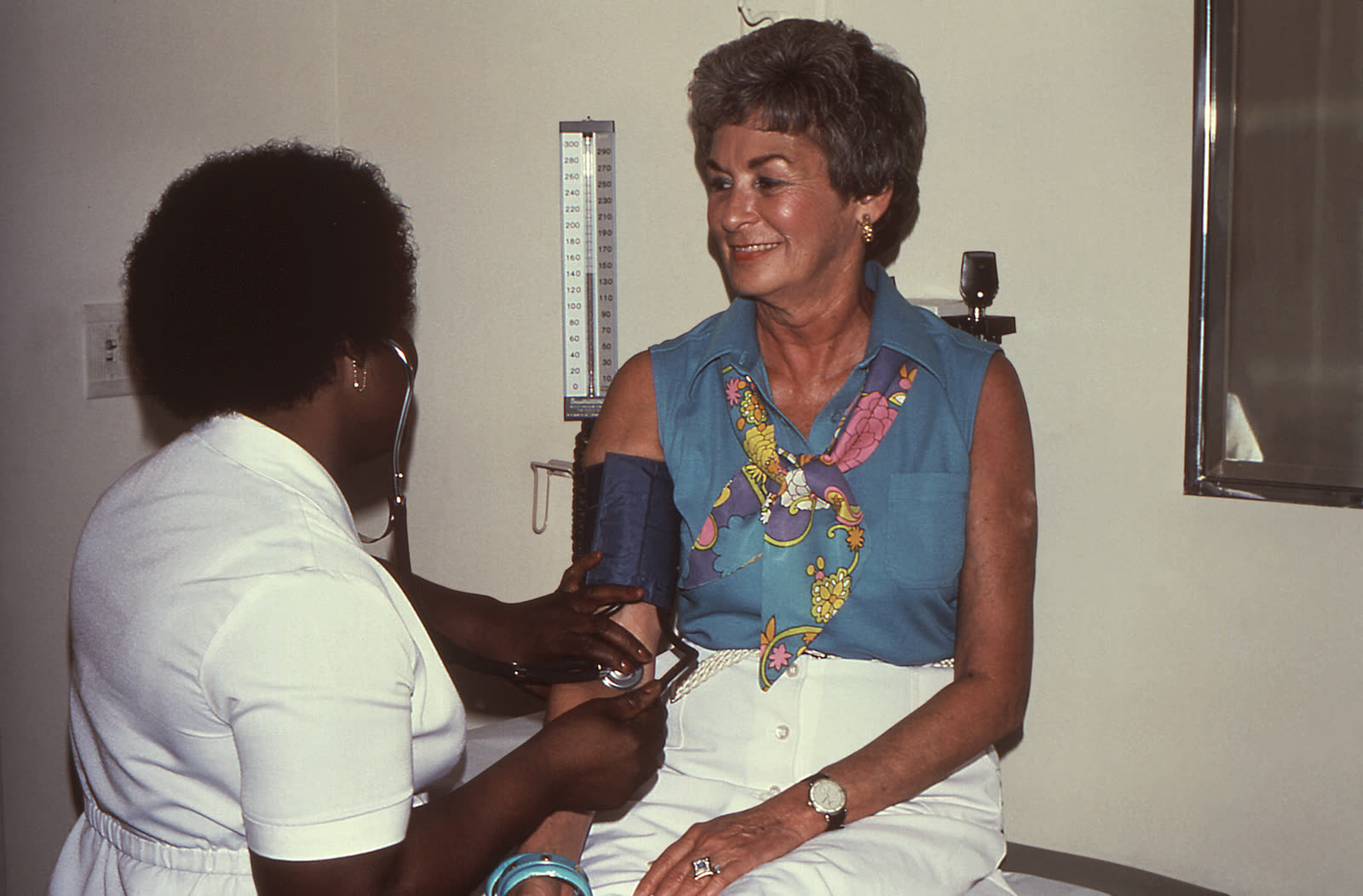
Image context: the CDC photograph is much later than Riva-Rocci and Korotkoff, but that is why it works. It shows the mature bedside form of the method: cuff position, stethoscope, observer, patient posture, and recorded numbers. The historical invention only became medicine when that choreography could be repeated thousands of times without drama.[5]
The cuff turned pressure into a controlled interruption
Riva-Rocci's method looks simple because the modern cuff has trained us to see it that way. The Wood Library-Museum record makes the mechanism plain: a rubber cuff wrapped around the arm, inflation by bulb, pressure tracked in a vertical mercury tube, and a clinician feeling the radial pulse while releasing the cuff.[2] The reading came when the pulse returned. The measurement was therefore not just an observation. It was a controlled interruption of blood flow.
That distinction matters. Earlier blood-pressure measurement had been technically awkward, often invasive or impractical for routine care. Riva-Rocci's contribution was to make the arm itself the testing site. Instead of entering an artery, the clinician compressed the artery from outside, watched the pressure column, and used the pulse as the signal that arterial flow had resumed.[1][2]
The first boundary is just as important as the breakthrough. Riva-Rocci's original system measured systolic pressure by palpation. It did not yet give clinicians the full two-number blood pressure that later became standard. It also depended on cuff dimensions: the Wood Library-Museum notes that Riva-Rocci's original cuff was narrow, about 5 cm wide, and later accounts emphasized that cuff size could distort the reading.[2][4]
So the first lesson is not "the cuff solved blood pressure." It is narrower and stronger: the cuff made noninvasive arterial pressure measurable enough to enter routine practice, while also creating new technical obligations around cuff width, placement, and observer method.[1][2][4]
Cushing treated the number as monitoring, not trivia
The Royal College of Physicians of Edinburgh's collection note on Cushing's 1903 paper is useful because it frames the instrument as a practice change, not a display object. Cushing had seen Riva-Rocci's sphygmomanometer in Pavia, brought one back to Baltimore, used it in surgical operations, and then demonstrated its value in Boston before the paper appeared.[3] The important word in that chain is "routine." A measurement can exist as an occasional curiosity without changing medicine. It changes medicine when clinicians decide it belongs in repeated observation.
That was especially important in surgery and anesthesia. An anesthetized or critically ill patient cannot always report distress. Pulse quality, color, bleeding, and respiration offered clues, but Cushing's adoption of blood-pressure measurement added a more explicit hemodynamic signal.[2][3] The number did not eliminate judgment. It disciplined judgment by making circulatory change harder to dismiss as a vague impression.
The source also shows why the blood-pressure cuff belongs in the history of safety infrastructure. The apparatus was not only a diagnostic tool for hypertension. In the operating room, it became part of a monitoring culture: observe, repeat, compare, and respond. That culture is now so ordinary that it can seem automatic. Historically, it had to be argued into place.[3]
Cushing's role also reminds us that adoption is a separate event from invention. Riva-Rocci devised a practical instrument; Cushing helped make it clinically consequential in surgical settings by showing that blood-pressure readings could matter during operations rather than only in retrospective discussion.[2][3] A tool moves faster when a respected user demonstrates where it changes decisions.
Korotkoff made the cuff speak in two numbers
Korotkoff's addition in 1905 changed the measurement from a palpated return of pulse into an auscultatory sequence.[1][2][4] A clinician placed a stethoscope over the brachial artery and listened while cuff pressure fell. The first audible sounds marked systolic pressure; the disappearance of sounds later came to define diastolic pressure in standard technique.[4]
That move is easy to understate. The cuff had already made systolic pressure practical. Korotkoff made the method richer by turning turbulent, changing flow beneath a deflating cuff into an audible marker. The hidden force became not only visible in mercury but audible through a stethoscope.
This is why the modern reading has two numbers. The first number tells when arterial pressure can overcome cuff pressure enough to produce the first sounds. The second tells when the artery is no longer being compressed enough to produce those sounds in the same way.[4] The exact physiology is more complex than the bedside mnemonic, but the clinical translation is durable: systolic and diastolic pressure became a paired measurement that could classify risk, guide treatment, and track change.
The pairing also made observer technique more important. A rushed deflation, poor hearing, wrong stethoscope position, talking during the measurement, or wrong cuff size can change the numbers. The modern AHA-derived guidance summarized by American Family Physician therefore reads almost like an afterlife of Korotkoff's discovery: support the arm at heart level, use an appropriate cuff, deflate at 2 to 3 mm Hg per second, record first and last audible sounds, avoid conversation, and average repeated readings when needed.[4]
The apparatus created a new error surface
Every useful measurement creates a new class of mistakes. Blood pressure is a classic example. Before a practical cuff, the problem was that arterial pressure was hard to measure. After the cuff, the problem became whether the measurement had been done well enough to trust.
The 2005 AHA recommendations, as summarized in American Family Physician, are blunt about this. Blood-pressure reading is described as one of the most inaccurately performed measurements in clinical medicine, and the summary highlights observer error, terminal digit bias, patient posture, arm position, cuff selection, deflation rate, talking, device maintenance, and repeated readings.[4] Those details are not pedantic. They define the difference between a physiological signal and a misleading number.
Cuff size is the clearest example. If the cuff is too small, pressure can be overestimated; the AHA summary recommends a bladder length of at least 80% of arm circumference and an ideal width of at least 40%.[4] That requirement reaches back to the history of the instrument itself. Riva-Rocci's original narrow cuff worked as an opening move, but later practice had to correct for the geometry of arms and cuffs.[2][4]
Posture is another example. The arm has to be supported at heart level because hydrostatic position changes the reading; the patient should sit with back supported and legs uncrossed; neither patient nor observer should talk during the procedure.[4] The number is therefore never just "the blood pressure." It is the blood pressure produced by a body, a cuff, a room, a posture, an observer, and a protocol.
That is the main historical correction. The cuff did not make measurement effortless. It made measurement available, then forced medicine to standardize the work around it.
Why this still matters
The blood-pressure cuff became powerful because it sits between individual care and population health. At the bedside, it can warn of shock, hypertensive crisis, anesthesia instability, pregnancy complications, medication effects, or orthostatic change. In clinics and surveys, it can classify hypertension and track cardiovascular risk across millions of people. That scale depends on the assumption that one reading can be meaningfully compared with another.
Riva-Rocci, Cushing, and Korotkoff each contributed a different part of that comparability. Riva-Rocci supplied the practical external compression system.[1][2] Cushing argued for routine clinical use where repeated readings could alter care.[3] Korotkoff supplied the sounds that made systolic and diastolic pressure legible by auscultation.[1][2][4] Modern guidance then turned the method into a controlled protocol because small differences can change diagnosis and treatment.[4]
The best way to read the cuff, then, is not as a quaint predecessor of automated devices. It is a reminder that measurement is a social technology as well as a physical one. A device compresses the artery. A stethoscope carries sound. A mercury or aneroid scale records pressure. But the clinical value comes from training, timing, posture, maintenance, repetition, and shared interpretation.
That is why the ordinary clinic ritual deserves respect. The cuff made a hidden force audible, but it did not make the truth automatic. It made a disciplined question repeatable: under these conditions, at this moment, what pressure is this circulation producing, and what should we do with that knowledge?
Sources
- Jeremy Booth, "A short history of blood pressure measurement" (Proceedings of the Royal Society of Medicine, 1977; PubMed/PMC record) - historical overview of blood-pressure measurement, including Riva-Rocci's 1896 cuff and Korotkoff's 1905 auscultatory method.
- Wood Library-Museum of Anesthesiology, "Riva-Rocci Sphygmomanometer" - museum catalog and historical note on Riva-Rocci's apparatus, cuff method, Cushing's adoption, and Korotkoff's later addition.
- Royal College of Physicians of Edinburgh, "Blood Pressure in the College Collections" - collection note identifying Harvey Cushing's 1903 Boston Medical and Surgical Journal paper and explaining his role in bringing Riva-Rocci's instrument into surgical practice.
- Liz Smith, "New AHA Recommendations for Blood Pressure Measurement" (American Family Physician, 2005) - accessible summary of the AHA scientific statement on cuff size, posture, deflation rate, Korotkoff sounds, observer error, and repeated readings.
- CDC Public Health Image Library, ID 14671, "Nurse conducting a blood pressure examination" - source page for the 1980 clinical photograph used as the article image.