
As of 2026-06-24 UTC, the most useful way to watch Mayo Clinic's insulin-pen demonstration is to treat it as a workflow video, not as a gadget review.[1] An insulin pen looks simple because it compresses medicine, dose dial, plunger, and needle into one portable object. That simplicity is the point: the American Diabetes Association notes that pens can be faster, more discreet, and easier to carry than vial-and-syringe setups, while NIDDK describes them as a practical option for people who find vial filling or syringe markings difficult.[2][3] But the device only stays simple if the repeated checks become part of the act rather than optional extras.
The video is worth embedding because insulin technique lives in small motions that prose can make too abstract: attaching a needle, clearing air, dialing the prescribed dose, pressing and waiting, then removing the needle safely.[1] The written sources add the safety boundary the video alone cannot fully carry. Diabetes UK frames priming as a way to regulate dose by removing air from the needle and cartridge; it also tells users to insert at a right angle, press until the dial returns to zero, and count slowly to ten before removing the needle.[5] The CDC adds a different kind of boundary: insulin pens must never be used for more than one person because improper sharing can expose people to bloodborne pathogens including hepatitis viruses and HIV.[4]
That makes the pen a sequence, not just a container. Watch for five decisions: confirm the right pen, put on a new needle, prime before the dose, choose a usable site rather than a familiar damaged spot, and keep the needle in long enough that the medication has time to enter the tissue.[1][2][3][5] This article is educational context, not a substitute for individualized training from a clinician, pharmacist, or diabetes educator. Insulin type, dose, timing, needle length, and injection site instructions are personal medical decisions.
The first check is identity, not injection
The opening value of the Mayo Clinic clip is that it slows the pen down before the needle reaches skin.[1] In ordinary life, the dangerous failure mode is not always dramatic. It can be picking up the wrong pen in a bag, using a pen past its usable window, assuming the needle is already ready, or treating a familiar number on the dose dial as proof that the whole setup is correct. The ADA's discussion of pens explains why this risk exists: different products can be color-coded and designed differently, and some reusable pens or connected pens add memory and dose-tracking features.[2] Convenience helps, but it also creates a household object that can feel too familiar.
NIDDK's overview is useful here because it positions pens among several delivery methods: vial and syringe, pen, pump, and inhaled insulin.[3] The pen is not "less medical" because it looks like a writing instrument. It is still a device for delivering a hormone whose timing and amount matter. That is why the pre-injection check has to be boring in the best sense: right medicine, right user, right needle, right dose window, right site, right disposal plan. The more routine the injection becomes, the more the routine needs guardrails.
The CDC's 2012 reminder about not sharing insulin pens sharpens this point.[4] In hospitals, clinics, assisted-living settings, or homes where more than one person uses injectable medication, the pen body can look reusable in the wrong way. Needles are visibly sharp and single-use; the pen body can appear like common equipment. CDC's warning is that the whole pen is patient-specific. A new needle does not make a shared pen safe.[4] That is not a subtle etiquette rule. It is infection-control logic.
Priming is the anti-guesswork step
The most important visual detail to notice in the demonstration is the step that happens before dialing the actual dose: priming.[1] Diabetes UK describes priming as pointing the pen upward, dialing two units, pressing until a drop appears, and repeating if no insulin appears.[5] The reason is plain but easy to underweight. If air is in the needle or cartridge path, the pen's dose dial may move while the full expected amount of insulin has not actually passed through the needle. Priming turns "the device probably works" into "the needle path is open and insulin is visible."
That is why priming should not be treated as a training-wheel step for beginners. It is a recurring check, especially when attaching a new needle. The Mayo video makes this more legible than a written checklist because the viewer can see that priming is a tiny operation placed between setup and treatment, not a separate ceremony.[1] The smallness is the challenge. In a rushed morning, a restaurant bathroom, a school health office, or a tired nighttime correction dose, the step can feel expendable precisely because it is short.
The article's interpretation is that priming is the pen's equivalent of a preflight control check. It does not decide whether the prescribed dose is right; that belongs to the care plan. It decides whether the device is ready to deliver the dose the user intends. A person who understands that distinction is less likely to read the dose window as the only evidence that matters.
The site is part of the dose environment
The video also deserves annotation because site choice can look like a matter of comfort when it is really part of delivery reliability.[1] NIDDK lists common injection areas such as the abdomen, thigh, buttocks, and upper arm, while noting that absorption can differ by area.[3] Diabetes UK tells readers to choose where they are going to inject, use a clean and dry spot, and inject at a right angle.[5] Those instructions are practical, but they imply a larger rule: the site is not merely a patch of skin. It is the local tissue through which the dose must enter the body.
Rotation matters for the same reason. Reusing one exact spot can make the action feel easier, but a too-familiar site can become a poor site. Diabetes UK tells users to choose where they will inject as part of the sequence, and the ADA notes that needle length, injection angle, and holding time all relate to placing insulin just below the skin rather than into muscle.[2][5] The sources do not require the reader to become an anatomy expert. They ask for a practical habit: choose a suitable area, vary exact spots according to the care team's instructions, and avoid turning convenience into tissue damage or unpredictable absorption.
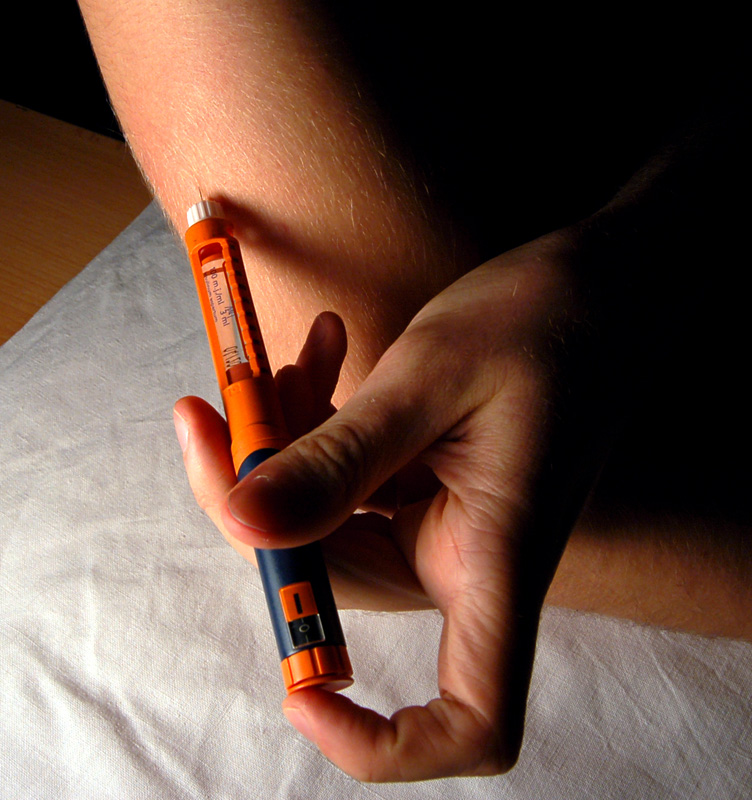
This is where the still photograph used for the article helps. It shows the pen in contact with an upper arm, a real body position rather than a diagram.[6] The image is not a universal instruction to use that site. It is a reminder that insulin technique is embodied. Arm, abdomen, thigh, and buttock are not interchangeable abstractions; they are sites with different reach, visibility, tissue thickness, and daily-life constraints.[3]
Counting is delivery control, not politeness
Another easy-to-miss moment is the hold after pressing the plunger.[1] Diabetes UK says to count slowly to ten before removing the needle so the insulin has time to enter the body.[5] The ADA gives a similar practical range, advising users to hold the needle in the skin for five to ten seconds after giving insulin to reduce leakage from the site.[2] That waiting period can feel oddly long because the decisive action appears to be over once the button is pressed. In fact, the count is part of dose delivery.
This is a useful place to separate what the video shows from what the article infers. The video demonstrates a clean sequence.[1] The written guidance explains why the pause matters: it helps make the intended dose more likely to stay under the skin rather than leaking back out.[2][5] The larger inference is that technique converts a prescribed number into a delivered medication event. A dose is not just what the dial displayed. It is what the correct pen, open needle path, selected site, full button press, adequate hold, and post-use disposal collectively made possible.
The count also protects against a common psychological error. People often speed up the end of a repeated task. They prepare carefully, inject, then rush the part that feels like waiting. In insulin-pen use, the waiting is not empty time. It is the final control that gives the device a chance to finish what the user started.
Disposal closes the loop
The last lesson is that the injection is not complete when the needle leaves the skin. Diabetes UK tells users to throw away the needle in a sharps bin.[5] The ADA likewise describes putting the used needle into a needle-safe sharps container after injection.[2] This matters for household safety, but it also matters for the next dose. Leaving a needle attached can blur the boundary between used equipment and ready equipment; removing and disposing of it makes the next setup start from a known state.
Read this way, Mayo Clinic's short video is not just a demonstration of how to operate a pen. It is a compact lesson in making a high-frequency medical task resistant to drift.[1] Pens became popular because they lower friction: fewer loose parts, easier portability, clearer dose dialing, and less public visibility than a vial and syringe for many users.[2][3] The hidden tradeoff is that lower friction can invite shortcuts. The answer is not to make the process intimidating. It is to make the right sequence memorable enough that the small checks happen even when the day is messy.
The practical takeaway is therefore simple but strict. An insulin pen is safe only as a complete workflow: the right pen for the right person, a new needle, a visible prime, the prescribed dose, a suitable rotated site, a full press, a slow count, and sharps disposal.[1][2][3][4][5] The video supplies the hand choreography. The sources supply the boundaries. Together they make the pen less mysterious and less casual at the same time.
Sources
- Mayo Clinic, "How to Use an Insulin Pen - Mayo Clinic Patient Education," YouTube video.
- American Diabetes Association, "Insulin Pens," device overview covering pen types, convenience, needles, angle, and hold time.
- National Institute of Diabetes and Digestive and Kidney Diseases, "Insulin, Medicines, & Other Diabetes Treatments," diabetes treatment overview including insulin pens and injection sites.
- CDC Stacks, "Insulin Pens Must Never Be Used for More than One Person," 2012 infection-control reminder.
- Diabetes UK, "Injecting insulin," patient guidance on priming, injecting, counting to ten, and sharps disposal.
- Wikimedia Commons, "File:Insulin Application.jpg," 2007 public-domain photograph of insulin being applied with a pen.