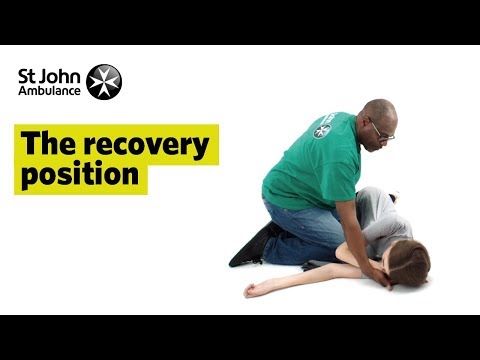
As of 2026-06-23 UTC, the most useful way to watch St John Ambulance's recovery-position video is to notice what happens before the roll.[1] The clip is not teaching a generic side-lying posture for anyone who looks faint, drunk, asleep, or injured. It is teaching a decision after a primary survey: the person is not responding, but they are breathing normally. That fork matters because the wrong branch changes the whole intervention. A person who is unresponsive and not breathing needs emergency help and CPR, not a careful pose on the floor.[2][3]
The recovery position has a strangely soft name for a high-stakes first-aid move. "Recovery" can make it sound passive, as if the helper is putting someone somewhere comfortable while nature handles the rest. The sources frame it differently. St John Ambulance says the position is for someone not responding but breathing normally, and that it keeps the airway open while vomit can drain away without blocking breathing.[2] British Red Cross explains the same mechanism in plainer language: when someone is unresponsive, relaxed muscles can let the tongue obstruct the airway; turning them on their side with the head back helps the tongue fall forward and lets blood or vomit drain out.[3] NHS 111 Wales adds the operational boundary that an unconscious but breathing person should be placed in the recovery position until help arrives, unless other injuries prevent movement.[4]
That is why the video is worth embedding rather than merely summarizing. The maneuver is physical enough that a reader benefits from seeing the sequence, but the video alone can make the move look more automatic than it should be. The article below treats the clip as an annotated viewing: what to watch for, what decision it assumes, and what must still happen after the person is on their side.[1][2][3][4]
The first move is the breathing check
The decisive lesson is not a hand placement. It is the triage logic. The recovery position belongs to a narrow state: unresponsive, breathing normally, and still needing emergency care.[2][3][4] If the person is responsive, the helper has a different problem. If the person is unresponsive and not breathing normally, the helper has a more urgent problem. British Red Cross tells helpers to check whether the chest is moving and to look, listen, and feel for breaths; if breathing is absent or not normal, the page sends the helper toward the non-breathing pathway.[3] NHS 111 Wales makes the same split in its first-aid overview: if someone is unconscious and breathing, the recovery position can hold them until help arrives; if severe breathing or bleeding threats are present, those have to be handled first.[4]
This is the point most likely to get blurred in public memory. People remember "put them on their side" because it is visible and easy to rehearse. But the side position is not a substitute for deciding whether the person is breathing. In the video, the roll should be read as the answer to a prior question, not as the first question itself.[1][2]
The side is doing airway work
Once the decision is made, the side position solves two airway problems at once. First, it helps keep the airway open by positioning the head and chin so the tongue is less likely to fall backward.[2][3] Second, it gives fluids somewhere safer to go. Vomit, blood, saliva, or mucus can drain from the mouth rather than pooling near the airway.[2][3] That does not make the person safe in the ordinary sense. It makes the waiting period safer while professional help is on the way.
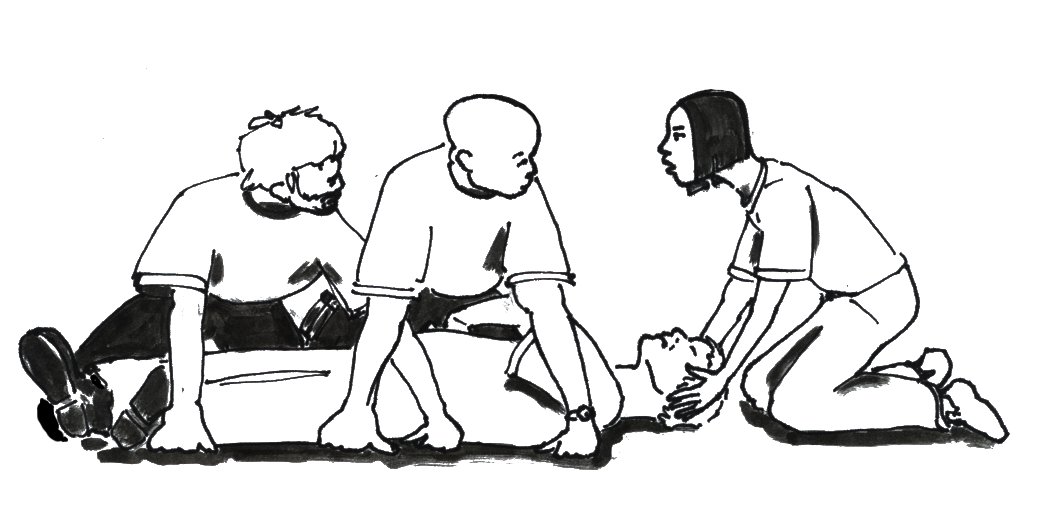
The St John written steps are useful beside the video because they slow down the geometry. The near arm is moved out, the far hand is held against the cheek, the far knee is brought up, and the person is rolled toward the helper onto the side; after that, the head is tilted back and the chin lifted so the airway remains open.[2] The photograph used for this article shows why the maneuver belongs in the hands rather than only in text: the helper is controlling the turn, the top leg stabilizes the body, and the face is not left flat against the ground.[5]
None of this is decorative. A stable side position buys time only if it still permits breathing. The wrong reading is "side equals done." The better reading is "side plus open airway plus continued observation."[2][3][4]
The spinal-injury question is a tradeoff, not a slogan
The hardest boundary is suspected head, neck, or spinal injury. First-aid advice has to hold two risks at once: moving the person might worsen an injury, but leaving an unresponsive breathing person flat on the back can let the airway obstruct. St John Ambulance addresses this directly. If a spinal injury is suspected and the person cannot maintain an open airway, the helper should still place them in the recovery position, trying to keep the head and spine aligned; if helpers are available, one steadies the head and neck while another rolls the person.[2]
British Red Cross gives a similar public-facing answer: if you suspect back or neck injury, still move the person onto their side so they can keep breathing, while trying to keep the spine straight and getting help if possible.[3] The article's inference from those sources is conservative: airway protection is not a casual reason to move someone, but it can be the reason that overrides the usual fear of movement. The goal is not to perform a perfect rescue drill. It is to avoid treating spinal caution as permission to ignore breathing.
Monitoring is part of the position
The final lesson comes after the visible maneuver. St John Ambulance says to call emergency help if it has not already been done and monitor the person's level of response while waiting; it also advises turning the person to the other side if they remain in the recovery position for 30 minutes.[2] NHS 111 Wales frames the recovery position as a temporary posture "until help arrives," which is exactly the point: the helper has not finished the event by rolling the person over.[4] British Red Cross adds that noisy, irregular, or gasping breathing should be treated as a sign that the heart and lungs are not working properly, moving the helper toward the not-breathing pathway rather than complacency.[3]
That post-roll work is where the phrase "recovery position" can mislead. The position is not proof of recovery. It is a monitored holding pattern for someone whose condition may change. The helper should be ready to reassess breathing, update emergency services, protect the airway, and begin CPR if the situation crosses that line.[2][3][4]
Watched this way, the St John video is not merely a demonstration of how to fold a body into a stable shape. It is a short lesson in first-aid sequencing. Check responsiveness and breathing. Use the side position only when the person is unresponsive but breathing normally. Keep the airway open. Let fluids drain. Call for help. Watch for change. The recovery position works as a public-health skill because it turns a frightening gray zone into a small set of decisions that ordinary people can perform without pretending the danger has passed.[1][2][3][4]
Sources
- St John Ambulance, "The Recovery Position - First Aid Training - St John Ambulance," YouTube video.
- St John Ambulance, "How to put someone in the recovery position," clinically reviewed first-aid advice, reviewed 28 April 2025.
- British Red Cross, "Learn first aid for someone unresponsive and breathing," first-aid advice on checking breathing, side positioning, and emergency action.
- NHS 111 Wales, "First aid," emergency first-aid guidance including use of the recovery position for someone unconscious but breathing.
- Wikimedia Commons, "File: Recovery position maneuver.jpg," 2004 first-aid training photograph by Rama.