Food poisoning used to announce itself most clearly when the victims were socially close: a wedding dinner, a church supper, a restaurant table, a picnic where people could remember the same potato salad. Modern food supply chains broke that simple clue. The same contaminated product can move through distant states, different stores, different kitchens, and unrelated households. The patients may never meet, may not remember the same brand, and may look like ordinary background cases until a laboratory pattern makes them visible.
PulseNet's central invention was to make scattered illness comparable before the story made social sense. CDC describes the network, established in 1996, as a national laboratory system that connects foodborne, waterborne, and One Health-related illness cases using the DNA fingerprints of the bacteria making people sick.[1] That phrase can sound like a slogan, but the mechanism is specific: isolate the pathogen, generate a standardized genetic pattern, submit it quickly, compare it with other patterns, flag clusters, then send epidemiologists toward the source while the outbreak may still be small.[2]
The result is a public-health instrument built out of laboratories, databases, naming discipline, and communication speed. PulseNet does not replace interviews, traceback, environmental inspection, or regulatory action. It makes those tools arrive at a better question. Instead of asking only "who ate together?", investigators can ask "why do these people, separated by geography, carry bacteria that look unusually alike?"[2][3]
The old problem was comparability
The 2001 Emerging Infectious Diseases synopsis of PulseNet is useful because it starts with a failure mode rather than a victory lap. Molecular subtyping had already helped outbreak investigations, but laboratories used many methods, protocols, and pattern names. That meant two labs could type the same kind of bacterium and still produce results that could not be confidently compared across jurisdictions.[4]
That incompatibility mattered more as food distribution widened. In 1993, a major E. coli O157:H7 outbreak tied to contaminated hamburgers showed how useful pulsed-field gel electrophoresis could be for characterizing patient and food isolates. But CDC's laboratory then faced more state requests than it could process in time for active investigations.[4] A centralized expert lab could confirm what had happened; it could not always move fast enough to guide the response while the contaminated product was still circulating.
PulseNet's early answer was decentralization with strict standardization. In 1995, CDC and the Association of Public Health Laboratories selected area laboratories in Massachusetts, Minnesota, Washington, and Texas for a national molecular subtyping network; in January 1996, the first five-day workshop trained laboratories on standardized PFGE methods.[4] The point was not merely to buy equipment. It was to make a pattern generated in one state comparable with a pattern generated somewhere else.
A fingerprint is useful only if it travels
The causal chain has several links, and each one can fail. First, a clinical specimen has to yield a bacterial isolate. Second, a public-health laboratory has to characterize it by the network's current method. Early PulseNet relied on standardized PFGE; CDC now describes whole genome sequencing as the updated standard, with 2019 marking WGS as the new PulseNet gold standard for identifying foodborne pathogens.[3][4]
Third, the result has to enter a shared system quickly enough to matter. CDC's current outbreak-detection workflow says state, local, or federal laboratories analyze DNA-fingerprint data in real time, enter it into an electronic database, and submit it immediately to CDC. CDC scientists then review fingerprints for matching patterns or clusters, notify state and local health departments, and work with FDA, USDA, epidemiologists, and environmental health specialists to identify the contaminated food.[2]
That last step is why "DNA fingerprint" should not be mistaken for proof by itself. The 2001 paper is careful on this boundary: indistinguishable PFGE patterns are not automatic proof of a shared exposure, and different patterns do not always rule out a common source.[4] A genetic cluster is a lead. It narrows the search and gives investigators a reason to compare interviews, purchase histories, distribution records, plant inspections, and product samples.
This is the strongest way to understand PulseNet. It is not a magic microscope that sees the meal. It is a matching system that turns invisible relatedness into an operational signal.
The system works by shrinking time
CDC calls PulseNet often the first step in identifying a widespread foodborne outbreak.[2] The reason is timing. If cases are geographically dispersed, traditional recognition may wait for many people to become sick, for local officials to notice unusual reports, or for a shared product to emerge from interviews. PulseNet can surface a cluster because the bacteria match before the human stories do.
The 2001 paper's examples show the practical difference. In a 1996 unpasteurized apple-juice outbreak, PFGE linked patient and juice isolates; 70 people were identified, 25 were hospitalized, 14 developed hemolytic uremic syndrome, and one died, and recognition of the source prompted a rapid recall.[4] In 1998, PulseNet helped distinguish two simultaneous E. coli O157:H7 clusters in the northeastern United States and later helped link dispersed Shigella sonnei restaurant outbreaks to imported parsley.[4] The details vary, but the mechanism repeats: compare isolates, detect a cluster, test the food hypothesis, act sooner.
CDC's current description of the network keeps that same sequence. PulseNet data can identify the specific bacteria, track down the contaminated food, and help determine what caused the contamination; if a link is found between cases and a source, the public can be alerted and a manufacturer may recall the product.[2] The public-health win is not only solving the outbreak in front of you. It is identifying gaps in food safety systems that would otherwise remain hidden.[1]
Whole genome sequencing changed the resolution, not the mission
The move from PFGE to WGS is a technology change, but the public-health logic stayed recognizable. CDC explains WGS as reading the genetic content of bacteria, then using that information to compare bacteria from sick people, identify outbreaks, and learn about severity or antibiotic resistance.[3] It also gives the network's current scale: 82 federal, state, and local public-health laboratories in all 50 states, Washington, D.C., and Puerto Rico use standardized laboratory and data-analysis methods.[3]
Higher resolution makes the signal sharper. CDC says WGS improves investigators' ability to link illness cases to outbreaks and identify common sources.[3] But the page also states a crucial limit: WGS information is only one clue. Investigators still need non-laboratory information such as where people went and what they ate, and health departments need enough epidemiology workforce to collect it.[3]
That boundary is healthy. More precise genomes can produce better cluster detection, but a cluster without interviews and traceback is still an unfinished sentence. The bacterium can say "these cases are unusually close." It cannot, by itself, say which bag of greens, batch of flour, restaurant garnish, animal contact, or production step explains the exposure.
Why this belongs in health history
PulseNet is easy to file as food-safety infrastructure, which is true but too narrow. It changed the shape of diagnosis at the population level. A single patient still needs care: hydration, monitoring, antibiotics only when appropriate, and attention to complications depending on the pathogen. But public health needs a second diagnosis: whether this illness is isolated, part of a local cluster, or one visible edge of a distributed outbreak.
PulseNet gave that second diagnosis a repeatable mechanism. Its timeline anchors are clear: the 1993 hamburger outbreak helped show the utility and bottleneck of PFGE; 1995 created the area-laboratory concept; 1996 launched the standardized network; 2001 documented a system already linking state, local, FDA, and USDA laboratories; 2013-2019 moved the network into routine WGS use for major pathogens, culminating in WGS as the PulseNet gold standard.[3][4]
The deeper lesson is that surveillance is not just counting. Counting cases tells you burden. Comparing cases tells you structure. PulseNet matters because it made comparison fast, national, and standardized enough to change action. It helped move foodborne outbreak control away from waiting for everyone to remember the same meal and toward detecting the microbial signature of a shared source before the social pattern is obvious.[1][2][4]
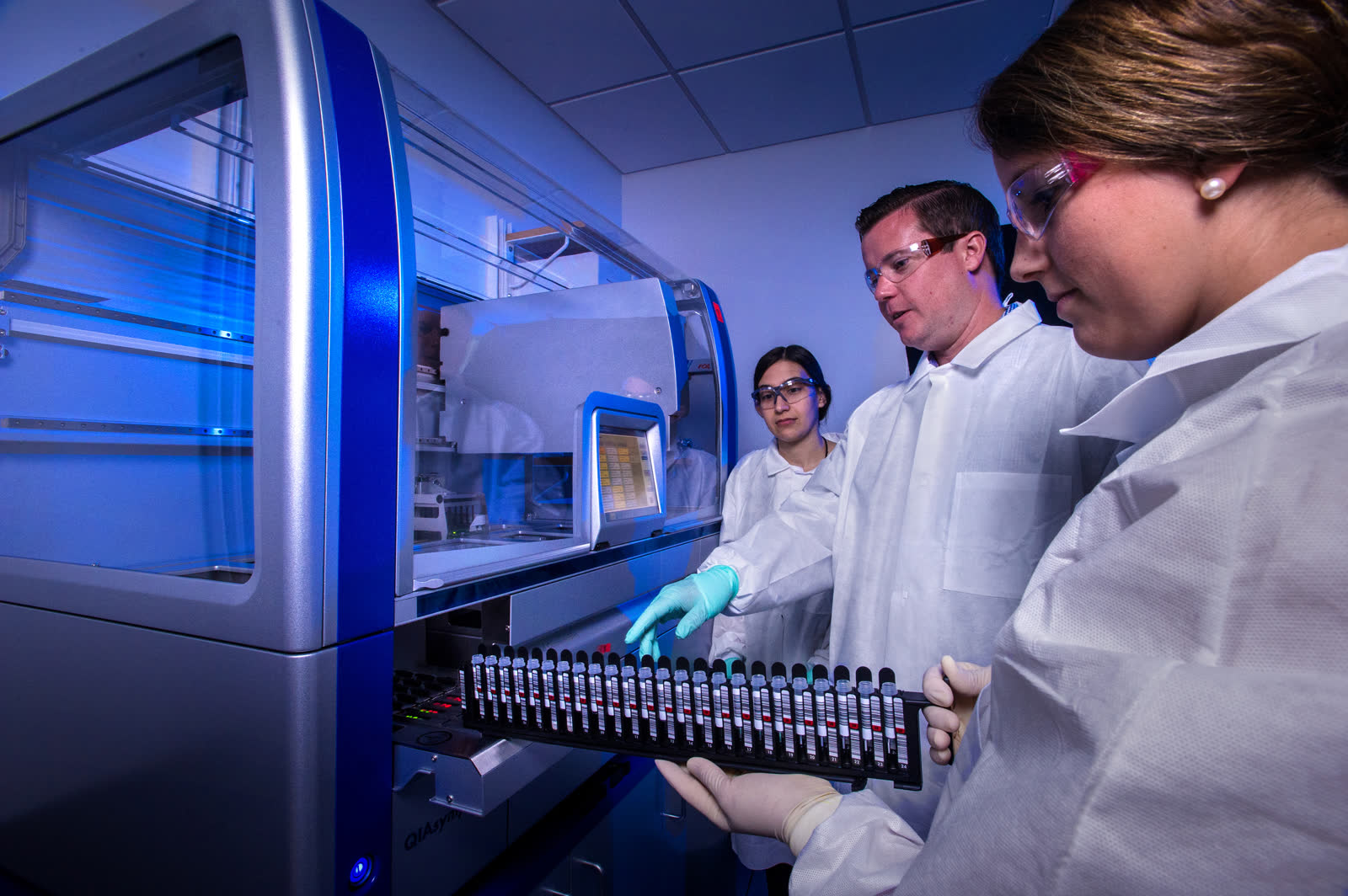
That is why the photograph of laboratory scientists extracting bacterial DNA is more than a generic lab scene. The work in the image sits at the center of the causal chain. Without the specimen, there is no sequence. Without standard methods, no trustworthy comparison. Without the database, no cluster. Without epidemiology, no source. Without regulatory and industry response, no prevention. PulseNet's achievement is the coordination of all those pieces into a system that can see a contaminated food supply through the bacteria it leaves behind.[2][3][5]
Sources
- Centers for Disease Control and Prevention, "About PulseNet" (May 14, 2024) - overview of PulseNet's 1996 establishment, mission, and role in connecting foodborne, waterborne, and One Health-related illness cases.
- Centers for Disease Control and Prevention, "Outbreak Detection" (March 18, 2024) - operational workflow for DNA-fingerprint submission, cluster review, health-department notification, and FDA/USDA-linked source investigation.
- Centers for Disease Control and Prevention, "PulseNet Next Generation Technology" (May 9, 2024) - WGS transition, 82-laboratory network scale, 2013-2019 milestones, and the boundary between genome evidence and epidemiologic investigation.
- Bala Swaminathan, Timothy J. Barrett, Susan B. Hunter, Robert V. Tauxe, and the CDC PulseNet Task Force, "PulseNet: The Molecular Subtyping Network for Foodborne Bacterial Disease Surveillance, United States," Emerging Infectious Diseases 7, no. 3 (2001) - early history, PFGE standardization, database logic, examples, and interpretation limits.
- CDC Public Health Image Library, ID #23120 - real 2019 photograph by James Gathany of Enteric Diseases Laboratory Branch scientists extracting bacterial DNA for WGS, used as the article image.