The RAND Health Insurance Experiment is often remembered as if it delivered one clean verdict on copays. It did not. It delivered something more useful and less comfortable: a controlled look at what happens when the price of starting care changes, and a warning that patients do not reliably sort needed care from waste just because a bill arrives at the door.[1][2]
That distinction matters because the experiment keeps getting pulled into two tidy stories. One story says RAND proved cost sharing works: people used less care, spending fell, and average health did not collapse. The rival story says RAND proved cost sharing is dangerous: poorer and sicker participants gave up care that mattered, and free care improved some outcomes. Both readings are grounded in real evidence. Both become misleading when they pretend to be the whole lesson.[2][4][6]
The stronger historical reading is that RAND made cost sharing visible as a blunt instrument. It can reduce use. It can reduce spending. But it does not, by itself, tell a patient which visit is low value, which medication prevents a future crisis, which symptom can wait, or which chronic condition needs more contact rather than less.[2][5][6]
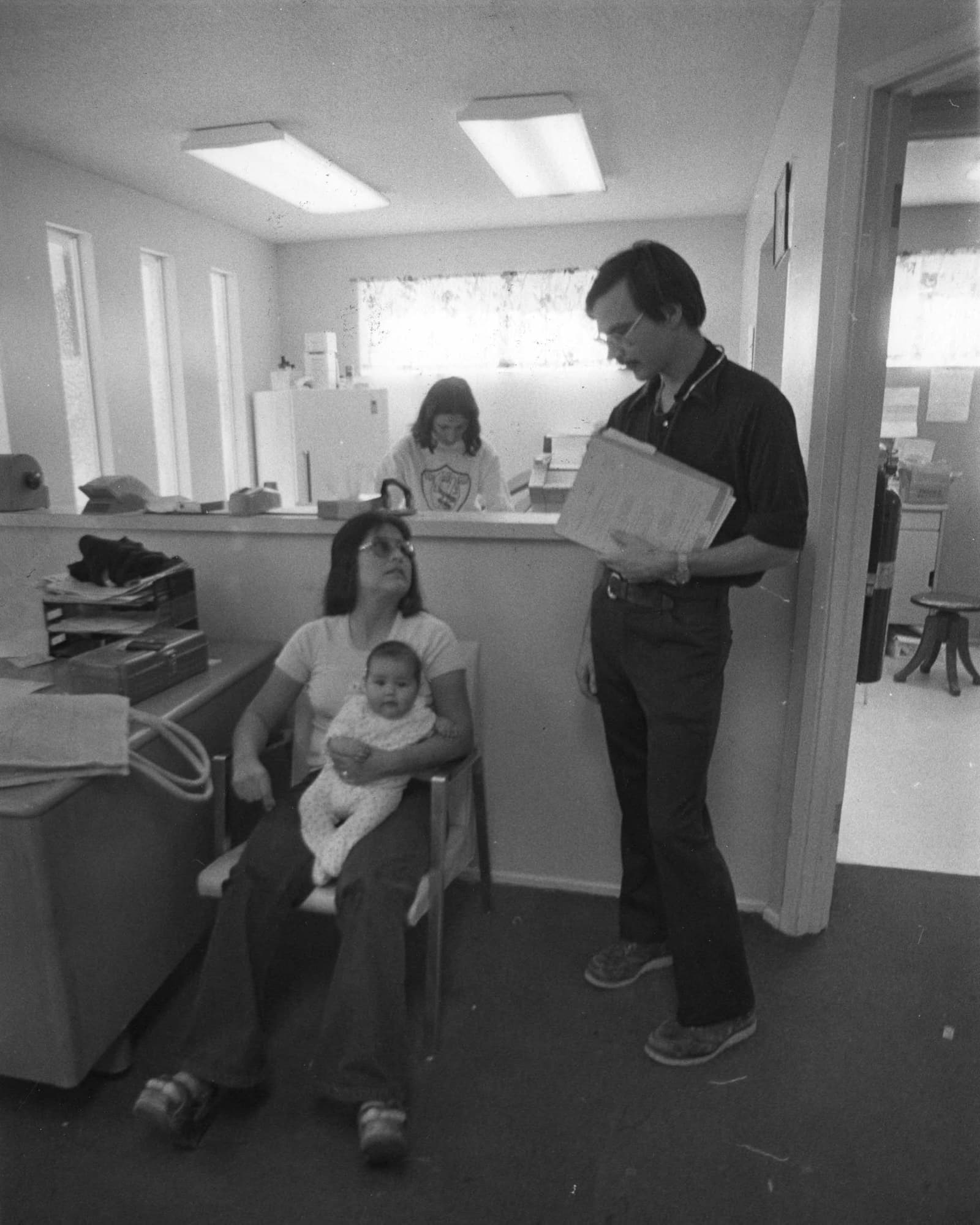
Image context: the Calexico Clinic photograph is not a RAND site image. It is used as a period-appropriate clinical scene from the late 1970s, the same policy era in which the experiment tested how out-of-pocket prices changed care use. The article's argument is about ordinary care thresholds, not about abstract insurance diagrams.[7]
The Experiment Had A Real Price Gradient
RAND's anniversary account places the experiment inside the early 1970s debate over free universal care and whether its benefits would justify the costs. The project recruited 2,750 families from six sites, covering more than 7,700 people under age 65, and assigned them to plan designs created for the study.[1] Other later summaries narrow the analytic sample differently; the 2013 reanalysis describes more than 5,800 individuals from about 2,000 households across six U.S. locations between 1974 and 1981.[5] The difference in counts is a reminder that "the RAND experiment" is not one table. It is a large project with several analytic cuts.
The plan menu was clear enough for the historical argument. Some participants received free fee-for-service care. Others faced 25 percent, 50 percent, or 95 percent coinsurance. A fifth group received free care through a staff-model HMO. For poorer families in the cost-sharing plans, RAND capped fees at 5, 10, or 15 percent of income, or at $1,000 annually, whichever was lower.[1] RAND also served as the insurer, processed claims, and used physical exams and surveys to measure health before and after participation.[1]
The basic demand result was not subtle. The RAND research brief reports that cost-sharing participants made one to two fewer physician visits annually and had 20 percent fewer hospitalizations than those with free care.[2] The 1987 demand paper puts the spending contrast another way: per capita expenses under no out-of-pocket costs were 45 percent higher than under 95 percent coinsurance, subject to the out-of-pocket maximum.[3] The biggest drop in outpatient use came between free care and the 25 percent coinsurance plan, and cost sharing affected the number of medical contacts more than the intensity of care once an episode began.[3]
That last point is the first clue that the experiment was not simply finding "waste." Cost sharing changed the front door. It made people less likely to start care.
Interpretation One: Cost Sharing Cuts Waste Without Much Harm
The pro-cost-sharing reading starts from the average result, and it has evidence behind it. RAND found that people used fewer services when they had to pay more out of pocket. The savings came from fewer services, not from patients somehow bargaining down prices.[2] The research brief also reports that, in general, the reduction in services did not create broad adverse health effects among average participants.[2]
For policymakers worried about rising spending, that was a powerful result. If free care generates more visits and admissions without clearly improving average health, then some degree of patient cost exposure looks like a plausible spending brake. RAND's HMO arm added another layer: participants assigned to the HMO-style cooperative had 39 percent fewer hospital admissions than free-care fee-for-service participants, with comparable spending reductions to higher coinsurance in the fee-for-service system.[2]
This interpretation became influential because it seemed to offer a hard randomized answer to moral hazard. If insurance lowers the price of care at the point of use, people consume more care. The 2013 Journal of Economic Perspectives reanalysis notes that RAND remained the gold-standard evidence for medical-spending responses to insurance design decades later, partly because no one is likely to repeat such a large cost-sharing experiment on the same scale.[5]
The narrow pro-cost-sharing conclusion is therefore legitimate: price matters. Any history of RAND that ignores that result is not reading the experiment honestly.
Interpretation Two: The Price Signal Was Too Crude
The second interpretation starts from what people reduced. RAND did not find that patients selectively gave up only frivolous care. The research brief says cost sharing reduced effective and less-effective services across the board. It also reports that the proportion of inappropriate hospitalizations was the same in cost-sharing and free-plan participants, and inappropriate antibiotic use did not differ either.[2]
That is a serious problem for the simple "consumer discipline" story. A deductible or coinsurance rate is not a clinical triage tool. It gives the patient a price, not a diagnosis. A person with a sore throat, blurry vision, rising blood pressure, or vague chest discomfort may know the visit costs money, but not know whether skipping the visit is harmless, prudent, or dangerous.
The exception pattern makes the point sharper. RAND's research brief says the poorest and sickest 6 percent of the sample had better outcomes under free care for 4 of 30 measured conditions. Free care improved hypertension control, marginally improved vision among the poorest patients, increased the likelihood of needed dental care, and was associated with fewer serious symptoms among poorer people.[2]
The 1985 hypertension report turns that into mechanism rather than anecdote. Among clinically defined hypertensive participants, blood pressure with free care was 1.9 mm Hg lower than with cost-sharing plans. The difference was larger for low-income hypertensive participants than for high-income hypertensive participants: 3.5 versus 1.1 mm Hg. The report attributed the difference to additional physician contact under free care, which led to better detection and treatment of hypertensive patients not already under care at the start.[4]
So the anti-cost-sharing interpretation also has evidence. For people at higher baseline risk, the reduced front-door contact could mean missed detection, weaker follow-up, or poorer control of a condition whose benefit depends on continuity.
The Historical Problem Is Over-Compression
The argument becomes distorted when either interpretation uses RAND as a slogan. "Copays safely reduce waste" overreads the average result and underreads the poorer, sicker tail. "Free care always improves health" overreads the exception pattern and underreads the broad average finding. RAND is more important than either slogan because it shows why insurance design can move spending and still fail as a clinical guidance system.[2][4][5]
The 2013 reanalysis makes a related methodological caution. It revisits the famous estimate that medical spending elasticity with respect to out-of-pocket price is about -0.2 and warns against applying one elasticity too casually to nonlinear insurance contracts.[5] That sounds technical, but it matters historically. A coinsurance rate, a deductible, an income cap, and an out-of-pocket maximum do not all expose patients to the same price at the same moment. A patient early in the year, a patient near the cap, and a patient with chronic medication needs may experience the same nominal plan very differently.
This is why RAND's design details matter. The experiment did not just ask whether people like free things. It created specific plan contracts, capped exposure for poorer families, tracked claims, and measured health. The results belong to that design. Pulling one headline from the experiment and dropping it onto every modern high-deductible plan, drug tier, emergency visit, or chronic-disease copay flattens the evidence.[1][3][5]
Modern Medicine Raises The Stakes
The 2008 AJMC review puts the translation problem in contemporary terms. It accepts the core RAND finding that higher cost sharing reduces spending and that average health consequences in the experiment were minimal or clinically small. But it argues that the modern risk is different because many more conditions now have effective chronic treatments, and cost sharing can reduce use of clinically important services.[6]
That is a crucial update. A 1970s visit for a condition with limited treatment options is not the same decision as a 2020s refill for diabetes, hypertension, HIV prevention, asthma control, anticoagulation, or migraine prevention. Modern medicine has more high-value maintenance care. It also has more low-value or marginal care. A blunt price signal can hit both.
AJMC's proposed answer is value-based insurance design: keep cost sharing low for high-value services, especially for patients likely to benefit, while preserving some discipline where services are lower value or preference-sensitive.[6] That is not a rejection of RAND. It is a more precise reading of it. If RAND showed that patients reduce care when exposed to prices, and also showed that they reduce needed and unneeded care together, then the next design problem is not "more cost sharing" or "no cost sharing." It is better sorting.
What The Debate Settles
The most durable RAND lesson is not ideological. It is mechanical. Cost sharing works first by discouraging initiation of care. That mechanism can reduce spending, but it can also suppress detection, monitoring, and treatment for people whose conditions benefit from contact. The same lever can look efficient in an average table and inequitable in a high-risk subgroup.[2][3][4]
That does not mean every visit should be free at the point of care. It means the burden of proof is on insurance design. If a plan raises out-of-pocket costs, it should be clear which use it expects to discourage, why that use is low value, and how the plan protects care that prevents worse outcomes. A cost-sharing design that treats a trivial visit and a blood-pressure follow-up as morally equivalent is not using RAND carefully. It is borrowing RAND's authority while ignoring RAND's warning.[2][4][6]
The experiment still matters because it refuses easy comfort. Free care increased use. Cost sharing cut spending. Average health effects looked small. Poorer and sicker patients had meaningful exceptions. Needed and less-needed care fell together. Forty years later, those facts still sit in tension. Good health policy starts by keeping the tension visible.
Sources
- RAND, "40 Years of the RAND Health Insurance Experiment" - project overview, enrollment scale, plan designs, fieldwork period, insurer role, health measurement, and impact framing.
- RAND, "The Health Insurance Experiment: A Classic RAND Study Speaks to the Current Health Care Reform Debate" - research brief summarizing utilization, spending, quality, appropriateness, and health-outcome findings.
- Harvard Medical School Department of Health Care Policy, "Health Insurance and the Demand for Medical Care: Results from a Randomized Experiment" - page for the 1987 American Economic Review final demand paper by Manning, Newhouse, Duan, and colleagues.
- Emmett B. Keeler et al., How Free Care Reduced Hypertension of Participants in the RAND Health Insurance Experiment, RAND report R-3326-HHS, 1985 - hypertension subgroup mechanism and blood-pressure differences.
- Aviva Aron-Dine, Liran Einav, and Amy Finkelstein, "The RAND Health Insurance Experiment, Three Decades Later," Journal of Economic Perspectives 27, no. 1 (2013) - reanalysis of sample, treatment effects, and price-elasticity interpretation.
- A. Mark Fendrick, Michael E. Chernew, and Katherine Baicker, "What Does the RAND Health Insurance Experiment Tell Us About the Impact of Patient Cost Sharing on Health Outcomes?" American Journal of Managed Care, 2008 - modern interpretation, chronic-care concerns, and value-based insurance design.
- Walter P. Reuther Library, "(3351) Medical Treatment, Clinics, Calexico, California, 1970s" - Cathy Murphy late-1970s photograph of Dr. Tom Lampert meeting Linda Rodriquez and her daughter Olivia at the Calexico Clinic, used as the article image.