The simplest story about 988 is that the United States made a mental-health crisis number easier to remember. That is true, and too small. Three digits do not de-escalate a crisis by themselves. The mechanism only works when a person can remember the number, the network routes the contact quickly, a trained counselor answers, the conversation lowers immediate risk, and the local system can connect the person to the next layer of help if the crisis does not end with the call.[1][2][3]
That chain is why 988 belongs in health history rather than telecommunications trivia. It converted suicide, mental-health, and substance-use crises into a public routing problem. A crisis that once depended on knowing a ten-digit number, finding a local hotline, or defaulting to 911 was given a national front door. But a front door is not the whole house. The national number is only as strong as the local rooms behind it.[2][3][4][5]
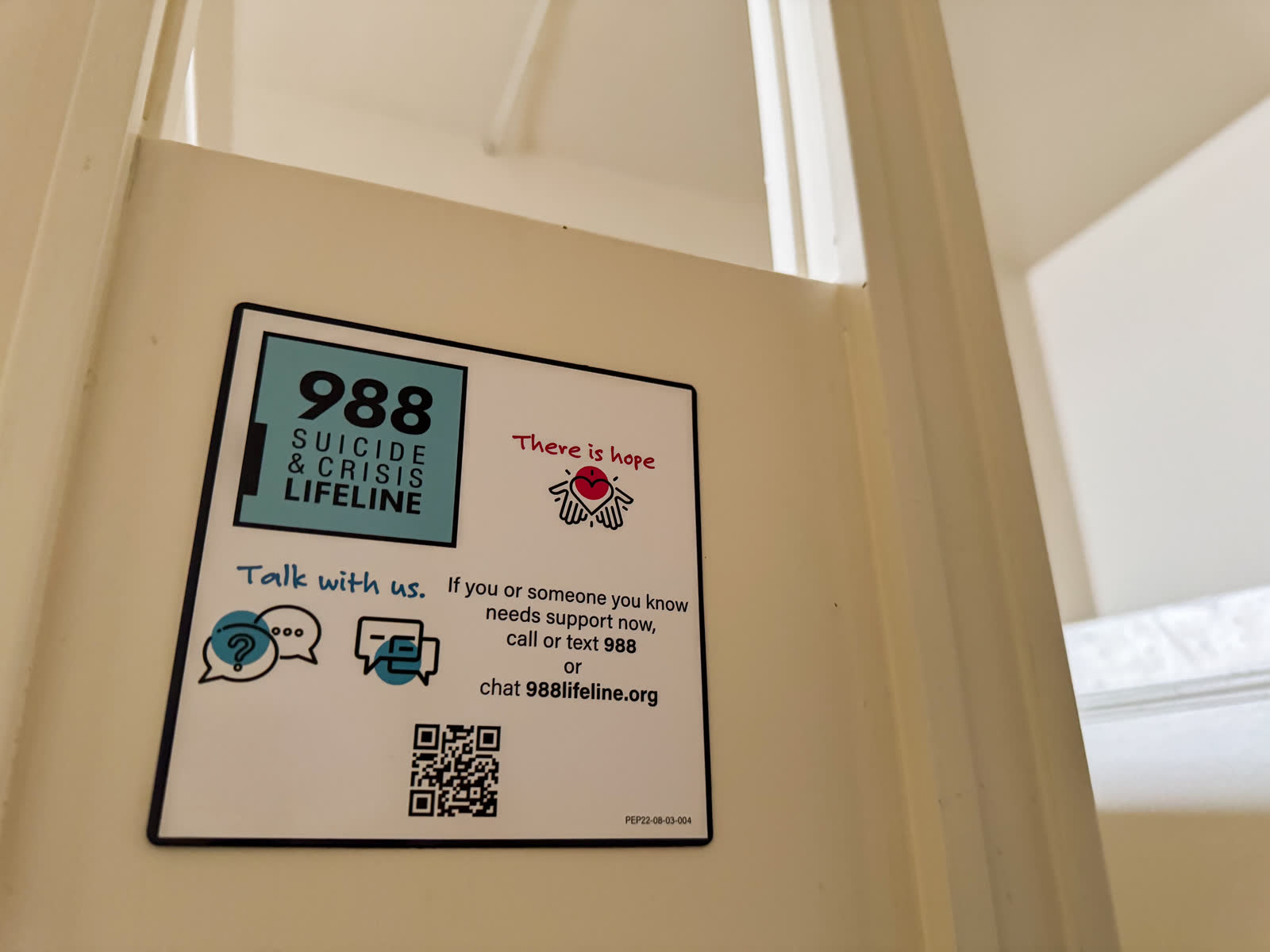
Image context: the posted 988 sign matters because public-health infrastructure often has to become ordinary before it becomes useful. A person in distress, a friend, a school staffer, a clinic receptionist, or a transit worker needs a reachable path in the moment. The sign makes that path visible, but the work begins after contact is made.[2][3][9]
The first mechanism is memory
Before 988, the Lifeline was reached through the longer 1-800-273-TALK number. That was real infrastructure, but it still asked people to retain or discover a ten-digit path during a moment when cognition, privacy, fear, and urgency may all be working against them.[1][3]
The 988 designation attacked that first failure point. The Federal Register final rule adopted by the FCC in 2020 designated 988 as a simple three-digit dialing code for a national suicide-prevention and mental-health crisis hotline, and required covered providers to implement it by July 16, 2022.[1] The same rule shows how operational the change was: covered providers had to route 988 calls to the Lifeline's existing toll-free number, and areas where 988 already functioned as a local prefix had to complete 10-digit dialing so the new three-digit code would work nationally.[1]
That history explains the first causal link. 988 did not invent crisis counseling. It lowered the search cost for reaching it. In public health, that matters. A service that is technically available but hard to recall under stress is not equally available in practice.
The second mechanism is routing
Once a person calls, texts, or chats, 988 has to decide where the contact should go. Public 988 materials describe the basic model: the Lifeline offers 24/7 access to trained crisis counselors for suicidal, mental-health, and substance-use crises, and people can call, text, or chat 988.[2][3] The crisis network is not one room; it is a national entry point connected to more than 200 state and local centers.[2]
That local layer is not administrative trivia. Local routing changes what a counselor can do after listening. A national backup center can answer the crisis and provide support, but a local center is more likely to know nearby mobile crisis teams, clinics, peer supports, emergency departments, warm lines, transportation limits, and follow-up pathways.[3][4][5] Current FAQ material describes georouting for calls so contacts can be routed by approximate location when available, rather than relying only on area code, a practical correction for a mobile country where phone numbers often move with people.[3]
Routing is therefore a clinical mechanism in disguise. It connects the immediate conversation to the surrounding care system. If the call ends with a plan, that plan is stronger when the counselor can name local next steps rather than hand over generic advice.
The third mechanism is capacity
More demand is both a success signal and a stress test. KFF's third-anniversary analysis, using Lifeline data through May 2025, reported 16.5 million contacts since the July 2022 launch: 11.1 million calls, 2.9 million texts, and 2.4 million chats. It also found monthly volume consistently above 500,000 contacts over the prior year, approaching or exceeding 600,000 per month in early 2025.[4]
Those numbers mean awareness and access improved. They also mean the system has to absorb a load that the old network was not built to carry. KFF reported that most states were answering at least 80% of calls in-state by May 2025, up from 23 states just before launch, but the range still ran from 58% to 99%.[4] That spread is the local-capacity problem in one line: the same national number can produce different practical experiences depending on where the call lands.
The workforce evidence points in the same direction. Psychiatric News summarized a 2026 JAMA Network Open survey of 988 center leaders that received responses from 159 centers, or 77% of U.S. centers. It reported that 71% of leaders described their center as understaffed, 89% reported difficulty acquiring financial resources to hire staff, 80% reported recruiting difficulty, and 79% reported retention difficulty.[5]
That is the second correction to the "magic number" story. A good number can increase use faster than staffing, funding, and local crisis services can mature. If the capacity layer is weak, the public-health promise thins out at exactly the moment demand proves the service is needed.
The evidence is encouraging, but it is not a spell
The best evidence supports 988 as a serious intervention, not as a standalone cure for suicide. A 2019 systematic review of crisis-line services found a growing evidence base, including studies of immediate distress reduction and longer-term outcomes, while also emphasizing gaps, study-design limits, and the need for stronger evaluation.[8] That is the right evidence posture: crisis lines can help, but measurement is difficult because calls occur during real crises, not controlled laboratory moments.
The post-launch population signal is stronger than many expected. A 2026 JAMA research letter examined suicide mortality among adolescents and young adults after launch of 988; Science News and Associated Press both covered the study as evidence of an association, not proof of single-cause attribution.[6][7] The AP account described nearly 4,400 fewer deaths among U.S. teens and young adults than projected in the first two and a half years after launch, with deaths among ages 15 to 23 about 11% lower than expected between July 2022 and December 2024.[7]
The caveat matters as much as the result. The AP account notes that the researchers could not say 988 was the sole cause of the decline, and that suicide mortality was down overall.[7] That boundary should not make the finding disappear. It should keep the mechanism honest. 988 can lower friction, answer crises, de-escalate distress, and route people toward care. It cannot repair the entire mental-health system, undo social isolation, create beds, fund clinics, or guarantee follow-up by itself.
The failure mode is a national front door with no hallway
The strongest way to read 988 in 2026 is as a chain of linked weak points. Memory improved when the number became three digits. Telecom access improved when providers implemented routing. Conversation quality depends on trained counselors. Local usefulness depends on in-state answering, georouting, and knowledge of nearby resources. Long-run impact depends on whether communities have mobile crisis teams, stabilization options, outpatient care, peer support, and follow-up pathways that do not vanish after the phone disconnects.[1][2][3][4][5]
That chain also explains why "just call 988" can be both necessary and incomplete. It is necessary because the crisis moment needs a reachable, low-friction door. It is incomplete because the public-health outcome depends on what happens after the door opens. A three-digit number can make help easier to seek; a staffed and locally connected crisis system decides whether help can actually travel.
The real achievement of 988 is not that it made crisis care simple. It made the unfinished work visible. If monthly contacts keep rising, if local answer rates keep improving, if staffing stabilizes, and if callers are connected to real next steps rather than left with a conversation alone, then 988 becomes more than a hotline. It becomes an operating layer in American mental health: memorable at the front, local in the middle, and accountable at the handoff.
Sources
- Federal Register, "Implementation of the National Suicide Hotline Improvement Act of 2018" (FCC final rule, 2020) - 988 designation, covered-provider implementation requirement, and July 16, 2022 deadline.
- National Council for Mental Wellbeing, "988 Key Messages and Points of Contact" - summary of 988 as a 24/7 universal entry point, more than 200 state and local call centers, trained crisis counselors, and the vision for local crisis services.
- Reimagine Crisis, "Frequently Asked Questions about 988" (updated July 15, 2025) - public FAQ on call/text/chat access, language services, local routing, and georouting.
- KFF, "Demand for 988 Continues to Grow at Third Anniversary" - contact volume through May 2025, calls/texts/chats breakdown, in-state answer-rate improvement, and local-capacity variation.
- Psychiatric News Alert, "988 Call Centers Report Staffing, Recruitment Challenges" - accessible summary of the 2026 JAMA Network Open staffing survey, including 159 centers, understaffing, recruitment, retention, and hiring-resource findings.
- Science News, "Suicide deaths in U.S. teens and young adults fell after 988 launch" - accessible science-news summary and citation record for the 2026 JAMA mortality analysis.
- Devi Shastri, "988 hotline's launch is linked to thousands of fewer suicide deaths among teens and young adults," Associated Press (April 22, 2026) - accessible summary of the JAMA findings and stated causality caveats.
- Lee A. Brodsky et al., "The Effectiveness of Crisis Line Services: A Systematic Review," Frontiers in Public Health 7 (2019) - evidence base, outcome categories, and limitations in crisis-line effectiveness research.
- Wikimedia Commons, "File:988 Suicide and Crisis Lifeline Sign at QR Code (53839126281).jpg" - source page for the real photographic 988 sign image used with this article.