Rabies frightens people for a good reason: once clinical disease begins, medicine is usually operating after the decisive window has closed.[2][4][5] That is also why rabies post-exposure prophylaxis works. The treatment is not magic given after the disease is fully underway. It works because, after a bite or scratch, the virus still has distance to travel. Rabies enters through a wound, gains access to peripheral nerves, and only later reaches the central nervous system.[1][2] The time between inoculation and encephalitis is the interval in which washing, passive antibodies, and vaccine-induced immunity can still win the race.
That timing logic is easy to lose when public discussion collapses everything into the phrase "rabies shots." The real protective system has three parts. First comes immediate wound cleaning with soap and water. Then, for people who have not previously been vaccinated, human rabies immune globulin gives immediate antibodies at the start of care. The vaccine series then trains the body to make its own immune response over the following days.[3][4] Each part handles a different clock.
The rabies mechanism matters because the disease burden is still large. WHO says dog bites and scratches account for 99% of human rabies cases, that the incubation period is typically 2-3 months but can range from 1 week to 1 year, and that there are an estimated 59,000 rabies deaths globally each year.[5] Those numbers explain why the public-health lesson has to stay concrete. Rabies is usually preventable after exposure, but only if action happens before symptoms begin.
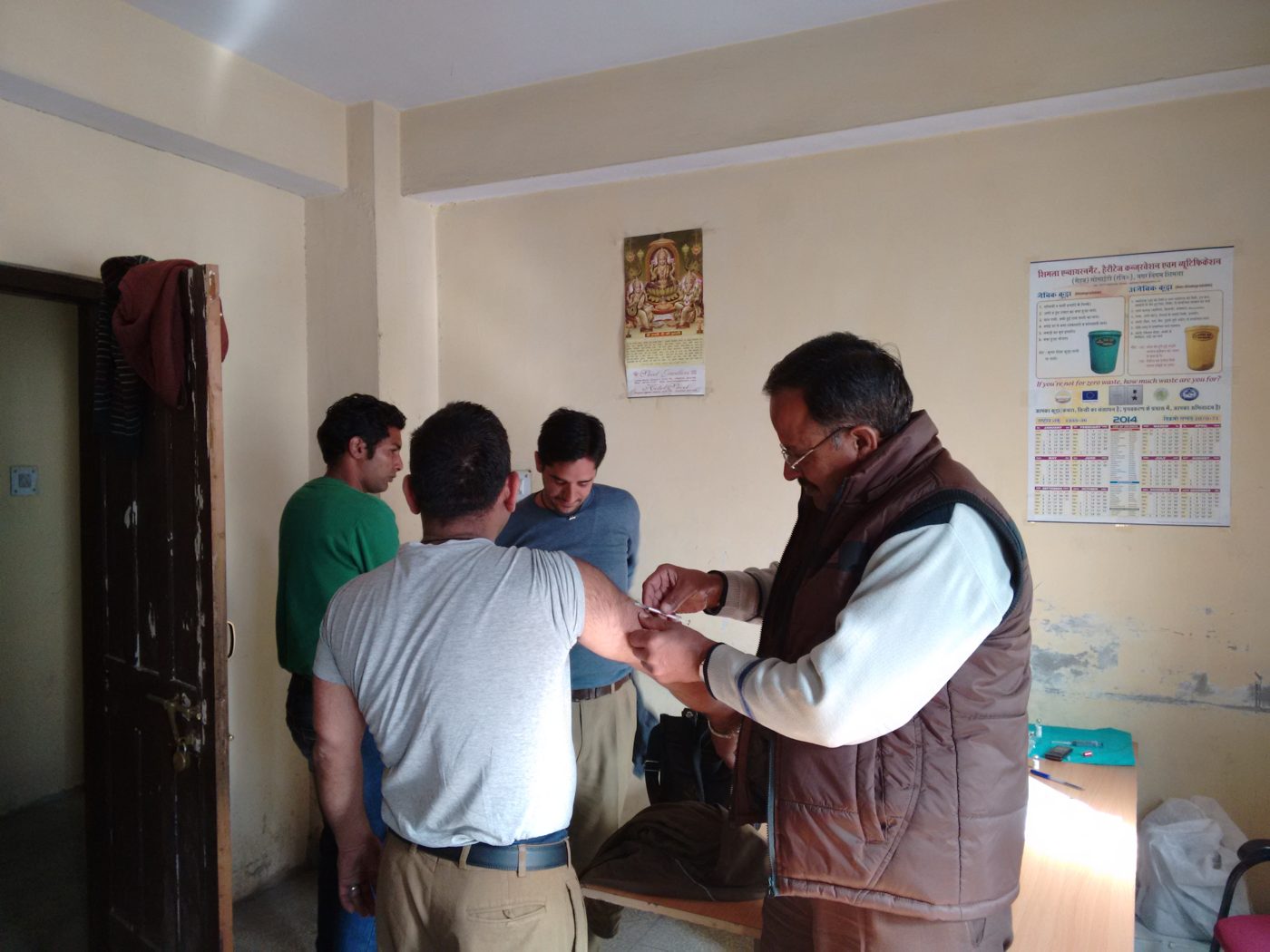
Image context: the cover uses a real photograph of anti-rabies vaccination in India. That choice keeps the article grounded in the ordinary public-health work that prevents death after exposure. Rabies rescue does not begin in an ICU. It begins in clinics, wound-washing stations, vaccine rooms, and the decision to start treatment before certainty feels emotionally complete.[6]
Timeline anchors before the mechanism
- At exposure: saliva from a potentially rabid animal enters through a bite, scratch, or open wound.[1][5]
- Minutes to hours after exposure: CDC says all post-exposure prophylaxis should begin with immediate and thorough cleansing of all wounds with soap and water.[3]
- Day 0: for a person without prior rabies vaccination, CDC recommends HRIG plus the first vaccine dose at the first medical visit.[3]
- Days 3, 7, and 14: additional vaccine doses continue the standard U.S. post-exposure schedule; immunocompromised patients receive a fifth dose on day 28.[3]
- Weeks to months after exposure if untreated: CDC says the virus must travel to the brain before symptoms appear, so incubation may last for weeks to months depending on wound location, exposure severity, age, and vaccine status.[2]
- After symptom onset: CDC's vaccine information statement says rabies vaccine is no longer helpful in preventing rabies once symptoms begin.[4]
The sequence matters more than any single fact. Rabies prophylaxis works because treatment starts before the disease reaches the phase that public memory associates with rabies.
1. Rabies buys medicine a window by moving through nerves, not by exploding immediately in the blood
CDC's Yellow Book describes the key path clearly: rabies virus is neurotropic, gains access to the nervous system through exposed peripheral nerve synapses after inoculation, and travels from the point of entry within peripheral nerves to the central nervous system, where replication then increases exponentially.[1] That route is the reason post-exposure treatment can exist at all.
If rabies caused instant generalized infection at the moment of the bite, preventive treatment after exposure would make little sense. The disease would already be everywhere before the patient reached a sink or a clinic. Rabies usually behaves differently. The virus is introduced locally, then advances toward the brain on a biologic timetable shaped by wound site, inoculum, and host factors.[1][2][5] A bite on the hand or face carries a different practical urgency from a more distal wound because the path to the central nervous system is shorter.[2][5]
This also explains why incubation looks paradoxical in ordinary conversation. People hear that rabies is almost always fatal and assume symptoms should begin immediately. WHO and CDC say otherwise: incubation often lasts weeks or months, and WHO gives a typical range of 2-3 months while noting that the interval can be as short as 1 week or as long as 1 year.[2][5] The disease is deadly, but it is not instantaneous. That gap is the whole operational opportunity.
2. Wound washing, HRIG, and vaccine divide the work across different clocks
CDC's post-exposure guidance makes the treatment sequence explicit. All PEP begins with immediate cleansing of wounds with soap and water; for previously unvaccinated people, care then includes HRIG and a 4-dose vaccine series on days 0, 3, 7, and 14.[3] For immunocompromised patients, the schedule adds a fifth dose on day 28.[3]
Those components are easy to memorize and easier to misunderstand. They are not redundant. Wound washing acts first, at the surface and around the wound, before the virus gets further advantage.[3][5] HRIG handles the earliest immune gap by supplying immediate antibodies. CDC says HRIG is given only once at the beginning of the course and provides immediate antibodies until rabies vaccination provides immunogenicity.[3] The vaccine then takes over the longer job of generating the patient's own active immune response.[3][4]
This layered design is why CDC insists that HRIG should never be given in the same syringe or at the same anatomical site as the first vaccine dose.[3] The system is coordinated, but the tools are different. One is passive antibody already made. The other is a stimulus for the patient to make their own. Public understanding often compresses both into the phrase "get the shots." The medical logic is more exact: clean the wound, buy instant coverage, then build durable protection quickly enough to stay ahead of the virus.
3. The symptom boundary is so sharp because the race changes once the brain is involved
CDC's clinical-features page states the blunt part: rabies is an acute disease that typically causes death within 4 weeks of symptom onset.[2] WHO says that once clinical symptoms appear, rabies is virtually 100% fatal.[5] CDC's vaccine information statement translates the same point into decision language: once symptoms begin, rabies vaccine is no longer helpful in preventing rabies.[4]
That is why rabies prophylaxis is best understood as preemptive rescue rather than treatment of established encephalitis. Before symptoms, the virus is still moving toward the CNS.[1][2] After symptoms, the disease has crossed into a phase in which the target is no longer a local inoculation plus a travel interval. It has become clinical rabies, with encephalitis already present.[2][5]
This is also the reason delay is so dangerous even when the wound looks small. Rabies risk is not graded by dramatic appearance alone. CDC says the decision to use PEP follows a risk assessment, and the combination of HRIG and vaccine is recommended for both bite and non-bite exposures in previously unvaccinated people regardless of the interval between exposure and treatment, so long as the patient is not already showing signs consistent with rabies.[3] The window is wider than panic suggests, yet narrower than complacency allows.
4. What the mechanism changes in practice
The practical lesson is that rabies prevention is a time-window problem, not a symptom-watching problem. Waiting to "see what happens" wastes the very feature that makes post-exposure prevention possible.[2][3][4] Early rabies symptoms are nonspecific, and by the time hydrophobia, agitation, hypersalivation, or encephalitis enter the picture, the disease is already in the wrong phase for vaccine to help.[2][4][5]
That means the highest-value public habits are simple:
- Clean the wound immediately and thoroughly with soap and water.[3][4]
- Get a real exposure assessment fast instead of using the animal's appearance as the only test.[3]
- Start recommended PEP before symptoms begin, understanding that HRIG and vaccine are doing different jobs on different time scales.[3]
Rabies remains one of the clearest examples in medicine of why mechanism matters to public behavior. The disease is almost always fatal once symptoms start, yet often preventable after exposure.[2][4][5] Those two facts are not contradictory. They describe a virus that gives medicine one narrow advantage: it still has to travel. Post-exposure prophylaxis works by using that distance better and faster than the virus can.
Sources
- Centers for Disease Control and Prevention, CDC Yellow Book: Rabies - rabies virus gains access through peripheral nerve synapses and travels from the wound to the central nervous system.
- Centers for Disease Control and Prevention, "Clinical Features of Rabies" - symptom timing, weeks-to-months incubation, and the statement that rabies typically causes death within four weeks of symptom onset.
- Centers for Disease Control and Prevention, "Rabies Post-exposure Prophylaxis Guidance" - wound washing, HRIG, standard vaccine schedule, and the rule that PEP remains indicated before symptoms even if some time has elapsed since exposure.
- Centers for Disease Control and Prevention, "Rabies Vaccine VIS" - public-facing vaccine statement noting that once symptoms begin, rabies vaccine is no longer helpful in preventing rabies.
- World Health Organization, "Rabies" fact sheet - dog-mediated transmission burden, incubation range, post-exposure prophylaxis, and the statement that rabies is virtually 100% fatal once clinical symptoms appear.
- Wikimedia Commons, "File:Anti-Rabies Vaccination - India (17028920346).jpg" - documentary photograph of an anti-rabies vaccination campaign used as the article image source.