HPV vaccination is easy to misread because the disease it prevents arrives so late. A shot is given in early adolescence, often before sexual debut, while cervical cancer usually appears many years later. That distance can make the intervention look indirect. The mechanism is actually tight. HPV vaccine prevents cervical cancer by reducing the chance that oncogenic human papillomavirus infection will become a persistent cervical infection, then a precancerous lesion, and only later an invasive cancer.[1][2]
That sequence matters because the vaccine does not work like chemotherapy, surgery, or even a screening test. It does not shrink a tumor that already exists. It does not clear every established HPV infection. Its power sits earlier in the chain. The goal is to keep the cervix from entering the long-risk state in which persistent high-risk HPV keeps abnormal cells alive long enough to accumulate into cervical intraepithelial neoplasia and then, in a smaller subset of people, invasive cancer.[1][2]
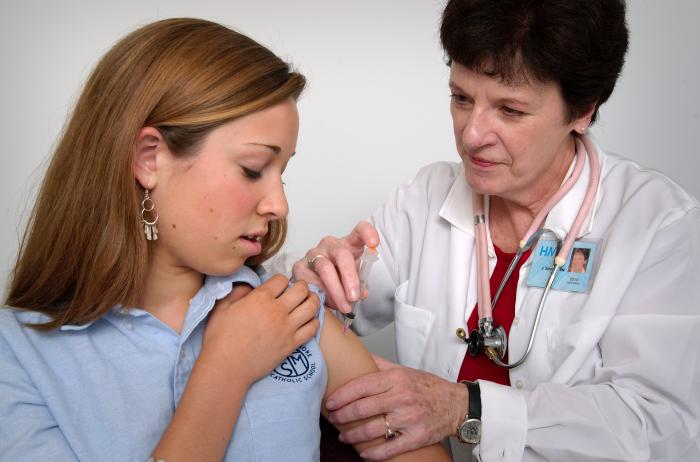
Image context: the cover uses a real CDC clinic photograph of an adolescent receiving a vaccine injection. That choice keeps the article grounded in the public-health setting where HPV cancer prevention actually happens: a routine preventive visit, not an oncology ward.[5]
Timeline anchors before the mechanism
- 2008: England began its national HPV immunisation programme for girls, creating one of the first large birth-cohort tests of whether vaccination would later bend cervical-cancer incidence.[4][6]
- September 30, 2020: a Swedish population study published in The New England Journal of Medicine reported that HPV vaccination was associated with a substantially reduced risk of invasive cervical cancer, with the strongest benefit in girls vaccinated before age 17.[3]
- November 2021: England's first national cervical-cancer incidence analysis reported an estimated 87% reduction in cervical cancer among women offered vaccination at age 12-13 years.[4]
- December 16, 2022: WHO issued its updated HPV vaccine position paper, endorsing reduced-dose schedules without changing the vaccine's basic preventive logic.[2]
- May 15, 2024: an England follow-up study in The BMJ reported that the routine cohort still showed cervical-cancer rates 83.9% lower and CIN3 rates 94.3% lower than the unvaccinated reference cohort across socioeconomic groups.[6]
- December 2, 2025: WHO's updated cervical-cancer fact sheet restated the full prevention chain: vaccination, screening, and treatment are all required because vaccination is powerful but not total.[1]
1. The hinge is persistence, not simple exposure
HPV is common enough that exposure alone is the wrong unit of fear. WHO's 2025 cervical-cancer fact sheet says almost all sexually active people will be infected with HPV at some point, usually without symptoms, and in most cases the immune system clears the virus naturally.[1] That means the question is not whether HPV ever touches the cervix. The harder question is which infections persist, which viral types are oncogenic, and how long the abnormal cellular state is allowed to continue.
WHO describes the progression in a precise order. Almost all cervical cancers are caused by oncogenic HPV infection. Persistent infection with certain carcinogenic types causes abnormal cells, those changes can become precancerous lesions, and, if left untreated, those lesions account for about 95% of cervical cancers.[1] The long dwell time is part of the mechanism, too. WHO estimates that it usually takes 15-20 years for abnormal cells to become cancer, though in women with weakened immune systems, such as untreated HIV, the process can move faster, in about 5-10 years.[1]
Once that timeline is visible, the prevention logic becomes clearer. Cervical cancer is not one event. It is a staged process with a long upstream window. Vaccination matters because it acts before the persistent-infection phase hardens into a lesion that screening later has to catch and treat.[1][2]
2. Vaccination works upstream, which is why age at vaccination matters so much
WHO's fact sheet now states the operational point directly: HPV vaccination is a priority for girls aged 9-14 years, before they become sexually active.[1] The age target is not mainly a moral or cultural preference. It reflects the biology of a prophylactic vaccine. Protection is strongest when immune memory is in place before the relevant viral encounter has occurred. Once someone already carries an established high-risk infection, the vaccine's preventive force against that infection is no longer doing the same kind of work.[1][2]
The position paper adds another layer. As of WHO's December 2022 update, countries can use one-dose or two-dose approaches for most immunocompetent girls and young women, a programmatic change designed to widen access while preserving protection.[2] That matters for delivery, but it does not alter the underlying mechanism. Whether a country uses one dose or two, the public-health bet remains the same: vaccinate early enough, at high enough coverage, and the later pool of persistent oncogenic infection should shrink.[2]
WHO's 2025 fact sheet also helps quantify why the target types matter. It says five WHO-prequalified vaccines are available globally and all protect against HPV 16 and 18, which cause about 76% of cervical cancers.[1] That is enough to explain why vaccination can produce large population effects without being equivalent to total elimination on its own. The vaccines block the most carcinogenic pathways at the front end of the disease process.[1][2]
3. Population evidence looks strongest when vaccination happens before the persistence window opens
The most persuasive real-world evidence follows the mechanism rather than replacing it. In Sweden, the large population-based study summarized by NCI and published in NEJM followed nearly 1.7 million girls and women from 2006 through 2017.[3] Cervical cancer was diagnosed in 19 women who had received quadrivalent HPV vaccination and 538 women who had not.[3] The study's most striking result was timing: girls vaccinated before age 17 had a nearly 90% reduction in cervical cancer incidence, a far stronger effect than vaccination after that age.[3]
That age gradient is exactly what the mechanism would predict. Earlier vaccination means more people are protected before the cervix ever enters the long interval of persistent oncogenic infection. Later vaccination can still help, but it is operating after a larger share of the cohort has already had a chance to encounter HPV.[1][3]
England's national programme shows the same pattern from the birth-cohort side. The 2021 Lancet analysis reported that women offered vaccination at age 12-13 had cervical-cancer incidence reduced by about 87%, with particularly low crude incidence rates in the routinely vaccinated cohorts.[4] The later 2024 BMJ follow-up found that the routine school-age cohort still had cervical-cancer rates 83.9% lower and CIN3 rates 94.3% lower than the unvaccinated reference cohort, while also showing substantial benefit across socioeconomic deprivation groups.[6]
These are not abstract vaccine-efficacy percentages floating free of anatomy. They are what it looks like when a national programme blocks enough high-risk persistent infection that fewer young women ever arrive at CIN3, and still fewer move onward to invasive cancer.[4][6]
4. Screening still matters because vaccination changes risk; it does not erase every pathway
One common overcorrection is to turn strong vaccine evidence into a claim of complete replacement. WHO's current guidance does not do that. The same fact sheet that calls HPV vaccination highly effective also says women should still be screened for cervical cancer regularly, even if they have been vaccinated.[1] That continued screening requirement is not bureaucratic inertia. It follows from the boundaries of the mechanism.
First, vaccination does not clear established infection.[1][2] Second, although current vaccines cover the most important oncogenic types, they do not collapse every possible cancer pathway into zero risk.[1] Third, program coverage is never perfect; missed doses, late vaccination, and uneven uptake leave cohorts with mixed protection.[2][6] Fourth, immunocompromised patients, especially women living with HIV, face faster progression and higher baseline risk, which means screening and treatment remain essential even in a vaccinated era.[1]
Seen this way, vaccination and screening are not rival strategies. They sit at different points in the same timeline. Vaccination reduces the number of people who ever enter the high-risk persistence pathway. Screening catches those who still do enter it, before invasive disease develops.[1][2]
5. The practical lesson is that HPV vaccination is a long-latency cancer intervention
HPV vaccination can seem less dramatic than oncology because its success is made of absences. No lesion appears. No excision is needed. No cancer diagnosis arrives in a woman's twenties or thirties. Public health sometimes struggles to make those negative outcomes feel real, because the event prevented is invisible.[1][3]
The evidence from Sweden and England helps recover that reality. Vaccination given early in life is followed years later by large declines in cervical precancer and then invasive cervical cancer.[3][4][6] The delay between the injection and the benefit is not a weakness in the argument. It is part of the disease biology. A virus that usually needs years of persistence to generate cancer is exactly the kind of target where early vaccination can create unusually deep downstream effects.[1][2]
That is why the strongest reading of HPV vaccination is simple and structural. It prevents cervical cancer by keeping many cervixes from ever entering the persistent high-risk HPV state that makes precancer and cancer possible. The shot is small, the interval is long, and the outcome is large.[1][2][3][4]
Sources
- World Health Organization, "Cervical cancer" (2 December 2025) - causes, persistence timeline, vaccination age targets, screening boundary, and 90-70-90 elimination framework.
- World Health Organization, Human papillomavirus vaccines: WHO position paper, December 2022 - updated vaccine recommendations, program logic, and elimination framing.
- Jiayao Lei et al., "HPV Vaccination and the Risk of Invasive Cervical Cancer" (New England Journal of Medicine, 2020) - PubMed record for the Swedish population study linking vaccination, age at vaccination, and invasive cervical-cancer risk.
- Milena Falcaro et al., "The effects of the national HPV vaccination programme in England, UK, on cervical cancer and grade 3 cervical intraepithelial neoplasia incidence: a register-based observational study" (The Lancet, 2021) - abstract page for the first national English cervical-cancer incidence analysis after bivalent HPV vaccination.
- Wikimedia Commons, "File: Vaccination of girl.jpg" - CDC Public Health Image Library source page for the vaccination photograph used in this article.
- Milena Falcaro et al., "Effect of the HPV vaccination programme on incidence of cervical cancer and grade 3 cervical intraepithelial neoplasia by socioeconomic deprivation in England: population based observational study" (The BMJ, 2024) - follow-up analysis with 12 additional months of English registry data across deprivation groups.