Carbon monoxide alarms belong to a class of health devices that look almost boring until one remembers what problem they were built to solve. Carbon monoxide does not announce itself with the ordinary signals people trust. It has no reliable warning smell, it can build in enclosed space while people sleep, and the first symptoms often feel generic enough to be mistaken for fatigue, a virus, or the aftermath of bad air in a closed room.[3][4][5] By the time a household is trying to interpret those symptoms, the toxic process is already underway.
That is why the alarm matters. It does not merely "detect a gas." It replaces late human interpretation with earlier machine interpretation. NIST's plain-language explanation gets to the engineering core: residential alarms measure carbon monoxide concentration in parts per million and are designed to sound when enough of the gas is present for long enough to create danger, with exposure to 70 ppm over a few hours or concentrations above 400 ppm over a few minutes both reaching the warning threshold.[1] The device is therefore translating dose over time into a household command: wake up, move, ventilate, leave.
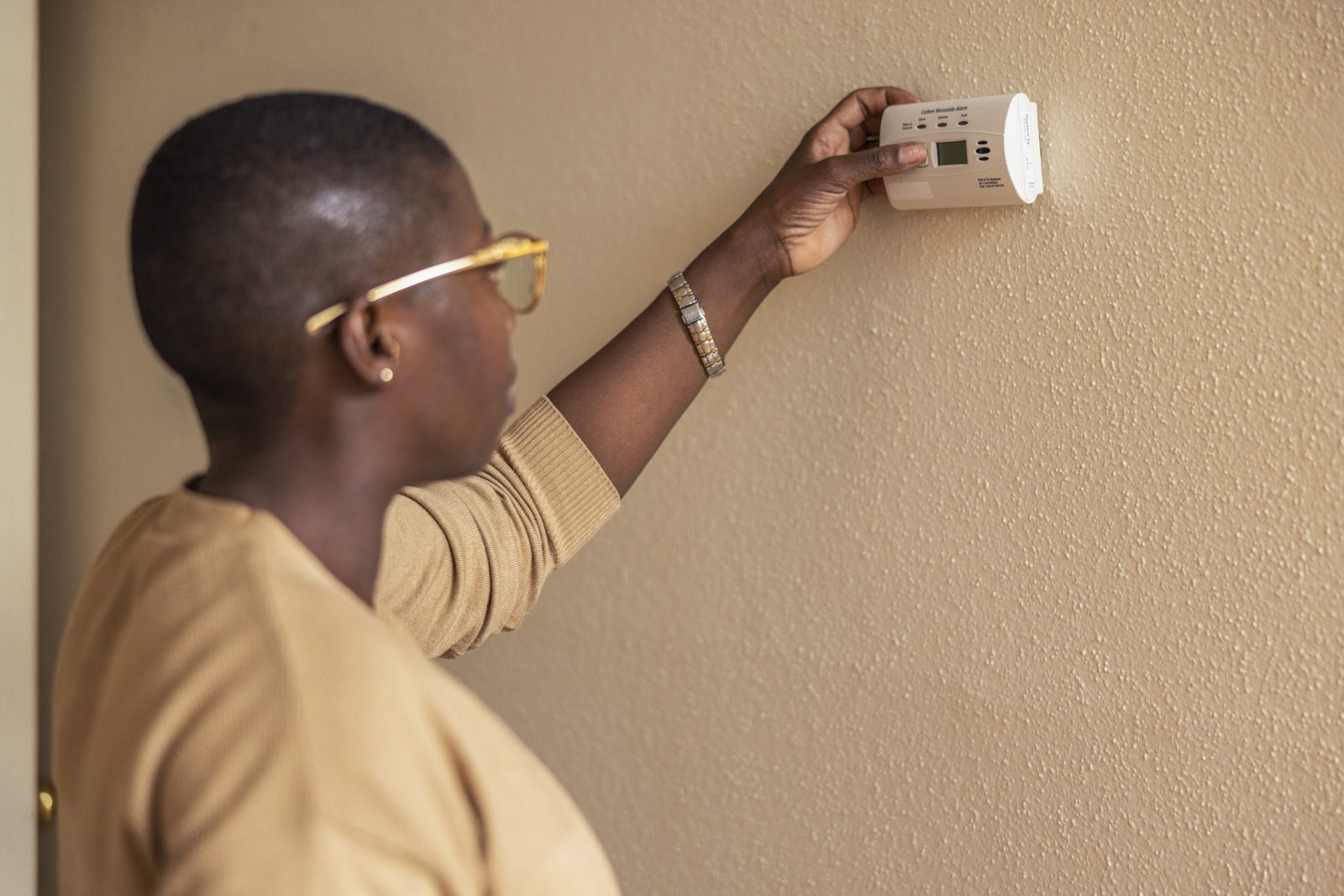
Image context: the cover photograph shows a person testing a wall-mounted carbon monoxide alarm in a domestic setting. It belongs here because the public-health value of the device does not live in abstract sensor chemistry alone. It lives in placement, maintenance, reachability, and the repeated household habit of checking that the warning system still works before an emergency arrives.[6]
Why carbon monoxide defeats ordinary intuition
Carbon monoxide is hard on households precisely because it is easy on the senses. ATSDR describes exposure in practical terms: carbon monoxide enters the body rapidly through inhalation, reaches the blood, brain, heart, and muscles, and then leaves only gradually through the lungs, with elimination taking about a full day.[4] CPSC's consumer safety page uses the more familiar public warning language, calling it an "Invisible Killer" because it is colorless, odorless, and poisonous.[3] Those two descriptions belong together. One explains why the gas is so easy to miss; the other explains why missing it matters.
The source pattern is also ordinary enough to create false confidence. ATSDR lists gas appliances, wood-burning stoves, fireplaces, generators, vehicles, and gasoline-powered tools among common exposure routes.[4] CPSC sharpens the generator case because it combines familiarity with extraordinary output. Its current safety center says one portable generator can produce the same amount of carbon monoxide as hundreds of cars, that more than 200 people in the United States die each year from accidental non-fire carbon monoxide poisoning associated with consumer products, and that more than 100 of those deaths are linked to portable generators.[3] The danger is therefore not exotic chemistry. It is routine combustion in the wrong place.
This is also why disasters magnify the hazard. CDC's 2024 storm-safety guidance warns that generators, grills, and other fuel-burning devices should never be used inside the home, garage, or carport or near openings, and repeats the now-standard siting rule of at least 20 feet from doors, windows, and vents.[2] The rule sounds simple because the problem has to be made simple. In real life, storms, cold weather, darkness, and improvised power plans all push households toward bad placement decisions. Carbon monoxide alarms are part of the counter-design. They assume people will not always recognize risk correctly in the moment.
Why the alarm listens for dose over time
The most useful correction is that a carbon monoxide alarm is not a purity monitor. It is a danger-timing device. NIST explains that residential units are calibrated to respond to concentration and duration, so that the sensor distinguishes between trace presence and an exposure pattern likely to become injurious.[1] EPA's consumer guidance points households toward alarms certified to the current UL 2034 standard and treats installation near sleeping areas as a core safety requirement rather than an optional gadget choice.[7] Taken together, those sources reveal the design philosophy: the home unit is meant to warn before serious poisoning, while avoiding constant nuisance alarms from insignificant or transient conditions.
That design makes engineering sense because poisoning itself is cumulative. A brief low reading is not the same event as a persistent medium reading, and neither has the same urgency as a short burst at high concentration. NIST's explanation of alarm thresholds makes this logic visible: 70 ppm over hours and 400 ppm over minutes can both cross into the action zone because the body experiences carbon monoxide as an accumulating burden, not as a simple on-off switch.[1][4] An alarm that shrieked at every trace would be ignored. An alarm that waited for unmistakable human symptoms would arrive too late. The residential device sits between those failures.
The sensing hardware reflects that translation problem. NIST notes that the most common residential units use electrochemical sensors: carbon monoxide enters a gas-permeable compartment, reacts within an electrolyte system, and alters electrical current in proportion to concentration.[1] That sounds technical, but the public-health meaning is simple. The device is carrying out a chemistry reading no human body can do consciously. It is watching the air so the family does not have to trust noses, headaches, or guesswork.
Why this is a health-system problem in miniature
Carbon monoxide poisoning looks like a household accident, but the burden data show a patterned public-health problem. CDC's 2023 surveillance report found annual rates of 39.5 poison-center exposure calls per million people nationwide, 56.5 emergency department visits per million across 17 states, 7.3 hospitalizations per million in 26 states, and 3.3 deaths per million nationally from unintentional carbon monoxide poisoning during 2005-2018.[5] Non-fire incidents were most often reported in winter, especially in January and December.[5] That seasonal shape is another reason alarms matter: the hazard clusters in the same months when people close houses tightly, lose power, improvise heating, and sleep through the first stage of exposure.
The symptom profile makes interpretation even worse. CDC's surveillance summary lists headache, nausea, and dizziness or vertigo as the most commonly reported signs.[5] CPSC's public page adds weakness, vomiting, sleepiness, and confusion.[3] None of those symptoms is specific enough to serve as a reliable early household detector. They are bodily clues that arrive after exposure has started and often in circumstances that encourage misreading. A winter headache in a stuffy room does not present itself as toxicology.
The age pattern in the CDC data also matters. Children aged 0 to 9 years had the highest reported poison-center and emergency-department rates, while adults older than 80 had the highest hospitalization and death rates.[5] A child cannot be expected to interpret malaise correctly, and an older adult may deteriorate faster under the same burden. The alarm therefore acts as a shared warning layer for people with very different risk profiles and very different capacities to notice danger in time.
Placement is part of the mechanism
Because the device exists to beat delayed interpretation, placement is not secondary. EPA says alarms should be installed in the hallway near every separate sleeping area.[7] CPSC recommends battery-operated or battery-backup alarms on every level of the home and outside sleeping areas, with interconnected alarms preferred so that when one sounds, all sound.[3] Those are not generic code phrases. They follow directly from the exposure pattern the device is trying to interrupt. Carbon monoxide emergencies often unfold when people are asleep, separated by walls, or far from the appliance that is producing the gas.
The same logic explains why alarms are not a substitute for maintenance. EPA repeats CPSC's advice that fuel-burning appliances should be professionally inspected for leaks.[7] ATSDR similarly points to proper installation, venting, and periodic maintenance of stoves, furnaces, heaters, fireplaces, and generators.[4] The alarm is the warning layer, not the whole prevention system. Its role is to catch failure early enough that escape and treatment remain possible.
That boundary matters because a detector can be misunderstood in two opposite ways. One mistake gives it too little credit, treating it as another optional household gadget. The other gives it too much, treating the presence of the device as proof that the combustion setup is safe. The better reading is narrower. A carbon monoxide alarm is an early-warning tool designed for a poison that hides well and accumulates before people can interpret it accurately. That is already a major public-health achievement.
What the alarm really does
The strongest way to remember a carbon monoxide alarm is that it buys interpretive time. Carbon monoxide enters fast, leaves slowly, and blurs itself into symptoms too ordinary to trust.[3][4][5] The alarm interrupts that lag by converting invisible chemistry into a loud, actionable message while escape is still possible.[1][3][7]
That is why the device belongs in the same mental category as other quiet health infrastructures. It works best before anyone has to admire it. Mounted outside bedrooms, placed on each level, maintained along with the appliances around it, it turns a hidden combustion failure into a warning with enough lead time to matter. In a hazard defined by delayed recognition, that lead time is the whole point.[2][3][7]
Sources
- National Institute of Standards and Technology, "How Do Carbon Monoxide Detectors Work?" - NIST explainer on residential alarm thresholds, electrochemical sensors, and the concentration-over-time logic behind warning timing.
- Centers for Disease Control and Prevention, "Avoiding Carbon Monoxide Poisoning" (Feb. 8, 2024) - CDC disaster guidance on generator placement, the 20-foot rule, and the broader annual death warning.
- U.S. Consumer Product Safety Commission, "Carbon Monoxide Information Center" - current consumer-product mortality figures, generator risk, symptom list, and alarm-placement guidance.
- Agency for Toxic Substances and Disease Registry, "Carbon Monoxide | Public Health Statement" - toxicology overview on exposure routes, body distribution, delayed elimination, and prevention basics.
- Shin M, Bronstein AC, Glidden E, et al., "Morbidity and Mortality of Unintentional Carbon Monoxide Poisoning: United States 2005 to 2018" (Annals of Emergency Medicine, 2023; CDC Stacks) - surveillance summary covering exposure calls, ED visits, hospitalizations, deaths, seasonality, symptoms, and age patterns.
- Wikimedia Commons, "File:Carbon Monoxide Safety - Person with a disability testing their carbon monoxide alarm.jpg" - source page for the documentary CPSC photograph used as the article image.
- U.S. Environmental Protection Agency, "What about carbon monoxide detectors?" - EPA guidance on UL 2034-certified alarms and placement near separate sleeping areas.