
CDC's demonstration of donning and doffing personal protective equipment is worth watching because it makes the least glamorous part of infection control visible: protection is not achieved when a gown, gloves, respirator, and face shield are merely present. Protection is achieved when the equipment is selected for the hazard, put on in a workable order, used without breaking the barrier, removed without dragging contamination back across the body, and paired with hand hygiene at the right moments.[1][2]
That distinction matters because PPE can look reassuring in a still photograph while remaining fragile in motion. A covered torso, gloved hands, and shielded face are not a magic perimeter. They are temporary barriers that have edges, ties, cuffs, straps, contaminated outer surfaces, and awkward removal steps. CDC's transmission-based precautions page places PPE inside a broader infection-control structure, alongside patient placement, respiratory hygiene, environmental cleaning, and the choice of contact, droplet, or airborne precautions according to the suspected route of spread.[2] The video is therefore best read as a small systems lesson, not as a wardrobe tutorial.
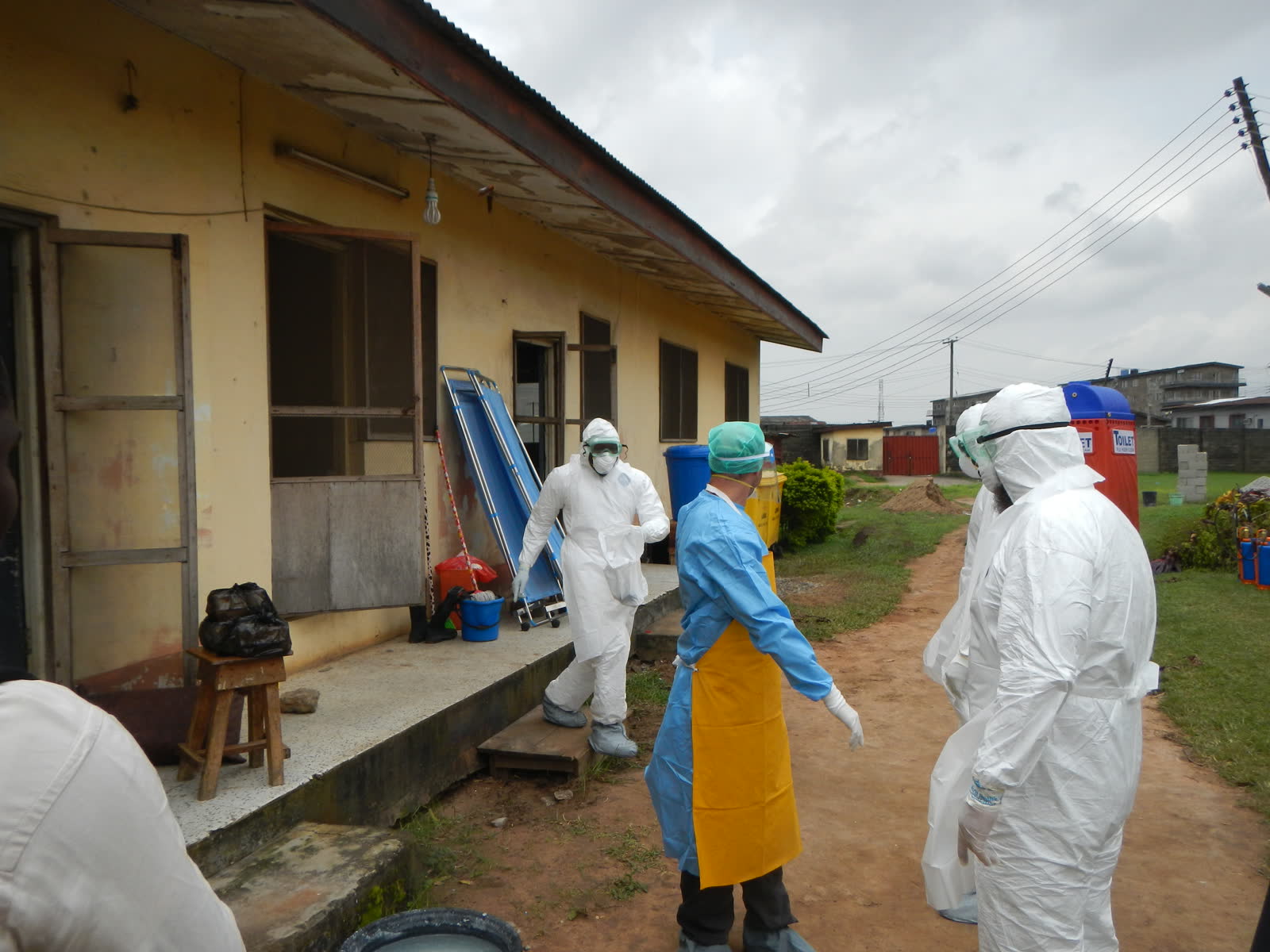
Image context: the cover photograph shows WHO workers gearing up before entering an Ebola isolation ward in Lagos, Nigeria.[6] It is a real photograph, not a diagram, chart, or generated visual. The image belongs here because high-consequence infection control depends on practiced sequence, buddy checks, and awareness of the hot-zone boundary before anyone touches a patient.
The video treats PPE as a sequence
The first annotation is simple: order is part of the intervention. In a clinic, emergency department, ward room, or training lab, PPE is often discussed by category: gloves, gown, respirator, eye protection. The video changes the frame from inventory to choreography.[1] Donning has to create coverage without trapping mistakes underneath. Doffing has to remove the dirtiest surfaces without using those surfaces as handles.
This is why the CDC guidance for viral hemorrhagic fevers is so explicit about demonstrated competency, repeated practice, and observation. For high-risk care, CDC says healthcare workers should be required to demonstrate competency in donning and doffing while being observed by a trained observer before working with affected patients.[3] That is not bureaucratic ornament. It is an admission that PPE performance depends on human factors: fatigue, heat, anxiety, fogged eye protection, unfamiliar fasteners, tight rooms, and the instinct to hurry when the patient-facing task is finished.
The video's value is that it slows down the ordinary transitions. The viewer sees that the end of patient care is not the end of risk. A contaminated glove can touch a gown tie. A face shield can tempt someone to reach toward the front. A respirator strap can become a path for hand-to-face contamination if the worker rushes or forgets what is clean enough to handle. Written policy can name those risks, but video makes the body mechanics harder to ignore.[1][3]
Doffing is a contamination-control problem
The strongest written context to add after the embed is that PPE removal is not just cleanup. It is exposure prevention. The Cochrane review on PPE for highly infectious diseases describes the underlying uncertainty clearly: PPE can reduce exposure by covering body parts, but the best types of PPE, the safest donning and doffing methods, and the most effective training methods are not all settled with high-certainty evidence.[5] That uncertainty should make institutions more disciplined, not less. If the evidence base is imperfect and the task is physically error-prone, then practice, standardization, and observation become part of the control.
WHO's PPE overview makes the same point from another direction. PPE protects health workers from biological agents, but it sits inside infection prevention and control, including hand hygiene, waste management, and context-specific recommendations.[4] That boundary prevents a common mistake: treating PPE as the whole safety plan. A respirator does not replace ventilation decisions. Gloves do not replace hand hygiene. A gown does not fix a poorly planned doffing area. A face shield does not make every room equally safe.
In the CDC video, hand hygiene functions like punctuation. It separates phases and repairs the risk created when surfaces have just been touched.[1] That matters because a person leaving a contaminated care space is not simply "taking equipment off." They are moving from a potentially contaminated outer shell back to skin, scrubs, hallway, phone, keyboard, charting station, and eventually home. The safer interpretation of doffing is therefore not "remove everything." It is "remove the barrier without importing its outside surface into the next zone."
The observer is not a luxury role
One reason PPE training can feel repetitive is that the steps are easy to recite and hard to execute perfectly under pressure. CDC's high-consequence guidance treats the trained observer as a control layer because the person wearing PPE has a narrowed view, reduced tactile feedback, and competing attention.[3] The observer can catch a strap, a missed hygiene step, an unsafe hand position, or a sequence drift before it becomes self-contamination.
This is also a useful way to read the video for lower-drama settings. The article is not saying every routine precaution requires Ebola-level staffing. It is saying the logic scales. The more dangerous the pathogen, the more complex the PPE, and the more fatigued the worker, the less realistic it is to rely on memory alone. A checklist, mirror, marked clean and dirty areas, trained observer, or deliberate partner check all serve the same purpose: they externalize attention when attention is likely to fail.
The written evidence also keeps the message humble. Cochrane's review found that training may improve compliance with PPE guidance, but much of the evidence around PPE type and doffing methods has low or very low certainty.[5] That does not mean sequence is optional. It means healthcare systems should avoid theatrical confidence. They should test whether staff can perform the exact protocol with the exact products stocked locally, in the exact spaces where removal will happen.
What the clip cannot replace
The CDC clip is educational, not a substitute for a facility's current protocol, occupational health requirements, fit testing, or pathogen-specific guidance.[1][2][3] That boundary is important. PPE choice changes with transmission route, task, splash risk, aerosol-generating procedures, room ventilation, patient stability, and local supply. The video gives a visual grammar. It does not answer every clinical or occupational-safety scenario.
Its lasting lesson is narrower and stronger: PPE is a temporary system for controlling contamination across a moving human body. The system works only when equipment, sequence, hand hygiene, room layout, training, and observation line up.[1][2][3][4] A reader who never watches the video should still take away the central claim. The danger point is not only the moment a clinician approaches an infectious patient. It is also the quiet minute afterward, when the task feels over, the gloves are dirty, the worker is tired, and the protective shell has to come off without bringing the outside with it.
Sources
- Centers for Disease Control and Prevention, "Demonstration of Donning (Putting On) Personal Protective Equipment (PPE)," YouTube video.
- Centers for Disease Control and Prevention, "Transmission-Based Precautions" - CDC infection-control basics covering PPE within contact, droplet, and airborne precautions.
- Centers for Disease Control and Prevention, "PPE: Confirmed Patients and Clinically Unstable Patients Suspected to Have Viral Hemorrhagic Fevers" - guidance on training, competency, and trained observers for donning and doffing.
- World Health Organization, "Personal protective equipment (PPE)" - overview of PPE as part of infection prevention and control for health workers.
- Verbeek JH, Rajamaki B, Ijaz S, et al., "Personal protective equipment for preventing highly infectious diseases due to exposure to contaminated body fluids in healthcare staff," Cochrane Database of Systematic Reviews, 2020, full text via PubMed Central.
- Wikimedia Commons, "File:WHO in PPE.jpg" - Bryan Christensen / CDC Global Health photograph of WHO workers gearing up at an Ebola isolation ward in Lagos, Nigeria, used as the article image.