All 86 feet had been corrected. A reader could stop at that sentence in Matthew Dobbs and colleagues’ January 2004 paper and come away with a perfect score for the Ponseti method of treating clubfoot. Read a few lines further and 16 children are on their way back into plaster. Both observations belong to the same study. What happened between them was supposed to take place largely at home, where the researchers had the least opportunity to see it.[1]
A baby born with clubfoot has a foot that turns inward and points down. In the Ponseti method, a clinician guides the foot a little further toward its corrected position with each change of cast. Many babies also need a small procedure to release a tight Achilles tendon. When the last cast comes off, the family takes home two shoes joined by a bar. The brace holds the feet turned outward while the child grows. For a parent looking at a foot that finally sits straight, the purpose of this next piece of equipment can be harder to see than the work the casts have already done.[1][2]
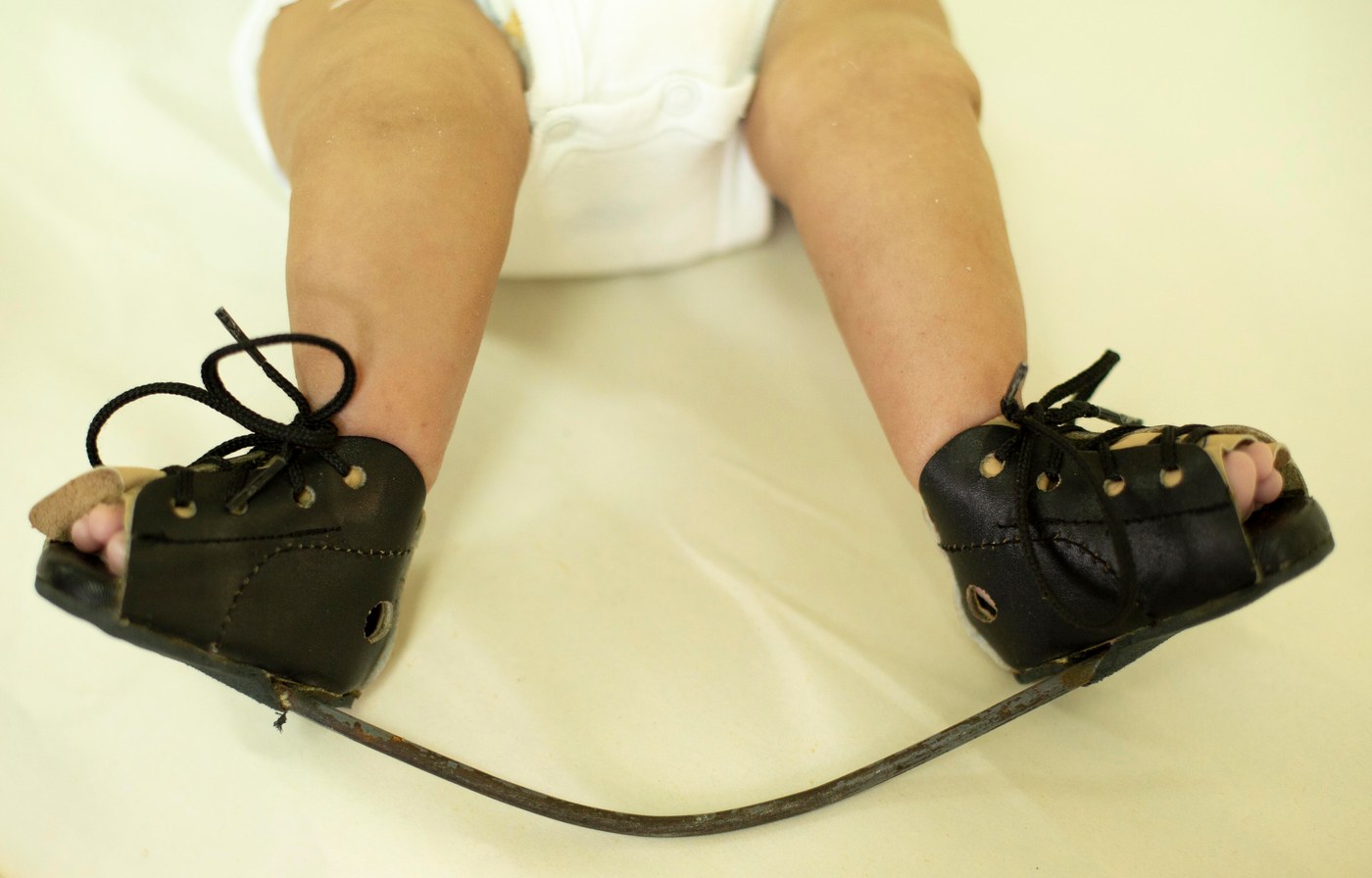
The zero in the table
The St. Louis investigators looked back through the cases of 51 infants. Some had two affected feet, which accounts for the 86 in the opening result. For the question about wearing the brace, the useful unit was a child. One family took home one bedtime routine, however many feet had needed casting.[1]
Table I can be read across in two lines. Of the 21 children whose families reported stopping the brace, 16 had a relapse and five maintained the correction during follow-up. Of the 30 whose families reported following the regimen, zero had a recorded relapse. The clinicians checked for a heel turning inward again or an ankle losing its ability to bend upward. They followed the children for at least two years.[1]
That zero accounts for an arresting figure in the abstract. The authors reported an odds ratio of 183 for recurrence. A footnote explains that they used a statistical correction for the empty cell. Without such an adjustment, dividing one group’s odds by the other’s would mean dividing by zero. The estimated ratio had a 95% confidence interval stretching from about 9.5 to 3,519. The counts show why the team took stopping seriously. They also show how little precision a sample of this size could give the multiplier.[1] A second team, reporting in March 2007, also saw more recurrences among children who wore the brace inconsistently. This time 14% of the group classified as following the regimen had a recurrence too. That makes the St. Louis zero easier to interpret as an observation about those 30 children.[4]
What a night at home leaves out of the record
The families counted as having stopped reported giving up the brace altogether. All but one stopped during the first three months, when the prescription called for 23 hours of wear a day. A parent who missed an occasional night could look in vain here for an estimate of what that lapse meant. The study recorded a much bigger interruption. Dobbs and colleagues also entertained a possibility that runs in the other direction. A foot already beginning to turn inward might become uncomfortable in the shoe, making it harder for the family to keep the brace on.[1]
In 2016, Sophia Sangiorgio and colleagues brought a different measuring instrument into the home. Temperature sensors attached to the sandals registered wear over three months. The team recovered sensors from 44 children. For the eight whose deformity recurred during monitoring, wear averaged five hours a day. For the others it averaged eight. A sensor could register the hours after a child slipped out of a shoe or a parent took it off, even if everyone remembered bedtime accurately. It still could not say why the shoe came off. Nor does the average in the second group establish the number of hours that would protect any particular child.[5]
The St. Louis paper has a telling detail after its results table. When the 16 children returned for repeat casting, the team regained correction in all of them. Nurses then called the families each week to ask about trouble with the brace. Those calls were never tested separately, so the paper cannot tell us how much they helped. But they changed what the clinic could ask. At a follow-up months later, a parent might only be able to say when the family finally stopped. On the phone that week, there was still time to ask what happened when they tried to put the shoes on last night.[1]
Sources
- Matthew B. Dobbs and colleagues, “Factors Predictive of Outcome After Use of the Ponseti Method for the Treatment of Idiopathic Clubfeet,” Journal of Bone and Joint Surgery, 2004.
- Ponseti International Association, University of Iowa, “Bracing Tips,” a guide for families.
- Bassgrab75, “Clubfoot Foot Abduction Brace,” photograph, May 25, 2016, Wikimedia Commons.
- “Treatment of Idiopathic Clubfoot Using the Ponseti Method,” Journal of Pediatric Orthopaedics B, March 2007, study abstract.
- Sophia N. Sangiorgio and colleagues, “The Objective Measurement of Brace-Use Adherence in the Treatment of Idiopathic Clubfoot,” Journal of Bone and Joint Surgery, 2016.