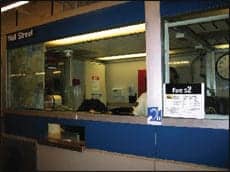
At a subway information booth on Wall Street, Barbara Bryan tried an unfamiliar way of asking for help. Bryan, a New Yorker with hearing loss, usually caught only a fraction of what people said to her at such windows. At this one she could make out the clerk’s words clearly. David Myers recorded her account in The Hearing Review in 2010, when New York transit officials had announced plans to equip 488 subway booths with hearing loops. How could a change on the clerk’s side of the glass make such a difference on hers? [1]
Where the microphone listens
Imagine asking the clerk which platform to use. By the time the answer reaches the microphone on a hearing aid, the voice shares the platform with a train pulling in and the next passenger asking a question. Turning up that mixture can make the answer louder while leaving a crucial word just as hard to catch. A booth offers a second place to listen. A microphone close to the clerk can pick up the answer while the voice is still loud compared with the sounds around it. The problem then is how to get that version of the answer across the counter. [2][3]
A hearing loop takes the electrical signal from that microphone and feeds it to an amplifier. The amplifier drives a current through a wire loop near the window. As the clerk speaks, the current varies with the speech and produces a correspondingly varying magnetic field. Inside a compatible hearing aid sits a second, much smaller coil of wire called a telecoil. In that changing field, a voltage develops across the tiny coil. The aid now has an electrical version of the clerk’s voice that it can process using the listener’s own hearing settings. The glass can stay exactly where it is. [2][3]
The name telecoil preserves its earlier job of picking up speech from a telephone handset. At a looped counter, a listener who selects the telecoil program on an equipped hearing aid can use that same receiver. The two people at the window need no introduction and their devices need no pairing. Someone whose aid lacks a telecoil can also listen through a separate loop receiver and headphones, if the venue provides them. That distinction matters when the entire conversation may last fifteen seconds. [1][2][3]
What the passenger can hear
The location of the first microphone explains both the clarity Bryan described and the limits of the system. Imagine a colleague beside the clerk giving directions at the same time. If the booth microphone picks up both voices, the wire carries both. Now imagine someone beside the passenger repeating the platform number. In a telecoil-only program that second person may be harder to hear precisely because their voice never entered the booth microphone. The train can still be rumbling through the station during either conversation. What changes when the listener switches programs is which microphone supplies the words. [2][3]
The scale of the installation follows from that small patch of magnetic coverage. In 1980 the Hearing Loss Association of America and its chapters began using loops at meetings. In 2008 the airport serving Grand Rapids, Michigan, installed the technology. Those settings offered a feed that many people might want to hear at once. At a subway window the audience might be a single passenger. The association’s timeline records the New York installation across 488 booths in 2011. Each counter could deliver the particular exchange taking place there. [3][4]
Bryan’s account tells us what one rider understood during a test. The installation count tells us how many booths were equipped. Neither measures how often a passenger found a loop switched on or knew to select the telecoil program. This is where the little sign at a window earns its place. The clerk can see someone waiting to ask a question. The passenger can see the glass and the grille. The one thing neither can see is the magnetic field carrying the answer. [1][3][4]
Sources
- David G. Myers, “Progress Toward the Looping of America,” The Hearing Review (2010). Wall Street test, rider account, and booth photograph.
- National Institute on Deafness and Other Communication Disorders, “Assistive Devices for People with Hearing, Voice, Speech, or Language Disorders.” Hearing loops and telecoil receivers.
- Hearing Loss Association of America, “Hearing Loop Technology.” Signal coverage, compatible devices, and signage.
- Hearing Loss Association of America, Get in the Hearing Loop toolkit, “Historical Timeline and Milestones.”