
The toothbrush comes first. That is the easily missed instruction in Devon Square Orthodontics’ short film about plaque-disclosing tablets. Brush as usual, the practice tells its viewers, and then chew the dye tablet. By the time the colour appears, you have already made a small prediction about your teeth. You have put the brush down because you think you have finished. Now you get to look. [1]
The practice posted its demonstration in November 2020. Watch what happens between the first brushing and the second. The person at the sink acquires one piece of information that a timer, a new brush or an extra minute at the mirror could never supply on its own. They have an address for the next brushstroke. For someone trying to clean around the little ledges of a fixed brace, that can be quite a specific address. [1][2]
What to look for after the rinse
Imagine that a patch of colour survives beside one bracket while the neighbouring tooth looks clear. Both teeth had the same brushing time available to them. Only one offers an obvious place to go back to. The observation is local enough to act on, and small enough to check again. At the end of the film’s sequence, the brush returns to the colour left on the teeth. [1]
The rinse matters to anyone trying to read that moment. In its patient leaflet, reviewed in June 2025, Leeds Teaching Hospitals asks the reader to spread the colour over the teeth, gently rinse away the excess and then inspect the tooth surfaces in a mirror. Only after that inspection does the leaflet ask the reader to brush away the stained plaque and look again. A mouth full of loose dye makes a poor starting point for deciding where the bristles need to go. The photograph below records the stage worth inspecting. [3][4]
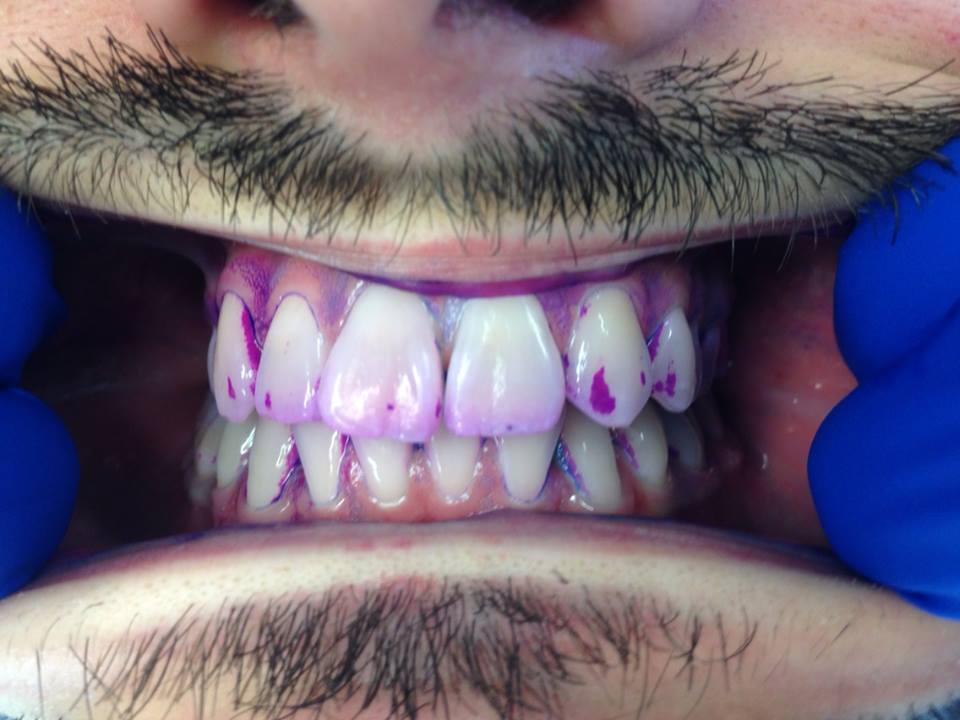
The film and the leaflet invite two different questions at the sink. Disclose before brushing and the colour can guide the first pass. Disclose after your usual brushing and the colour can tell you something about a habit. Perhaps you always start with the same tooth and sweep past the same corner on your way to the next one. Repeating your usual sequence once, before you know where the dye will show up, gives you a chance to catch that movement. [1][3]
Who gets to see the result?
A team at Gaziantep University in Turkey built a version of that question into an orthodontic trial in 2015. All the teenagers received brushing instruction. One group also got to try disclosing tablets in the clinic. A third had the same chairside experience and took tablets home, where participants were asked to use them before and after brushing after dinner. For three months, the upper teeth carried fixed braces while the lower teeth waited for treatment. An examiner scored plaque before treatment and at the one- and three-month visits. [2]
Among the 48 teenagers in the analysis, the home group had lower plaque scores than either of the other groups at both follow-ups. The researchers found no statistically significant difference in plaque scores between ordinary instruction and adding the clinic demonstration alone. A teenager in the chair could see exactly where plaque remained that day. A teenager with tablets at home could ask the same question again after an ordinary dinner, with their own mirror and their own hand on the brush. That repeated opportunity is one plausible explanation for the finding. [2]
There was also a piece of paper in the bathroom routine. The home group kept a chart that patients and parents signed after tablet use, and the study required high adherence for inclusion. A signature can be a reminder in its own right. The comparison therefore tells us how a supported home routine worked over three months. It leaves open how much came from the dye, how much came from keeping the record and what happened once families stopped doing both. [2]
Return to the film with that chart in mind. Its modest achievement is something you can see in one sitting. A person who already knew the instruction to brush can now point to a particular spot and give it another pass. Whether that changes where the brush goes tomorrow is a different question. It takes more than one look in the mirror to answer it. [1][2]
Sources
- Devon Square Orthodontics, “How to use disclosing tablets,” November 2020 (video).
- “The Effects of Using Plaque-Disclosing Tablets on the Removal of Plaque and Gingival Status of Orthodontic Patients,” Turkish Journal of Orthodontics, December 2019.
- Leeds Teaching Hospitals NHS Trust, “How to use your disclosing tablets,” patient leaflet reviewed June 2025.
- Ajeverett, “Post plaque disclosing,” photograph and licence, Wikimedia Commons, March 2015.