At the three-year visit in the LiGHT trial, a patient could have had two laser treatments, come back repeatedly for eye tests and still count as a success under one particularly memorable heading. In the group that started with laser treatment, 74.2% of patients could keep their eye pressure at its target without glaucoma drops. What had disappeared for those patients was the job waiting for them at home. How did the researchers decide it was safe to leave that job off the schedule? [1]
A pressure target for each eye
Between 2012 and 2014, six UK clinics enrolled 718 people with newly diagnosed open-angle glaucoma or ocular hypertension who had yet to start treatment. The distinction mattered. Some already had damage from glaucoma. Others had raised pressure that put them at risk of damage. The researchers assigned each person by chance to start with drops or with selective laser trabeculoplasty. They set a pressure target for each eye individually, taking account of its starting pressure and how much damage had already occurred. A person with two eligible eyes could therefore go home with two different targets. [1]
At the laser appointment, the patient sits at a microscope with chin and forehead supported. After numbing the surface of the eye, the clinician places a contact lens against it to see the ring of drainage tissue where the iris meets the cornea. Brief pulses of light applied to this tissue help fluid drain and bring the pressure down. The clinician can see where the light lands. How well the eye responds becomes clear at later measurements. [2]
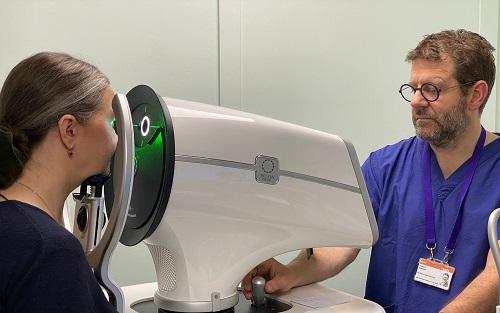
Imagine an eye whose pressure comes in exactly on target at the next visit. That reading answers only one of the clinic's questions. A visual field test checks which spots of light the patient can detect, and images of the optic disc let staff look for structural change. In LiGHT, convincing evidence that the eye was deteriorating could trigger more treatment even with an acceptable pressure reading. The team could lower the target. In effect, the eye's own history could overrule the estimate made on the day the patient joined. [1]
The trial protocol also allowed a second laser session if the first had helped and its effect was wearing off. Drops were available whenever laser treatment proved insufficient. Counting the people who could still manage without a bottle at three years tells us what a clinic could achieve with that sequence of decisions. Table 5 supplies the count for a single session. Of the 419 eyes at target without medication at three years, 321 had needed just one laser treatment. [1]
What the questionnaire could see
When the team published the results in 2019, its primary outcome was a questionnaire about everyday health. It asked about things such as walking, washing and dressing, pain, and anxiety. Of the 718 participants, 652 returned it at three years. Average scores were 0.89 in the laser-first group and 0.90 in the drops-first group, a difference the trial could not distinguish from chance. Both groups had received active care. An appointment at which an eye was within target was common in both, accounting for 93.0% of visits after starting with laser and 91.3% after starting with drops. [1]
Consider someone who can wash and dress independently and remembers the drops every night. Take the bottle out of that evening routine and the answer about dressing can quite reasonably stay the same. The questionnaire gave patients a way to report changes across their lives. The medication record answered the narrower question of who still had to fit treatment into the day. The investigators found a substantial difference on that second question without establishing a broad quality-of-life advantage on the first. [1]
The six-year report, published in the 2023 volume of Ophthalmology, rewards a close look at one small word. Among eyes in the laser-first group, 69.8% were still at or below target without pressure-lowering drugs or surgery. At three years the 74.2% figure counted people. One eye can meet its target unaided while its fellow needs drops, in which case the bottle is still part of someone's evening. The follow-up group had also changed. Of 633 people who entered the extension, 524 completed six years. Subtracting the two percentages would give a tidy but misleading estimate of how many patients had gone back on drops. [1][4]
For a patient wondering what might change at home, the three-year paper gives the more direct answer. For a clinician following an individual eye, the six-year finding shows how long pressure control can persist. Both results depend on the same continuing work at the clinic. Someone still has to measure the pressure, check what the eye can see and recognize when it is time to write a prescription. [1][4]
Sources
- Gus Gazzard and colleagues, three-year LiGHT trial results, The Lancet (2019)
- Moorfields Eye Hospital, patient guide to selective laser trabeculoplasty
- Moorfields Eye Hospital, “Innovations in glaucoma laser treatment,” clinical photograph and report
- Gus Gazzard and colleagues, six-year LiGHT trial results, Ophthalmology (2023), full paper