In 1926, treatment for a potentially fatal blood disease could arrive as a formidable daily helping of liver. George Minot and William Murphy's Boston patients were asked to eat roughly 120–240 grams of it, alongside other foods. Their report described 45 cases of pernicious anemia and a striking improvement in the blood.[1]
The meal worked before anyone could identify its decisive ingredient. Following it from plate to medicine bottle to laboratory preparation reveals an unusual sequence: physicians learned how to interrupt the disease, then investigated the failure that made treatment necessary. Each success left a different question unanswered.
A borrowed clue, an unexpected response
The clue came from another kind of anemia. George Whipple and his collaborators, including Frieda Robscheit-Robbins, had investigated blood regeneration in dogs subjected to blood loss. Liver proved particularly useful. Minot and Murphy took that experimental lead into the clinic, where pernicious anemia presented a different problem.[2]
An analogy can suggest an experiment without explaining its outcome. A food that helps an animal recover from bleeding might contain something useful to a patient whose blood production is disordered. Success in both settings would still leave open whether the same ingredient was doing the work.
Minot and Murphy's paper was careful about this uncertainty. Their regimen changed several foods at once. They also knew that pernicious anemia could temporarily improve without their intervention. A sequence of better-looking patients could therefore mislead. They compared their observations with earlier experience and explicitly withheld certainty about how long the remissions would last.[1]
The blood supplied evidence more specific than an impression of returning strength. Leonard Sinclair's historical account describes a rise in young red cells, called reticulocytes, within four to ten days: from about 1 percent to an average of 8 percent. Subsequent increases in red-cell counts and hemoglobin accompanied the clinical improvement. Other physicians then confirmed the treatment's effects.[2]
Those observations made the result increasingly persuasive while leaving the mechanism unresolved. The early report deserves attention for both achievements: it recorded an extraordinary response and preserved the questions that response could not settle.
The plate becomes a box
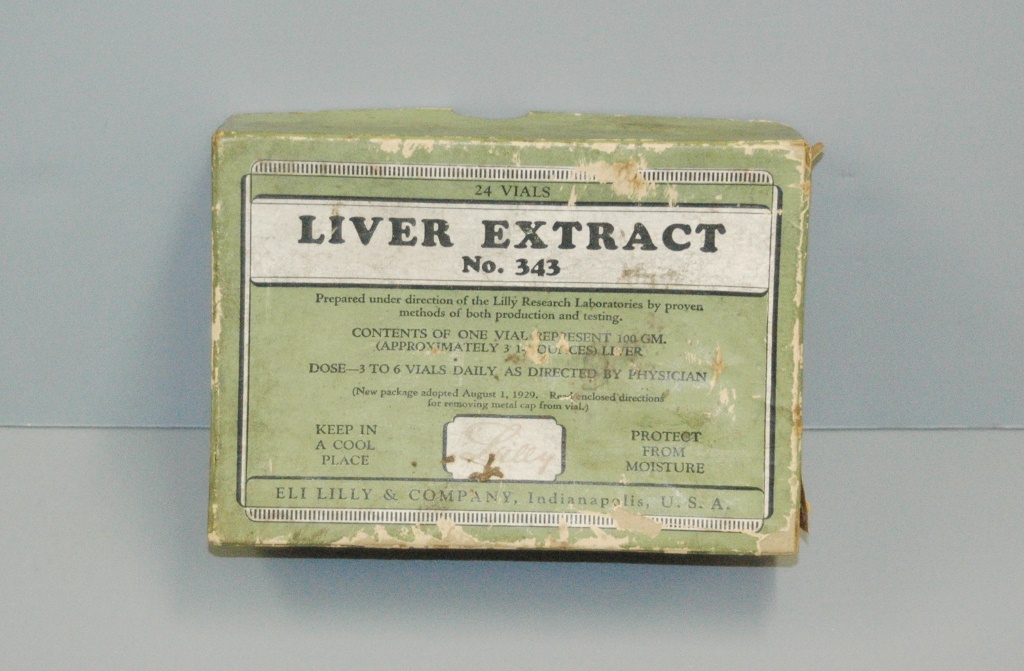
A green box in Harvard's Warren Anatomical Museum brings the next stage down to domestic scale. Dated around 1929, it originally held 24 vials of Eli Lilly Liver Extract No. 343. Of the 16 surviving vials, 15 are empty.[3]
By 1928, Minot and Murphy had collaborated with Lilly to bring the extract to market. The box's instructions called for three to six vials daily, according to the physician's advice. Those are historical directions, not a regimen for use today.[3]
At that stated rate, a full box represented four to eight days of treatment. The calculation gives the display a rhythm: opening, measuring, swallowing, replenishing. An object can preserve that routine even when its user's experience remains inaccessible.
The practical question was changing from how much liver someone could eat to how a medicine could be supplied repeatedly.
The stomach enters the story
Meanwhile, William Castle was asking why these patients needed liver in the first place. In a report presented in London on 11 June 1929, he noted that liver treatment could improve the blood without correcting the stomach's failure to secrete acid. Most people who never ate liver did not develop pernicious anemia. Something about the patient's handling of food needed explaining.[4]
Castle described experiments begun in 1927 in which beef was first digested in a healthy human stomach, recovered, and administered to patients through a nasal tube. Eight of ten showed a reticulocyte response. Beef alone had failed to produce a comparable response in three tested cases. Further experiments with Wilmot Townsend examined the interaction between beef and normal gastric juice outside the body.[4]
The report's explanation was provisional: Castle thought digestion might manufacture a necessary substance from food protein. That was not yet the modern account of vitamin absorption. His important move was experimental. He separated what was eaten from what the stomach contributed, making a digestive failure investigable through changes in the blood.[4]
The disease now connected two places in the body. A blood sample could reveal the consequences of a process that had gone wrong earlier, during the handling of a meal.
Recognition before identification
On 10 December 1934, The Harvard Crimson announced that Minot and Murphy were receiving the Nobel Prize for their liver-extract treatment. Its brief account dwelt on the Stockholm ceremony: the king, the medal, the diploma. The wording celebrated a remedy, reflecting what had already become clinically possible.[5]
There is a temptation to let an award close a discovery story. Here, it marks an interval. Patients had an effective intervention; researchers still had to identify the substance on which its effect depended. The celebrated achievement and the unfinished investigation occupied the same moment.
In April 1948, E. Lester Smith of Glaxo Laboratories published “Purification of Anti-pernicious Anæmia Factors from Liver” in Nature. His report described two red pigments with clinical activity, separated through repeated chromatography. The starting material included liver extract produced on a manufacturing scale: the medicine already in use had become material for further discovery.[6]
That year, Smith's work and independent work by E. L. Rickes and colleagues isolated the factor known as vitamin B12.[2] The progression from an organ to an extract to a defined substance allowed the treatment to be understood at a different scale. A plateful of food had concealed a requirement for a minute constituent.
What the meal could not repair
The modern explanation preserves Castle's distinction between food and its processing. Intrinsic factor, a protein made in the stomach, helps the body absorb vitamin B12. Pernicious anemia involves failure of this system. Having the vitamin in a meal does not guarantee that enough reaches the tissues that need it.[7]
B12 deficiency can disrupt blood-cell formation and damage the nervous system. Treatment therefore concerns more than a reassuring blood count. The US National Heart, Lung, and Blood Institute notes that some neurological problems may persist despite treatment, and that replacement depends on the cause and severity of the deficiency; some people require lifelong care.[7]
The old liver diet belongs to this history, rather than serving as a present-day treatment recommendation. Its great achievement was to make recovery possible while the underlying defect remained. The green box preserves that intermediate moment: medicine had found something patients could take, and was still learning why they needed to keep taking it.
Sources
- George R. Minot and William P. Murphy, “Treatment of Pernicious Anemia by a Special Diet,” JAMA 87 (1926), pp. 470–476. Original report, diet, case series, and uncertainty about spontaneous remission; facsimile preserved by the James Lind Library.
- Leonard Sinclair, “Recognizing, treating and understanding pernicious anaemia,” Journal of the Royal Society of Medicine (2008). Historical synthesis of the animal experiments, reticulocyte response, replication, and B12 isolation, with references to the original studies.
- Dominic Hall, “New artifacts donated to Warren Museum,” Harvard Countway Library, 8 August 2013. Photograph and documentation of Liver Extract No. 343.
- W. B. Castle, “The Ætiological Relationship of Achylia Gastrica to Pernicious Anæmia,” Proceedings of the Royal Society of Medicine (1929), pp. 1214–1216.
- “Two From Harvard Faculty Receive 1934 Nobel Prize,” The Harvard Crimson, 10 December 1934. Contemporary announcement describing the award as recognition of liver-extract treatment.
- E. Lester Smith, “Purification of Anti-pernicious Anæmia Factors from Liver,” Nature 161 (24 April 1948), pp. 638–639. Publisher's abstract describes active red pigments and chromatographic purification.
- National Heart, Lung, and Blood Institute, “Vitamin B12–Deficiency Anemia,” updated 24 March 2022. Intrinsic factor, absorption, neurological consequences, and treatment according to cause and severity.