The patches come off before the investigation is finished. Under the adhesive strips, each small chamber has held a particular test substance against the skin. The clinician has marked the positions so that a change appearing later can still be assigned to the right substance. A back covered in little squares becomes a record that must be read more than once.[5]
That delay is part of the test's design. Patch testing investigates the slower immune response behind allergic contact dermatitis.[2] It also creates a second, less visible task: deciding whether an allergy found on the back explains the rash that brought the patient into the clinic.[7]
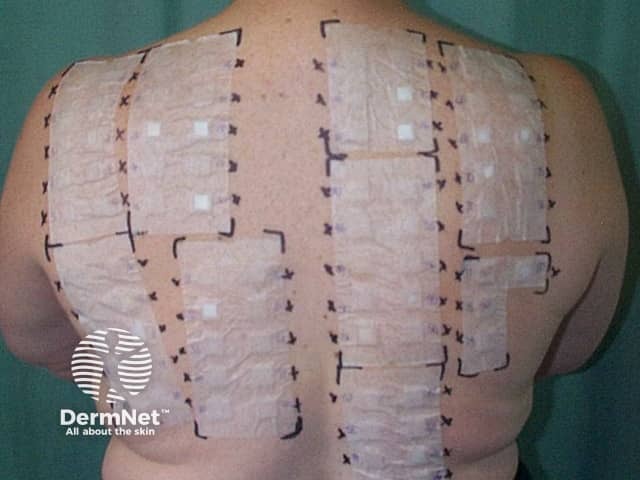
A reaction with a memory
In allergic contact dermatitis, immune cells called T lymphocytes recognize an allergen and release signals that drive inflammation. The response commonly becomes apparent 24–72 hours after exposure. A person may have used a substance for years before becoming sensitized to it; familiarity does not guarantee continued tolerance. Once that immune recognition exists, another encounter can bring out an itchy eruption.[2]
The patch test uses this capacity for a delayed response. Appropriately prepared substances remain in contact with small areas of skin long enough for a reaction to develop. This differs from skin-prick testing, which investigates immediate allergic reactions.[1] A diagnostic patch-test panel is not a general inventory of food allergies.[4]
Irritation follows another route. Repeated contact with detergents, solvents or frequent washing can damage skin without an allergy to a particular ingredient. The British Association of Dermatologists distinguishes this from the immune reaction of allergic contact dermatitis, while noting that the resulting rashes can look and feel similar. A worker's sore hands therefore do not identify the mechanism by appearance alone.[3]
Two days of contact, several days of evidence
The British Association of Dermatologists' July 2024 patient leaflet describes a typical course of three appointments over a week. Substances are usually left in place for 48 hours. After removal, the markings remain so the same sites can be examined again. The return visit is doing diagnostic work: it allows time for a response that was absent or inconclusive earlier to become visible.[4]
Exact schedules vary. Guy's and St Thomas' describes an initial reading on day 2 or 3 and another on day 7, when clinicians look for persistent or newly apparent reactions. Its instructions to keep the back dry and avoid activities that dislodge the strips protect the test's physical continuity. Without the intended contact or a legible location, a patch becomes harder to interpret.[5]
The European Society of Contact Dermatitis's June 2026 update to its 2015 guideline recommends at least two readings. Its preferred schedule includes day 2, day 3 or 4, and day 7. This is expert guidance informed by research and consensus, rather than a claim that one appointment schedule has been tested against every alternative.[7]
Reading also means more than spotting a red square. Clinicians distinguish doubtful and irritant responses from allergic ones, and grade the reaction. Some test materials can stain the skin. A visible mark alone is therefore insufficient: the character of the change matters as well as its location.[1]
The choice of squares shapes the answer
A panel can examine only what has been placed in it. The British Society for Cutaneous Allergy's series, updated in June 2024, combine a baseline selection of common allergens with additional groups for particular exposures. There are series for hair products, footwear, rubber, fragrances and other circumstances. A person's work and routine help determine which extensions deserve space on the back.[6]
This makes the interview part of the experiment. A standard panel and a hair-products series are different selections, even when the adhesive strips look identical. The society recommends additional series and appropriately diluted samples of patients' own products alongside the baseline. The practical aim is to make the tested substances resemble the exposures under investigation.[6]
Packaging helps make that connection. The BAD leaflet asks patients to bring relevant products and ingredient lists, and workplace safety data sheets where appropriate. These give clinicians something more specific to investigate than a recollection that a particular cream or shift at work made the skin worse.[4] Product selection and preparation belong with the clinic; household chemicals should not be improvised into homemade patches.[1]
A positive square still needs a plausible source
A positive allergic reaction establishes sensitization. Establishing its relevance requires a further connection: sufficient exposure to that allergen, consistent with the patient's symptoms and history. The European guideline distinguishes current, past and unknown relevance. A positive nickel test might explain an earlier reaction to earrings without explaining today's dermatitis. Unknown relevance remains an unresolved finding, rather than automatically becoming a false positive.[7]
A negative panel has limits too. An untested allergen can escape it, and irritation can still account for the skin problem. The useful conclusion depends on what was tested and what else the examination and history suggest.[1][3]
The reward for all those appointments is a more specific explanation. Finding a relevant allergen can make avoidance possible and improve allergic contact dermatitis; managing irritant exposure may still be necessary.[3] The marked squares help reveal what the skin recognizes. The patient's everyday life supplies the evidence of where that encounter happens.
Sources
- Ian Coulson, “Patch tests,” DermNet, updated December 2021 — test procedure, interpretation, limitations and the photograph “Patch test strips in place after application.”
- Amanda Oakley and colleagues, “Allergic contact dermatitis,” DermNet, reviewed August 2025 — delayed T-cell response, sensitization and clinical presentation.
- British Association of Dermatologists, “Contact dermatitis,” June 2025 — allergic and irritant mechanisms, overlapping appearances and exposure management.
- British Association of Dermatologists, “Patch testing,” patient information leaflet, July 2024 — appointments, materials, preparation and the scope of the test.
- Guy's and St Thomas' NHS Foundation Trust, “Skin allergies: Appointments” — the clinic's patch application, reading schedule and care instructions.
- British Society for Cutaneous Allergy, “BSCA Recommended Series,” updated June 2024 — baseline and supplementary allergen selections.
- Wolfgang Uter and colleagues, “European Society of Contact Dermatitis Guideline for Diagnostic Patch Testing—Recommendations on Best Practice (Update 2026),” Contact Dermatitis, June 21, 2026 — sections 1, 4.4 and 7 on evidence, reading times and clinical relevance.