In an early laboratory portrait, Alice Evans holds glass tubes toward the light. Bottles crowd the shelves beside her; more tubes stand on the bench. The National Photo Company photographed her as a scientist in the Department of Agriculture's Dairy Division, working on the microscopic life that affected dairy products. It is a useful setting for a discovery whose force came from bringing specimens into comparison.[6]
One bacterium was associated with failed pregnancies in cattle. Another caused Malta fever in people. Their names and clinical histories placed them in different compartments. Evans's work, presented in 1917 and published in June 1918, made that separation difficult to defend. If the organisms were so closely related, what justified assuming that the cattle bacterium in milk was harmless to its human drinkers?[1][2]
Her achievement becomes more interesting when that question remains a question. A resemblance on the laboratory bench could redirect medicine's attention. Establishing human infection, tracing its source and understanding its frequency still required further work.
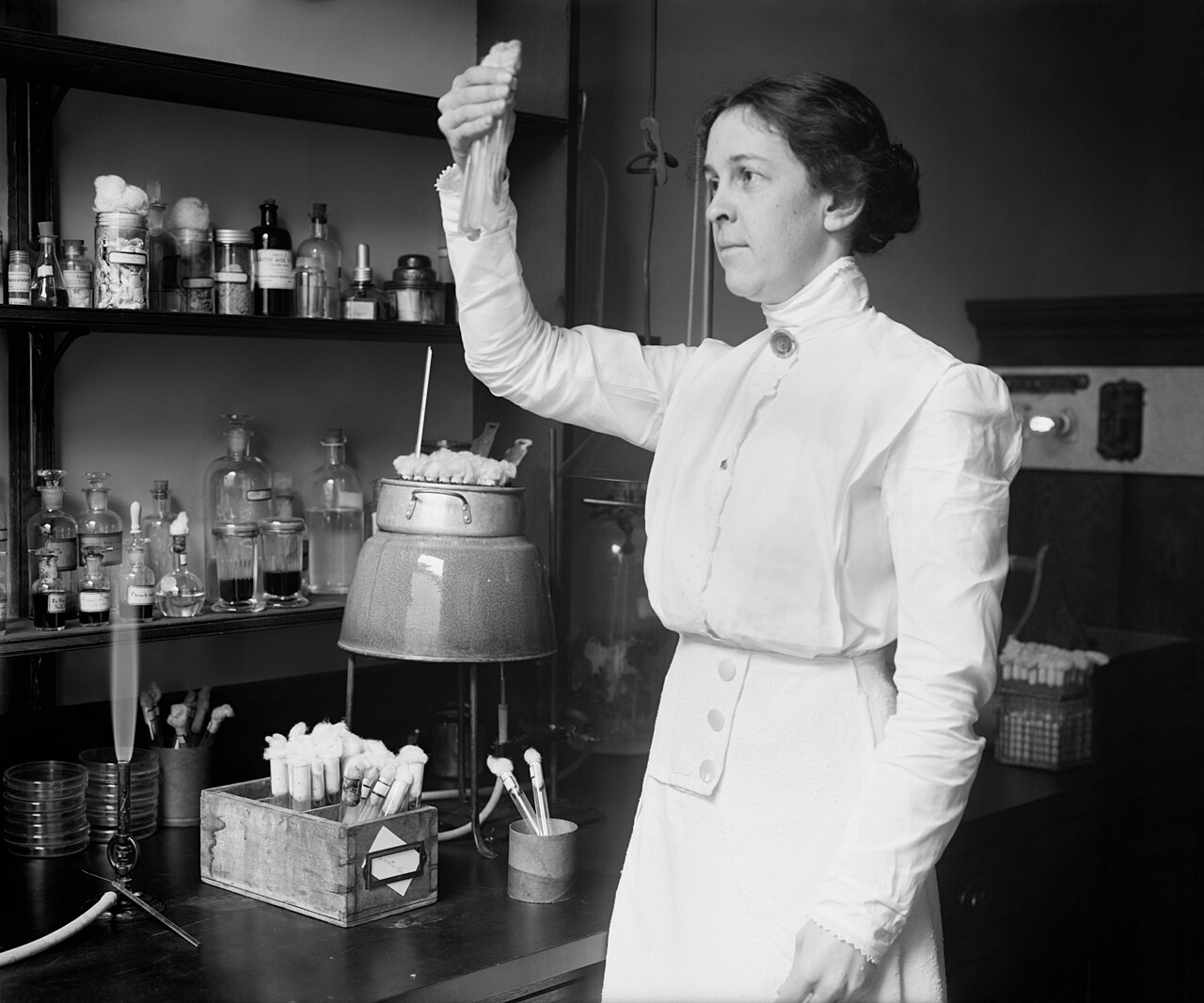
A route through the dairy laboratory
Evans reached research through teaching. Unable initially to afford college, she became an elementary schoolteacher in Pennsylvania. In 1905 she entered a free Cornell course intended to help rural teachers teach nature study, supporting herself with savings. The course opened a longer route into science: a bachelor's degree in 1909, then a master's at Wisconsin in 1910. Further doctoral study would have meant extending years of financial and physical strain.[2]
Instead, she accepted federal employment. Her first USDA work in Madison concerned improving cheddar cheese flavor. The assignment placed her inside a practical agricultural problem: microorganisms could change what people ate, how it tasted and how it kept. When she moved to the Dairy Division's Washington laboratories in July 1913, she was also given her own investigation into bacteria present within cows' udders and discharged in milk.[2]
That distinction mattered. A bacterium already inside the animal presented a different question from dirt introduced during milking. Earlier investigators had recovered the organism associated with contagious abortion from milk and raised the possibility of danger to people. Evans therefore inherited an unresolved warning, rather than discovering from nothing that milk might carry disease.[2][3]
As Public Health Service historian John Parascandola recounts, she asked veterinary pathologist Adolph Eichhorn whether an apparently healthy animal could produce milk containing bacteria harmful to humans. He pointed to goats and Malta fever. The example gave her a concrete comparison to pursue.[2]
What the resemblance established
The old names made the organisms sound more different than Evans found them to be. The cattle organism was commonly called Bacillus abortus; the Malta-fever organism, Micrococcus melitensis. Her 1918 paper compared their appearance, behavior in laboratory tests and reactions with immune sera. Across these different kinds of evidence, they were remarkably alike.[1]
The serum results carried a particularly consequential warning. Agglutination tests detect the clumping that occurs when antibodies react with bacteria. Evans concluded that the tests then used to diagnose Malta-fever infection could not reliably distinguish infection with one organism from infection with the other. A positive result might support a diagnosis while leaving the bacterial identity less settled than the diagnostic label implied.[1]
Animal observations strengthened the comparison. In small groups of pregnant guinea pigs, each containing four animals, three in each group aborted after exposure to one or the other organism. This was evidence of similar biological effects under those experimental conditions. It was neither a human trial nor a measurement of the risk associated with drinking milk.[1][2]
The distinction keeps Evans's reasoning in view. She had evidence that a familiar animal pathogen belonged close to an established human pathogen. That made a new investigation urgent; it did not supply every answer in advance. The practical implication was to look again at human illness that existing categories might have concealed.
The difficulty of being heard
Some resistance attached to the messenger. Parascandola judges that Evans's gender, limited professional standing and lack of a doctorate probably weakened her credibility. Yet he also describes supportive immediate colleagues at the Dairy Division. Her working world contained both opportunity and exclusion; it was not uniformly hostile.[2]
Other objections concerned the evidence itself. If the organisms were so similar, why had earlier investigators missed the connection? If the cattle organism caused human illness, where were the American cases? The second question deserved an answer, but the apparent absence of recognized cases could not settle it. Illness resembling influenza, typhoid or malaria might already be passing through medicine under another name.[2]
Evans's own recollection of 1918 offers a useful check against imagining an investigator with unlimited time and resources. After joining the Public Health Service's Hygienic Laboratory, she worked on meningitis. During the influenza emergency in Washington that October, she was redirected toward the pandemic. With the laboratory's media maker ill, she tried to prepare materials herself, realized that she too was becoming sick, and went home.[4]
Writing in 1963, she remembered returning more than a month later and resuming her meningitis work. She also acknowledged the scale of the influenza problem: finding its cause required more than a lone investigator. That recollection places her persistence within a real institution, interrupted by illness and urgent demands, and dependent on other people's labor.[4]
Following the question into human cases
Later work supplied the human evidence that resemblance alone could not. In their 1930 report on undulant fever in Iowa, A. V. Hardy and colleagues described 49 bacterial strains from 48 patients; one patient yielded two types. They classified 14 strains as the bovine-associated abortus type and 35 as the swine-associated suis type. Bacteria linked to livestock were being recovered from people with illness.[3]
These figures describe the report's culture-positive patients, not the share of all milk drinkers who became ill. The authors also resisted treating a bacterial type as a complete history of transmission. They compared laboratory findings with patients' work, animal contact and dairy consumption. Animals could harbor organisms associated with another livestock species, while some infections were harder to confirm in the laboratory. A name was a clue to investigate.[3]
The same report credited Evans's comparison and recorded the adoption of the genus name Brucella, proposed in 1920, while noting continuing disagreement over classification. A shared name helped bring the evidence together. It did not erase the need to distinguish different organisms, exposures and clinical courses.[3]
This is where Evans's contribution reaches beyond a familiar pasteurization story. Her work helped make a supposedly separate agricultural problem legible to physicians. The later investigations connected laboratory identification to patients and their surroundings, giving the initial comparison consequences outside the dairy laboratory.
Recognition during illness
Professional recognition arrived while Evans was herself living with the disease. The American Society for Microbiology's account dates her laboratory-acquired brucellosis to 1922. On December 30, 1927, she was elected to lead its predecessor, the Society of American Bacteriologists, for 1928—the first woman to hold the presidency. Illness prevented her from attending her installation.[5]
She continued studying brucellosis and later investigated streptococci, retiring from federal service in 1945. Her career helped establish the case for pasteurization, but its decisive intellectual act was more specific: she compared organisms whose familiar labels had encouraged people to keep their consequences apart.[5]
The photograph returns us to that scale of work. A person, a bench, specimens that can be examined together. Evans made the resemblance convincing enough that other investigators had to carry the question onward—to patients, farms and the milk supply. The answer became stronger as it traveled beyond her own experiments.
Sources
- Alice C. Evans, “Further Studies on Bacterium Abortus and Related Bacteria: II. A Comparison of Bacterium Abortus with Bacterium Bronchisepticus and with the Organism Which Causes Malta Fever,” The Journal of Infectious Diseases 22, no. 6 (June 1918), pp. 580–593—original comparison and diagnostic limits; Open JSTOR.
- John Parascandola, “Alice Evans, an Early Woman Scientist at NIH,” Public Health Reports 113 (September–October 1998), pp. 472–474—education, dairy research, experimental comparison and reception; CDC Stacks.
- A. V. Hardy, C. F. Jordan, I. H. Borts and Grace Campbell Hardy, “Undulant Fever: With Special Reference to a Study of Brucella Infection in Iowa,” Public Health Reports, October 10, 1930—especially pp. 2441–2446 on Evans, classification, human isolates and exposure histories; CDC Stacks issue PDF.
- Alice Evans, memoir excerpt dated September 2, 1963, reproduced as “NIH and the 1918 Flu,” The NIH Catalyst, May–June 2020—her firsthand recollection of the influenza emergency and its interruption of research.
- Geoff Hunt, “Alice Evans, A Pioneer for Women in Microbiology,” American Society for Microbiology, March 30, 2023—society records, December 1927 election for the 1928 presidency, illness and later career.
- National Photo Company Collection, Library of Congress, “Alice C. Evans, National Photo Company portrait, circa 1915,” Wikimedia Commons—archival Dairy Division photograph restored by Adam Cuerden; the Library of Congress dates the original to 1910–1920.