Pasteurization is easy to flatten into one sentence: milk is heated, germs die, the modern dairy system begins. The public-health record supports a sharper explanation. Milk became safer when safety stopped depending on perfect cows, spotless pails, and optimistic retail handling, and started depending on a reproducible kill step embedded in a larger control system.[1][2][3][4]
That distinction matters because milk is a biologic food that moves through many hands. By the time it reaches a kitchen or a cafe, the real question is not whether someone somewhere intended it to be clean. The real question is whether the system contains a step strong enough to interrupt pathogens before ordinary storage, transport, and selling variability can amplify them.[1][3][4]
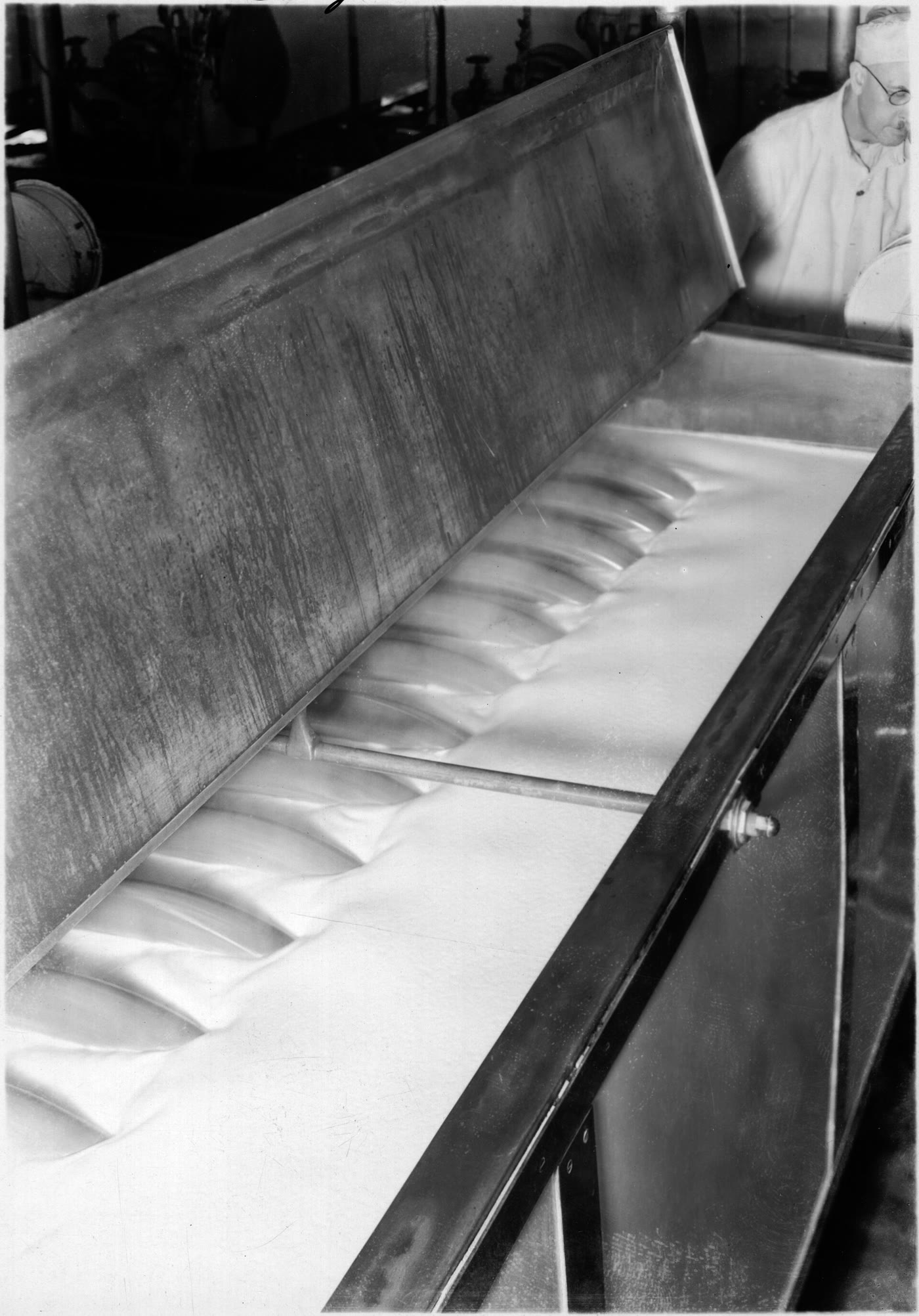
Image context: the cover image is a real archival dairy photograph from the Wellcome Collection. It belongs here because pasteurization worked as industrial public-health practice: workers, vats, heat, and timing had to become part of one repeatable routine.[6]
Timeline anchors before the mechanism
- Early 20th century: pasteurization entered routine milk control more than a century ago as cities confronted recurrent milk-borne disease and the limits of relying on appearance or source reputation alone.[3]
- 1948: Michigan enacted the first statewide requirement that dairy products be pasteurized, showing how the control step was moving from local practice into state-level rulemaking.[4]
- 1987: the U.S. Food and Drug Administration prohibited interstate sale of nonpasteurized dairy products for direct consumer purchase, narrowing the legal route for raw-milk distribution across states.[4]
- 1993-2006: outbreak surveillance still found that most dairy outbreaks with known pasteurization status involved nonpasteurized products, despite pasteurized milk's much larger consumption base.[4]
- 1998-2018: unpasteurized-milk outbreaks continued to cluster in a small-consuming population, with children and teenagers carrying a large share of the illness burden.[5]
1. Milk is a contamination problem before it is a freshness problem
The hardest thing to remember from a twenty-first-century refrigerator is that milk does not begin as a sealed retail object. It begins as a nutrient-rich animal product moving through udders, collection equipment, containers, transport systems, cooling steps, processors, and retailers. CDC's current consumer guidance compresses the core point well: pasteurization is "heating milk to a high enough temperature for a certain length of time," and it is crucial because it kills harmful germs that can cause illness.[1]
That public-health framing exists because visual cleanliness is weak protection. The 2015 review on raw-milk consumption notes that pasteurization was introduced more than a century ago to reduce milk-associated illness, and that in some studies up to one-third of raw-milk samples contained pathogens even when the milk came from clinically healthy animals or otherwise appeared to be good quality.[3] In other words, "good farm," "healthy herd," and "fresh taste" do not solve the same problem as pathogen control. They may improve upstream conditions, but they do not create a dependable terminal barrier.
This is why the common pastoral argument for raw milk has always been weaker than it looks. It treats contamination as an occasional failure of bad farms. The historical literature treats contamination as an expected systems hazard in a food that is wet, nutrient-dense, and repeatedly handled.[1][2][3]
2. Pasteurization worked because it inserted a kill step before the market could magnify small errors
Pasteurization changed milk safety by changing where confidence came from. Before a kill step, safety depended on every prior link holding together at once: animal health, milking hygiene, container cleanliness, transport temperature, shop storage, household timing. After a kill step, the system had a place where microbial risk could be cut down deliberately and repeatedly, even though upstream perfection remained unattainable.[1][3]
That does not make pasteurization a magic spell. It does something narrower and more valuable. It reduces the pathogen burden before milk enters the most variable parts of distribution. This is why CDC presents pasteurization as the practical route for safely obtaining milk's nutritional value, not as a cosmetic processing preference.[1] It is also why FDA continues to frame raw milk as a consumer-safety problem rather than as a lifestyle choice detached from infectious-disease history.[2]
The mechanism is easiest to understand as hazard control rather than purity. Public health did not need milk to become sterile in every metaphysical sense. It needed milk to carry far fewer viable pathogens into storage, sale, and household use. Once that happened, routine refrigeration and retail handling had a chance to succeed more often.
3. The heat step became durable only when law, cooling, and handling discipline wrapped around it
Pasteurization alone was never the whole regime. The outbreak literature is useful here because it shows what happens when the larger system around pasteurization breaks. The 2012 Emerging Infectious Diseases review tracks the regulatory ratchet clearly: statewide pasteurization requirements began to appear in 1948, and interstate direct-to-consumer sales of nonpasteurized dairy were restricted in 1987.[4] Those dates matter because they turned a technical option into a governing expectation.
The same paper also explains why outbreaks linked to products marketed as pasteurized do not refute pasteurization's logic. Where the contamination source could be identified, outbreaks involving pasteurized dairy products were generally traced to improper pasteurization, improper storage, or contamination after pasteurization, including post-pasteurization mishandling by food workers.[4] That pattern supports the mechanism instead of weakening it. It shows that the protective value sits in an intact sequence: correct heat treatment, clean equipment, cold storage, and disciplined handling after processing.
Put differently, pasteurization solved the wrong problem for anyone who imagined one heating event could rescue careless downstream practice forever. It solved the right problem for public health: it created a strong central barrier inside a broader control chain. The rest of the chain still had to hold.
4. Modern denominator evidence shows why the system still matters
The historical debate often gets trapped in anecdote. Surveillance data gives the cleaner read. In the 1993-2006 outbreak review, investigators found 121 dairy outbreaks with known pasteurization status. Of those, 73 outbreaks, or 60%, involved nonpasteurized products and produced 1,571 illnesses, 202 hospitalizations, and 2 deaths.[4] Among fluid-milk outbreaks specifically, 82% involved nonpasteurized milk.[4]
The more recent 1998-2018 analysis keeps the asymmetry visible. It identified 75 outbreaks and 675 illnesses linked to unpasteurized milk, with 48% of illnesses occurring in people aged 0-19 years.[5] The same paper notes that only about 1% to 2% of U.S. adults reported drinking unpasteurized milk, while pasteurized milk had been consumed by 70.2% of surveyed respondents in the prior week.[5] The exact survey frames are not interchangeable, but the directional message is hard to miss: a small-consuming subgroup generates a disproportionately visible outbreak record.
This is the real denominator lesson. Pasteurization did not eliminate dairy risk from the world. It compressed the routine risk of a massively consumed food. The outbreaks that remain visible help explain why the system continues to be defended: without the kill step, the baseline would sit much higher.
The strongest two interpretations
Interpretation A: clean farms and careful consumers make pasteurization optional
This reading keeps returning because it matches an appealing moral picture of food: local knowledge, visible care, short distance, personal trust. It does not fit the evidence chain well. The CDC and FDA framing, the century-long review literature, and the outbreak studies all point in the same direction: contamination can be present even when milk looks fine, animals look healthy, and handling seems conscientious.[1][2][3] A system built only on upstream virtue has no dependable terminal control point.
Interpretation B: pasteurization works because it is a kill step inside a governed food system
This interpretation fits the record better. Heat treatment reduces pathogen load before retail uncertainty compounds it; law and inspection make the step harder to skip; cooling and post-process hygiene keep the benefit from being undone later.[1][3][4][5] Even the outbreaks tied to pasteurized products reinforce the same model, because they usually trace back to failure at one of those adjacent control points rather than to proof that the kill step itself is useless.[4]
What the mechanism changes
Pasteurization changed milk because it relocated safety from hope to process.[1][3][4] Once that happened, milk could behave less like a recurring street-level infectious gamble and more like a routine food with governable failure modes. That is the durable achievement. Public health did not win by discovering that farms should try harder. It won by inserting a repeatable microbial barrier and then building distribution rules strong enough to protect that barrier on the way to the table.[1][2][4][5]
Sources
- Centers for Disease Control and Prevention, "Raw Milk" (updated January 31, 2025) - pasteurization definition and current safety framing.
- U.S. Food and Drug Administration, "Raw Milk Misconceptions and the Danger of Raw Milk Consumption" - FDA consumer-risk framing for unpasteurized dairy.
- John A. Lucey, "Raw Milk Consumption: Risks and Benefits" (Nutrition Today, 2015; PMC) - why pasteurization was introduced over a century ago and why herd appearance alone cannot guarantee pathogen-free milk.
- Adam J. Langer et al., "Nonpasteurized Dairy Products, Disease Outbreaks, and State Laws - United States, 1993-2006" (Emerging Infectious Diseases, 2012; PMC) - 1948 Michigan rule, 1987 interstate-sales restriction, and outbreak-source patterns.
- Christine Mungai et al., "Foodborne illness outbreaks linked to unpasteurised milk and relationship to changes in state laws - United States, 1998-2018" (Epidemiology & Infection, 2023; PMC) - outbreak counts, age distribution, and consumption-denominator context.
- Wikimedia Commons / Wellcome Collection, "File:Milk being pasteurized at a dairy (I0004247).jpg" - archival dairy photograph used as the article image.