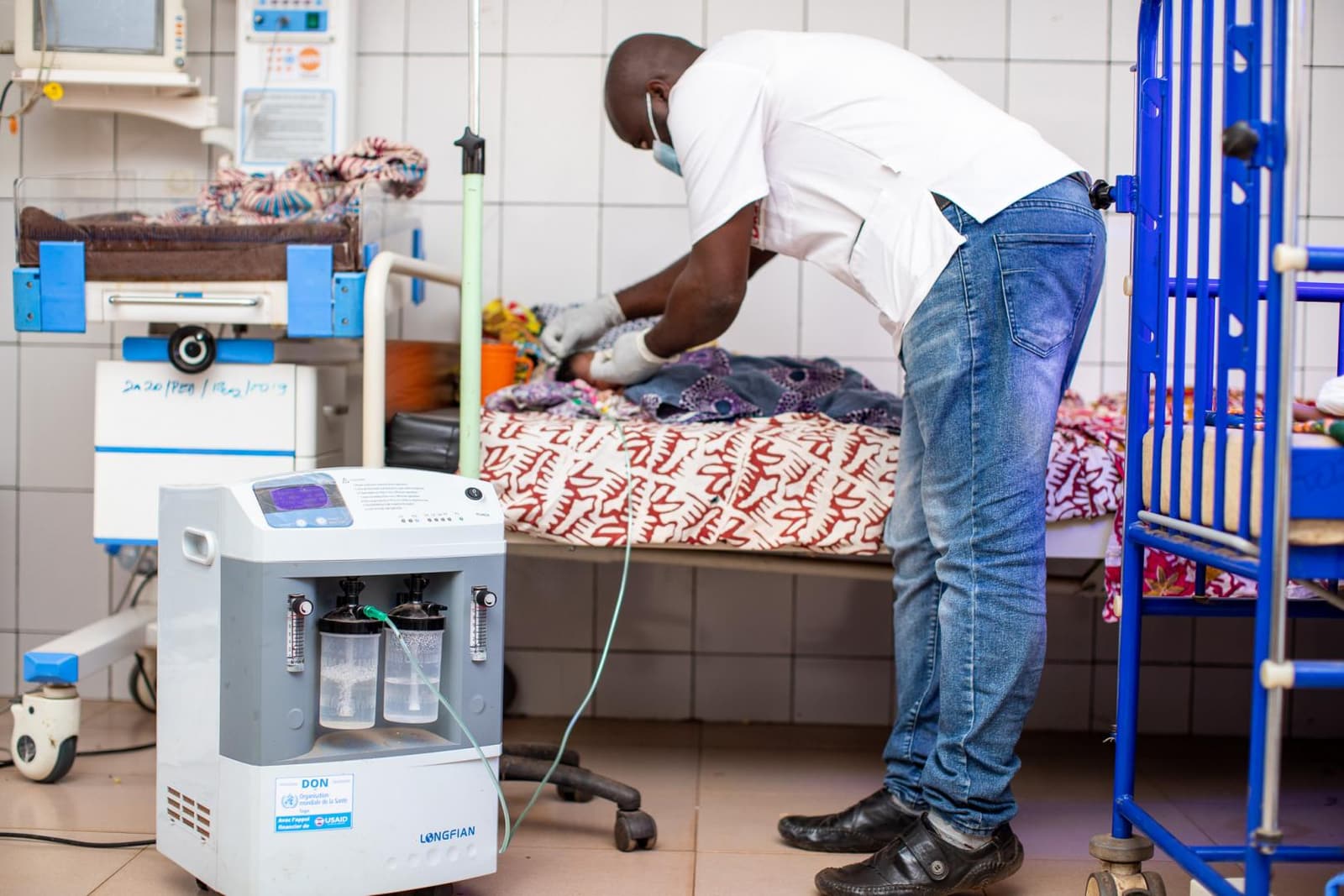
The machine in the foreground of the photograph is not an oxygen tank. No truck filled it, and no hidden cylinder is slowly emptying inside. While it runs, the concentrator pulls in the same room air surrounding the bed, keeps most of the nitrogen for a few seconds, sends an oxygen-rich stream toward the patient, then throws the nitrogen back into the room.[1][2]
That is the elegant part. The sobering part is the power cord.
An oxygen concentrator replaces one dependency—a chain of filled cylinders—with another: a continuously working compressor, timed valves, clean filters, healthy molecular sieves, verified output, electricity, and people able to recognize failure. It can make a remote ward less dependent on deliveries. It cannot make medical oxygen independent of infrastructure.[3][4]
The useful verb is not “make,” but “separate”
Ambient air is roughly 78% nitrogen and 21% oxygen, with argon and other gases making up most of the remainder. A concentrator does not synthesize oxygen atoms. It separates a useful fraction of the oxygen already present.[1][2]
The sequence begins with filtration. Room air enters through an intake filter, then a compressor raises its pressure. In the standard pressure-swing adsorption process, that compressed air is directed into a vessel packed with zeolite, a porous aluminosilicate mineral. Under pressure, nitrogen interacts more strongly than oxygen with charged sites inside the zeolite's microscopic pore network. Nitrogen therefore sticks to the material while much of the oxygen passes onward.[1][2]
“Molecular sieve” can make this sound like a kitchen strainer whose holes admit one molecule and reject another solely by size. The chemistry is subtler. Aninda Das and Anindita Das describe the selective capture as a quadrupolar interaction between nitrogen and the electric field created by charge-balancing ions in the zeolite. Pressure increases how much nitrogen the bed can hold; lowering pressure lets the material release it again.[2]
This is why the name contains the whole mechanism: pressure swing adsorption. Pressure rises, nitrogen adsorbs onto the sieve, oxygen-rich gas moves forward. Pressure falls, nitrogen desorbs, and the sieve becomes available for another cycle.
Two beds turn a stop-start reaction into a flow
One zeolite bed would produce oxygen only intermittently. Once loaded with nitrogen, it would have to stop and regenerate. A typical concentrator solves that timing problem with two beds and a set of fast valves.[1][2]
While bed A is pressurized and capturing nitrogen, bed B is depressurized and venting the nitrogen it captured during the previous cycle. Then the valves switch their roles. A small part of the product gas may help purge the regenerating bed, and a reservoir smooths the alternating pulses into a steadier output. The patient does not experience the machine as two chemical columns taking turns; the patient experiences a continuous flow.[1][2]
The product is concentrated oxygen, not the greater-than-99% oxygen made by cryogenic air separation. The 2025 Lancet Global Health Commission describes bedside concentrator output as generally 90–95% oxygen. That range is not an inferior imitation of “real” oxygen: oxygen made by an approved concentrator can be a legitimate medical source. But flow, concentration, and pressure have limits, so a bedside unit cannot substitute for every cylinder, plant, pipeline, or liquid-oxygen installation.[3][4]
This distinction is easy to lose when the machine is described as endlessly self-refilling. It is renewable only while the separation cycle stays inside specification. If a filter blocks, a compressor weakens, a valve mistimes, moisture damages the sieve, or a user demands more flow than the device can supply while maintaining concentration, gas may still emerge from the outlet without being the intended product. Air movement is not proof of oxygen purity. That is why technical specifications include concentration monitoring, low-output alarms, preventive maintenance, and performance checks rather than treating a humming fan as evidence of success.[1][3][4]
2019, 2020, 2023: the box became a systems test
On January 14, 2019, WHO and UNICEF published harmonized technical specifications for oxygen-therapy devices. The guide addressed far more than procurement: selection, use, and maintenance belonged in the same document because oxygen equipment works only as a chain from source to patient monitoring.[1]
The COVID-19 pandemic then turned that engineering principle into a global emergency. UNICEF says it procured more than 15,000 concentrators in 2020. Yet its subsequent resilient-concentrator project begins with an admission: many available machines were developed for home use where temperature and electricity are controlled, not for facilities facing dust, heat, humidity, altitude, voltage fluctuations, or weak repair networks.[5]
The project's target profile is revealing precisely because it is demanding. UNICEF sought devices able to operate from 0–40°C, at up to 95% relative humidity and 2,000 metres altitude, while using substantially less energy and tolerating common power problems.[5] Those are design targets, not a promise that any concentrator in a cardboard box will perform under those conditions. They identify the environment as part of the device.
The photograph offers a concrete field case. Facilities in Togo began using WHO-supported concentrators in December 2022; WHO's report, published on April 28, 2023, said all 39 health districts had received support. At Tsévié Regional Hospital, the machines reduced dependence on delivered cylinders, and the deployed units could provide up to 10 litres per minute. Staff training was part of the rollout.[6]
The scene does not prove that concentrators are the best oxygen source everywhere. It shows what the technology can change when its scale matches the ward: oxygen can be produced beside the bed instead of arriving only when transport, stock, and household finances align. The compressor converts electricity and room air into a local clinical supply. The health worker converts that supply into care.
A power cut is an oxygen interruption
The trade is now clear. A cylinder stores oxygen but depends on filling, transport, regulators, safe handling, and inventory. A concentrator avoids repeated refilling but depends on uninterrupted electricity every minute it is expected to produce.[3][4]
The Lancet Global Health Commission estimated in February 2025 that 374 million people need medical oxygen each year and that 82% live in low- and middle-income countries. It also found that operating expenses account for roughly 50–80% of the total cost of oxygen systems; electricity is the largest variable cost for concentrators and pressure-swing plants, while distribution logistics dominate cylinder systems.[4]
Those figures explain why a cheap purchase price can be a false victory. A donated machine without protected power, spare filters, oxygen analysers, trained technicians, a service budget, and a fallback source may become silent equipment—or worse, equipment that sounds alive while delivering out-of-specification gas. The Commission's facility evidence found poor concentrator functionality where preventive maintenance was weak and emphasized mixed oxygen sources with backups rather than one universal technology.[4]
Capacity matters too. Bedside concentrators are portable and relatively inexpensive, but their output is low-pressure and low-volume compared with bulk systems. Patients or devices requiring very high flow or higher pressure may need another source. A facility also needs a plan for demand peaks, multiple simultaneous patients, maintenance downtime, and the interval before a generator starts. “Produces oxygen from air” answers a chemistry question. It does not answer a hospital's capacity question.[3][4]
The number at the outlet is not the treatment
Oxygen is an essential medicine, not a generic wellness gas. The complete clinical loop includes assessment, pulse oximetry, the appropriate delivery interface, prescribed flow or concentration, monitoring, and a decision about when to escalate or stop. A concentrator supplies one part of that loop.[3][4]
That boundary protects the technology from two opposite myths. The first says a concentrator is merely a weak cylinder; the separation chemistry shows why that is wrong. The second says it is an inexhaustible oxygen box; the power, maintenance, output, and clinical limits show why that is wrong too.
The better mental model is a small air-separation plant with a bedside job. It inhales room air, alternates between two mineral beds, keeps nitrogen briefly, and releases oxygen-rich gas into a measured care pathway. Its brilliance is not that it abolishes an oxygen system. Its brilliance is that, with the right system around it, it can move oxygen production close enough to the patient that a delivery truck no longer decides every breath.
Sources
- World Health Organization and UNICEF, WHO-UNICEF Technical Specifications and Guidance for Oxygen Therapy Devices (14 January 2019) — concentrator process, device selection, procurement, operation, performance, and maintenance requirements.
- Aninda Das and Anindita Das, “Quadrupolar Interaction with Zeolite and Pressure Swing Adsorption in Portable Medical Oxygen Concentrators,” Resonance 27 (2022) — zeolite chemistry, nitrogen selectivity, and the alternating two-bed cycle.
- World Health Organization, Foundations of Medical Oxygen Systems (17 February 2023) — source, distribution, regulation, delivery, monitoring, infrastructure, and backup-system boundaries.
- Graham HR et al., “Reducing global inequities in medical oxygen access: the Lancet Global Health Commission on medical oxygen security,” The Lancet Global Health 13 (2025) — global need estimates, concentrator capabilities, mixed-source planning, power, maintenance, and total-cost evidence.
- UNICEF Office of Innovation, “Resilient Oxygen Concentrators” — 2020 procurement scale and the power, climate, altitude, efficiency, durability, and maintenance requirements behind its target product profile.
- WHO Regional Office for Africa, “Au Togo, les concentrateurs d’oxygène sauvent des vies !” (28 April 2023) — Togo deployment details, staff training, district coverage, bedside use, and the Tsévié clinical photograph used as the article image.