The word kwashiorkor entered English-language medicine carrying knowledge that medicine had not produced. Ga-speaking families on the Gold Coast already had a name for the sickness Williams was trying to distinguish: a disease associated with the older child being displaced at the breast when another baby arrived. In her 1935 gloss, Williams rendered the meaning as “the disease the deposed baby gets when the next one is born.”[2][3]
That origin changes the shape of her biography. Cicely Delphine Williams did not discover an invisible illness that nobody in West Africa had noticed. Nor did she settle its cause. Her more durable achievement was to connect three kinds of evidence that colonial medicine habitually kept apart: a recurring clinical pattern, caregivers' account of when it appeared, and the material sequence of weaning onto a monotonous diet.[1][2][3]
The result was a diagnosis strong enough to survive the theory first attached to it. Williams helped medicine see that these children did not have pellagra. Her suspicion that protein or an amino acid might be missing was careful, not conclusive. Later institutions converted that suspicion into a much larger “protein gap” story whose confidence outran the evidence.[5][6] The best way to understand Williams, then, is not as the owner of a disease or the author of its final mechanism. It is as a clinician who kept listening long enough to make an uncertain pattern discussable.
A clinic assembled from borrowed rooms
Williams arrived in the British Gold Coast colony in 1929 as a medical officer. The formal setting mattered: she worked inside a colonial service whose authority, categories, and budgets were not locally controlled. Yet the practical geography of her work extended beyond a single hospital. The Royal College of Physicians records that she ran small clinics in garages, schoolrooms, and shopfronts, trying to join treatment to prevention and to the circumstances of family life.[4]
At the Princess Marie Louise Hospital for Children in Accra, she repeatedly saw children whose illness did not fit the most convenient label. They were generally very young. Their diets after inadequate or interrupted breastfeeding relied heavily on maize preparations. They could have swelling of the extremities, distinctive skin damage, inflamed mucous membranes, irritability, diarrhoea, wasting, and—in fatal cases—an extremely fatty liver.[1]
Her December 1933 report in Archives of Disease in Childhood described the syndrome in children roughly one to four years old. Its title, “A nutritional disease of childhood associated with a maize diet,” was deliberately descriptive.[1] Williams did not yet call the condition kwashiorkor in print, and she did not claim that maize itself was a poison. She observed an abnormal feeding pattern, separated the syndrome from infections and familiar deficiency diseases, and wrote that “some amino acid or protein deficiency cannot be excluded.”[1]
That sentence is the hinge. It proposed a line of inquiry while preserving uncertainty. The children improved when an adequate diet was introduced early, but response to food did not identify one deficient molecule. The paper's strength lay in the assembled pattern: age, feeding history, skin and gut signs, oedema, behaviour, and pathology belonged together.
The argument with pellagra
The pattern immediately met resistance. H. S. Stannus, an influential authority on deficiency disease in Africa, argued in 1934 that Williams was describing pellagra, the niacin-deficiency disease already associated with maize-based diets. Williams returned with details from 60 further cases and made the differential diagnosis more explicit in The Lancet on 16 November 1935.[2][3]
Pellagra and kwashiorkor could share an impoverished food environment, but Williams argued that their clinical courses and skin lesions were not interchangeable. She also noted a practical inconsistency in the pellagra explanation: arkassa, a fermented maize preparation fed to children in Accra, contained yeast, then used as an anti-pellagra food. Later trials of nicotinic acid would likewise fail to make kwashiorkor behave like pellagra.[3]
The 1935 paper added the local name. That was more than an exotic label pasted onto a European case definition. In Williams's gloss, kwashiorkor carried a sequence within it: a new birth, an older child weaned, breast milk replaced, and a disease emerging through the reorganization of food and care. A laboratory name might have foregrounded a presumed nutrient. The Ga name kept the household transition visible before the biochemical explanation was secure.[2][3]
It also kept the question open. A name based on the observed social pattern could remain useful when the proposed mechanism changed. This is why the word outlasted “infantile pellagra,” “malignant malnutrition,” and the most confident versions of protein deficiency. It identified a recognizable form of oedematous malnutrition without pretending that recognition and explanation were the same act.[5][6]
What the protein story clarified—and concealed
Williams had good reason to look toward diet. The cases clustered after weaning; the replacement food was starch-heavy; milk could be part of successful early treatment; and the syndrome was not corrected by treating it as a vitamin deficiency.[1][2] By the late 1940s and 1950s, international nutrition institutions made protein the dominant explanation. Kwashiorkor became evidence for a worldwide protein shortage, and protein-rich supplements—especially milk products—became a favored technological answer.[5][6]
That framework did useful work. It insisted that a swollen child could be severely malnourished even when oedema concealed weight loss. It directed attention to diet quality, not calories alone. It helped standardize a syndrome that clinicians in different regions had described under different names.[6]
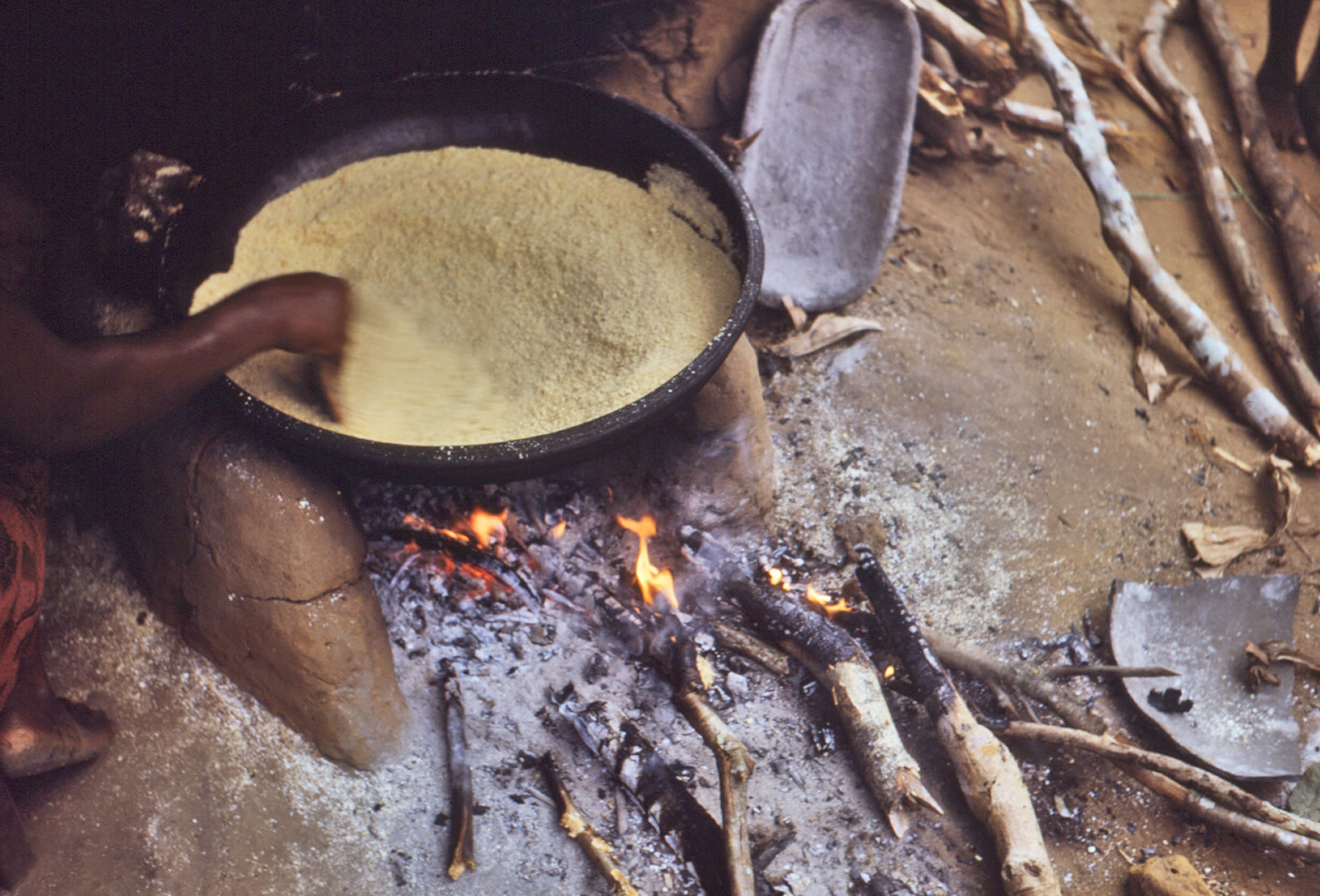
The cover photograph records that institutional afterlife in a Nigerian-Biafran refugee camp in 1968. A hand stirs protein-enriched corn-soya food over a wood fire for distribution primarily to children diagnosed with kwashiorkor.[8] It is not an image of Williams's Gold Coast clinic. It belongs to the story because, three decades later, the category she defended had become an operating term for mass nutrition assessment and relief.
But it also became too neat. Children with marasmus could consume diets that looked similarly deficient without developing oedema. Protein intake alone could not explain why one child became wasted and another oedematous, or why infection, metabolism, the gut, oxidative injury, and social conditions seemed to alter the presentation. Reviews of the evidence have repeatedly concluded that a simple chain—too little protein, low albumin, oedema—does not account for every case.[5][6]
The distinction matters historically. Williams's original wording left protein as a possibility. The later “protein gap” elevated a hypothesis into a global diagnosis, then treated imported protein as if it could solve a problem also made by poverty, food access, unsafe feeding conditions, infection, disrupted breastfeeding, and weak health services.[5] The clinical category endured; the single-cause confidence did not.
Listening inside a colonial system
There are two tempting ways to flatten this story. The first makes Williams a lone European-trained discoverer bringing scientific sight to an unknowing population. That is untenable: the disease already had a name, and that name encoded an epidemiological observation. The second treats her use of the word as simple appropriation and leaves no room for the clinical fight she undertook against colleagues who discounted both her evidence and the local category.[3][5]
The history sits between those versions. Williams listened unusually well for a physician working in a colonial hierarchy. She asked caregivers, took the answer seriously, and let their word challenge an established diagnosis. She also remained an officer of a system that could turn hunger into a technical defect in African diets and shift attention away from colonial political economy. Historian John Nott argues that the medicalization of kwashiorkor helped make a social crisis look like an endemic African nutritional problem, inviting commodity solutions while obscuring how scarcity was produced.[5]
Williams was not outside that paternalism. Some of her writing blamed ignorance and made broad judgments about African child care.[5] But her work also contained a countercurrent: treatment could not be separated from the home, the caregiver, or the conditions to which a child returned. The fair credit is therefore precise. She did not originate the local knowledge, and she did not finish the science. She built a bridge by which a locally recognized pattern could force its way into clinical argument.
The method traveled farther than the mechanism
Williams left the Gold Coast for Malaya in 1936. In Singapore in 1939, her “Milk and Murder” address attacked the promotion of sweetened condensed milk and commercial breast-milk substitutes where poverty and unsafe preparation made them dangerous. After wartime internment, she became the first head of maternal and child health at the new World Health Organization in 1948.[3][4]
Those later roles were not an unrelated second career. They extended the same operating idea. A child-health service had to combine curative and preventive work, use small community clinics and home visits, support local health workers, and listen before prescribing a universal technique.[4] Williams's biography is coherent not because she carried one nutrient theory around the world, but because she kept moving the clinical gaze outward—from lesion to diet, from diet to household, and from household to service design.
The language of current policy shows both continuity and correction. WHO's 2023 guideline is titled around “wasting and nutritional oedema (acute malnutrition),” a deliberately descriptive formulation. It treats oedema as a serious clinical sign without requiring an old one-nutrient story to explain every child. Its recommendations join treatment to breastfeeding support, nutrient-dense home foods, community health workers, and care for mothers and infants as an interdependent pair.[7]
That is a better afterlife for Williams than a discovery myth. The name kwashiorkor survived because it attached medicine to a pattern that families already knew. The protein theory did not survive intact because a useful hypothesis had been asked to carry too much. What remains is the harder discipline her best work modeled: observe closely, ask what a community calls the problem, separate a syndrome from its rivals, and do not confuse a plausible cause with a finished explanation.
Sources
- Cicely D. Williams, “A Nutritional Disease of Childhood Associated with a Maize Diet,” Archives of Disease in Childhood 8(48), 1933 — original clinical description, feeding histories, signs, pathology, treatment observations, and bounded causal hypothesis.
- Cicely D. Williams, “Kwashiorkor: A Nutritional Disease of Children Associated with a Maize Diet,” The Lancet, 16 November 1935; reprinted by the Bulletin of the World Health Organization — primary naming and differential-diagnosis paper.
- Jennifer Stanton, “Listening to the Ga: Cicely Williams' Discovery of Kwashiorkor on the Gold Coast,” in Lawrence Conrad and Anne Hardy, eds., Women and Modern Medicine (Rodopi, 2001), pp. 149–172 — historical reconstruction of the clinics, Stannus debate, 60-case follow-up, local name, and Williams's later career.
- Royal College of Physicians Museum, “Cicely Delphine Williams” — institutional biography covering Williams's Gold Coast clinics, maternal-and-child-health approach, Malaya, and WHO work.
- John Nott, “'No One May Starve in the British Empire': Kwashiorkor, Protein and the Politics of Nutrition Between Britain and Africa,” Social History of Medicine 34(2), 2021 — analysis of colonial nutrition politics, local knowledge, medicalization, and the protein-gap framework.
- Richard D. Semba, “The Rise and Fall of Protein Malnutrition in Global Health,” Annals of Nutrition and Metabolism 69(2), 2016 — review of Williams's early hypothesis, the postwar protein consensus, and the evidence that complicated a single-deficiency model.
- World Health Organization, WHO Guideline on the Prevention and Management of Wasting and Nutritional Oedema (Acute Malnutrition) in Infants and Children Under 5 Years (2023) — current terminology and integrated prevention-and-care framework.
- Centers for Disease Control and Prevention / Dr. Lyle Conrad, “Corn Soya Milk Cooked at a Nigerian-Biafran Refugee Camp” (1968), PHIL #7146, via Wikimedia Commons — source page and provenance for the archival cover photograph.