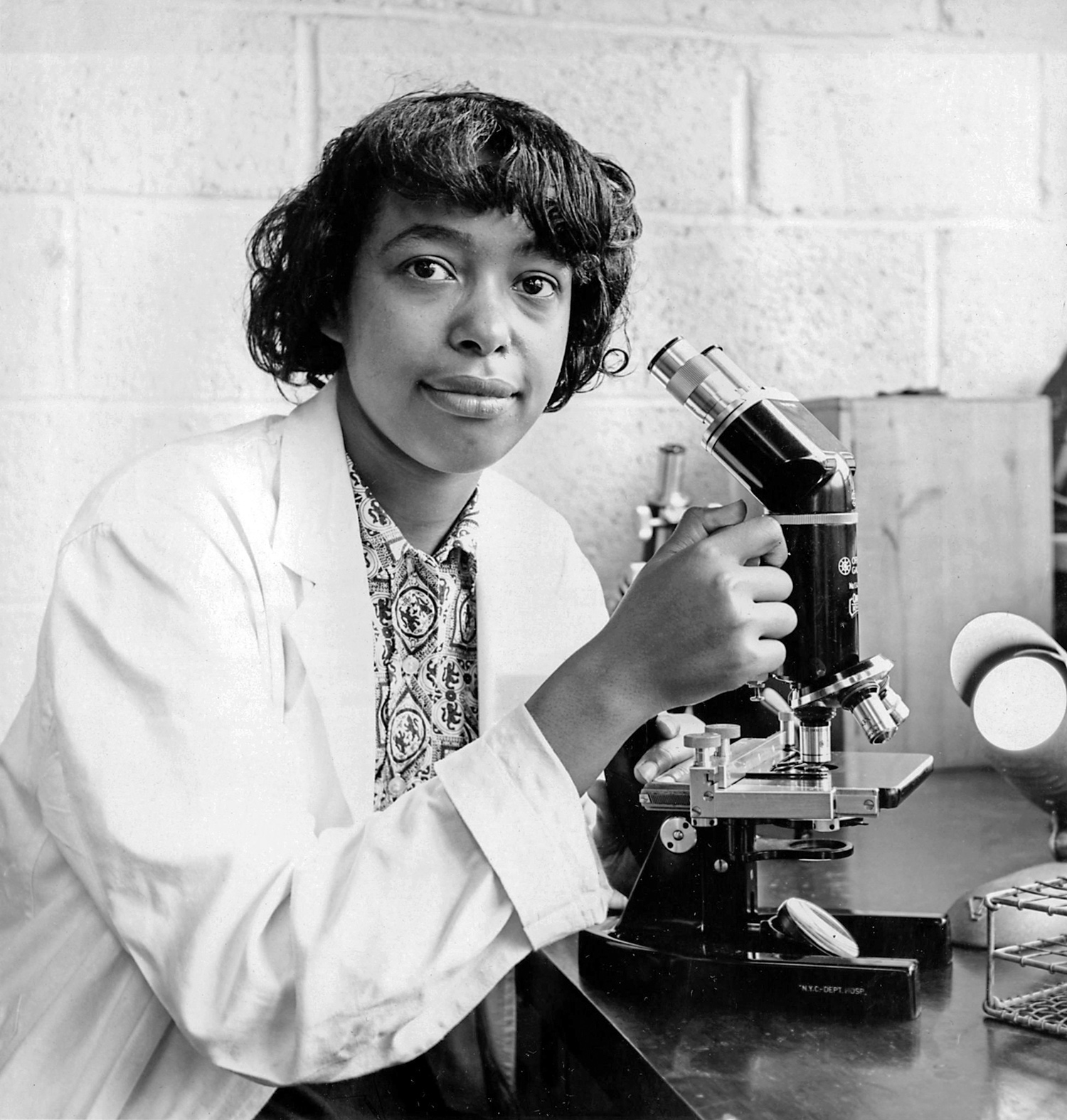
The microscope is almost as large as Patricia Bath's head. In Herbert S. Sonnenfeld's 1959 photograph, the sixteen-year-old steadies its focus with one hand and looks directly at the camera. She was spending the summer on a National Science Foundation-supported research program at Yeshiva University's Albert Einstein College of Medicine, years before she became an ophthalmologist. The image makes an irresistible origin story: gifted student meets instrument, then grows up to invent another one.[1]
But it captures only half of Bath's method. Her career did not proceed in a straight line from microscope to patent. It moved repeatedly between two distances: the gap separating a patient from eye care, and the fraction of a millimeter separating a surgical tool from a clouded lens. Bath treated both as design problems.
That connection is easy to lose in a biography built from “firsts.” Bath was the first African American resident in ophthalmology at New York University, the first woman appointed to the ophthalmology faculty at UCLA's Jules Stein Eye Institute, and, according to the U.S. Patent and Trademark Office, the first African American woman to receive a patent for a medical device.[1][2] Those milestones matter because they record doors that had been closed. Yet the more revealing story lies in what she tried to build after entering: a form of eye care that could travel outward, and an instrument that could work inward.
Two hospitals made an unequal map
Bath graduated from Howard University College of Medicine in 1968, interned at Harlem Hospital in 1968–69, and then held an ophthalmology fellowship at Columbia University in 1969–70.[2] Moving between institutions exposed a contrast larger than their physical distance. Patients arriving at Harlem carried serious eye disease but had less access to specialist care; Columbia offered a richer concentration of ophthalmic services. Bath's later writing converted that clinical impression into a population argument.
Her 1979 paper, “Rationale for a Program in Community Ophthalmology,” drew on blindness-register data collected in a 16-state reporting area from 1968 through 1970. In the 1970 table, recorded blindness prevalence was 252.7 per 100,000 among Black residents and 127.1 per 100,000 among white residents. The age-standardized rate attributed to glaucoma was 6.5 per 100,000 for Black residents and 0.8 per 100,000 for white residents.[3]
Those figures are often compressed into the cleaner claim that Black Americans were twice as likely to be blind and eight times as likely to be blinded by glaucoma. Bath's paper supports that approximate contrast, but it also supplies its limits. The reporting system covered selected states, some cells were not calculated because race was missing, and additions to blindness registers were only a proxy for true incidence. Its racial categories reflect the period's administrative data, not a biological explanation.[3]
Read carefully, the paper's force does not depend on pretending the registry was perfect. The pattern was consistent enough to pose a practical question: why were people being recorded with severe or preventable vision loss when examination and treatment existed? Bath's answer was not a new molecule. It was a missing route.
Community ophthalmology was a clinical mechanism
Bath called her proposed route community ophthalmology. She defined it as a discipline combining preventive medicine, public health, and clinical ophthalmology. Its basic components were health education and outreach screening, built after an epidemiological and demographic assessment of the community. She stressed that visual-acuity and intraocular-pressure checks could be adapted to community settings and performed without elaborate equipment, while abnormal findings could be routed onward for specialist care.[3]
This was more specific than bringing charity medicine to a neighborhood. It changed the sequence of care. The conventional clinic waits for a patient to recognize a problem, find a specialist, secure an appointment, and arrive before disease has destroyed useful vision. Bath's model moved the first contact upstream: explain warning signs, screen where people already are, identify risk, then connect detection to treatment. Community participation was part of the mechanism, not decoration.[3]
The model also clarifies what screening cannot do. A pressure check is not glaucoma treatment. Finding a cataract does not remove it. Outreach creates value only if referral, diagnosis, surgery, medication, and follow-up remain connected. Bath's contribution was to place that delivery chain inside the definition of ophthalmology instead of treating access as someone else's social problem.
Then the bottleneck narrowed to one millimeter
Bath joined the UCLA and Charles R. Drew University faculties in 1974. By 1981, she had conceived the device that became known as the Laserphaco Probe. Research time in Paris and Berlin gave her access to laser facilities she could not readily use in Los Angeles, and the surviving archive places her Laserphaco work across more than three decades of laboratory notes, patent correspondence, presentations, and business records.[1][2][5]
The first patent is precise about the problem. A cataract is an opaque lens that must be removed before an artificial lens can replace it. Bath proposed a flexible line one millimeter or less in diameter. An optical fiber would deliver coherent laser radiation to disintegrate lens material; a surrounding irrigation sleeve would bring in liquid; an aspiration sleeve would carry the fragments out. One claim specified fragments smaller than 0.1 millimeter, while another specified laser wavelengths between 193 and 351 nanometers. Bath filed the application on December 18, 1986; U.S. Patent 4,744,360 was granted on May 17, 1988.[4]
The crucial invention was not “a laser near an eye.” It was a managed interface. Energy had to reach the cataract without uncontrolled damage, fluid had to stabilize and cool the working space, and debris had to leave through the same narrow surgical route. The probe joined ablation, irrigation, and aspiration into one instrument architecture.[4]
That architecture rhymes with community ophthalmology without being the same achievement. At neighborhood scale, Bath connected detection to referral. At instrument scale, she connected light delivery to fluid delivery and removal. In both cases, the isolated capability—an eye examination, a laser—was insufficient. The interfaces made it useful.
What a patent can prove
Celebratory accounts sometimes jump from Bath's patent to the assertion that her probe is the basis of every modern cataract operation. The cited record does not establish that lineage. A patent proves that a defined invention met the legal standard for a grant; its claims and diagrams show what Bath designed. It does not, by itself, prove comparative safety, widespread adoption, or displacement of another technique.
That boundary matters because contemporary cataract surgery is generally described differently. The National Eye Institute says modern phacoemulsification uses an ultrasonic probe to break up the cloudy lens, after which the material is suctioned out and an artificial lens is implanted.[6] NEI reports that about nine in ten people see better after cataract surgery, while also noting the operation's real risks.[7] Laser systems have roles in eye surgery, but “laser” is not a synonym for the standard ultrasonic phacoemulsification platform.
The careful claim is still substantial. Bath invented and patented a particular laser-based apparatus for ablating and removing cataractous lenses, pursued related patents, and developed the work across an international research network.[1][4][5] Her accomplishment does not need an inflated adoption story. The patent itself is evidence of an ophthalmologist reasoning as an engineer—and doing so while institutions offered women, especially Black women, far less routine access to laboratories, capital, patent counsel, and professional recognition.[1]
The archive keeps the hard part visible
The Smithsonian's Patricia Bath Papers occupy 13 cubic feet, with 31 boxes and four map folders. The Laserphaco series contains drawings, research notes, test documentation, correspondence with attorneys and the USPTO, manufacturing material, and records of lawsuits Bath brought to retain her intellectual property.[5] That inventory complicates the lone-genius portrait. Invention appears not as one flash at a microscope but as years of access negotiations, experiments, applications, revisions, ownership disputes, and efforts to move a device beyond the bench.
Bath returned to this problem near the end of her life. In testimony before a U.S. Senate subcommittee on April 3, 2019, she framed her experience as part of a systemic loss: people cannot become inventors merely by having good ideas if they are denied early exposure, mentorship, research resources, and a navigable patent system.[1] She died the following month. Three years later, the National Inventors Hall of Fame inducted her posthumously.[1]
The teenager in the 1959 photograph therefore deserves a second look. The microscope mattered, but so did the grant, the teacher who nominated her, the laboratory that admitted her, and the public record that preserved the image. Talent became work because an access chain briefly held.
One career, two kinds of access
Bath's 1979 registry analysis should not be mistaken for a modern estimate, and her 1988 patent should not be mistaken for proof that Laserphaco became the universal cataract standard. Keeping those boundaries visible makes her career more coherent, not less.[3][4][6]
She saw preventable blindness as a failure that could occur at several interfaces. A person might never meet an eye-care worker. A screening result might never become treatment. A surgeon might have a source of energy but no safe way to deliver it, cool the field, and remove fragmented tissue. An inventor might have a workable design but no straightforward path through institutional and patent systems.
Bath worked on each interface at its own scale. Community ophthalmology moved the front door of eye care. Laserphaco compressed a surgical workflow into a narrow probe. Her biography joins them through a demanding idea: sight is not restored by knowledge or technology merely existing. It is restored when a system carries them all the way to the person who needs them.
Sources
- U.S. Patent and Trademark Office, “Sights on the Prize” — institutional biography, archival 1959 photograph, career chronology, invention history, and Bath's 2019 testimony.
- U.S. National Library of Medicine, “Dr. Patricia E. Bath,” Changing the Face of Medicine — education, appointments, community-ophthalmology work, and Laserphaco research chronology.
- Patricia E. Bath, “Rationale for a Program in Community Ophthalmology,” Journal of the National Medical Association 71(2), 1979 — full text, historical registry tables, methodological limits, and program design.
- Patricia E. Bath, U.S. Patent 4,744,360, “Apparatus for Ablating and Removing Cataract Lenses” (filed 1986; granted 1988) — patent record, abstract, claims, dimensions, and patent-family chronology.
- Smithsonian Institution, National Museum of American History, “Guide to the Patricia Bath Papers” — collection scope and records of Bath's medical, community, laboratory, patent, and intellectual-property work.
- U.S. National Eye Institute, “NEI Charts a Clearer Future for Cataract Prevention and Treatment” — description of modern ultrasonic phacoemulsification and the cataract-surgery pathway.
- U.S. National Eye Institute, “Cataract Surgery” (updated December 5, 2024) — current patient-facing description of the operation, outcomes, recovery, and risks.