Open-heart surgery is often compressed into one clean heroic frame: John Gibbon invents a machine, an 18-year-old patient survives in 1953, and modern cardiac surgery begins. The historical record supports a narrower and more useful reconstruction. The machine mattered when it created a controlled interval in which venous blood could leave the body, be oxygenated, and return to the arteries long enough for a surgeon to see and repair a defect under direct vision.[1][2][3][4][5]
That threshold did not arrive in a single stroke. It arrived through a long chain: a 1930 bedside shock, animal experiments that slowly proved physiologic possibility, engineering help in the late 1940s, a failed first human case, a successful but nearly compromised second case on May 6, 1953, and then later refinements that made the whole arrangement reproducible beyond one laboratory.[2][3][4][5] Read that way, the heart-lung machine becomes more than an invention story. It becomes a reconstruction of how a surgical impossibility turned into a managed system.
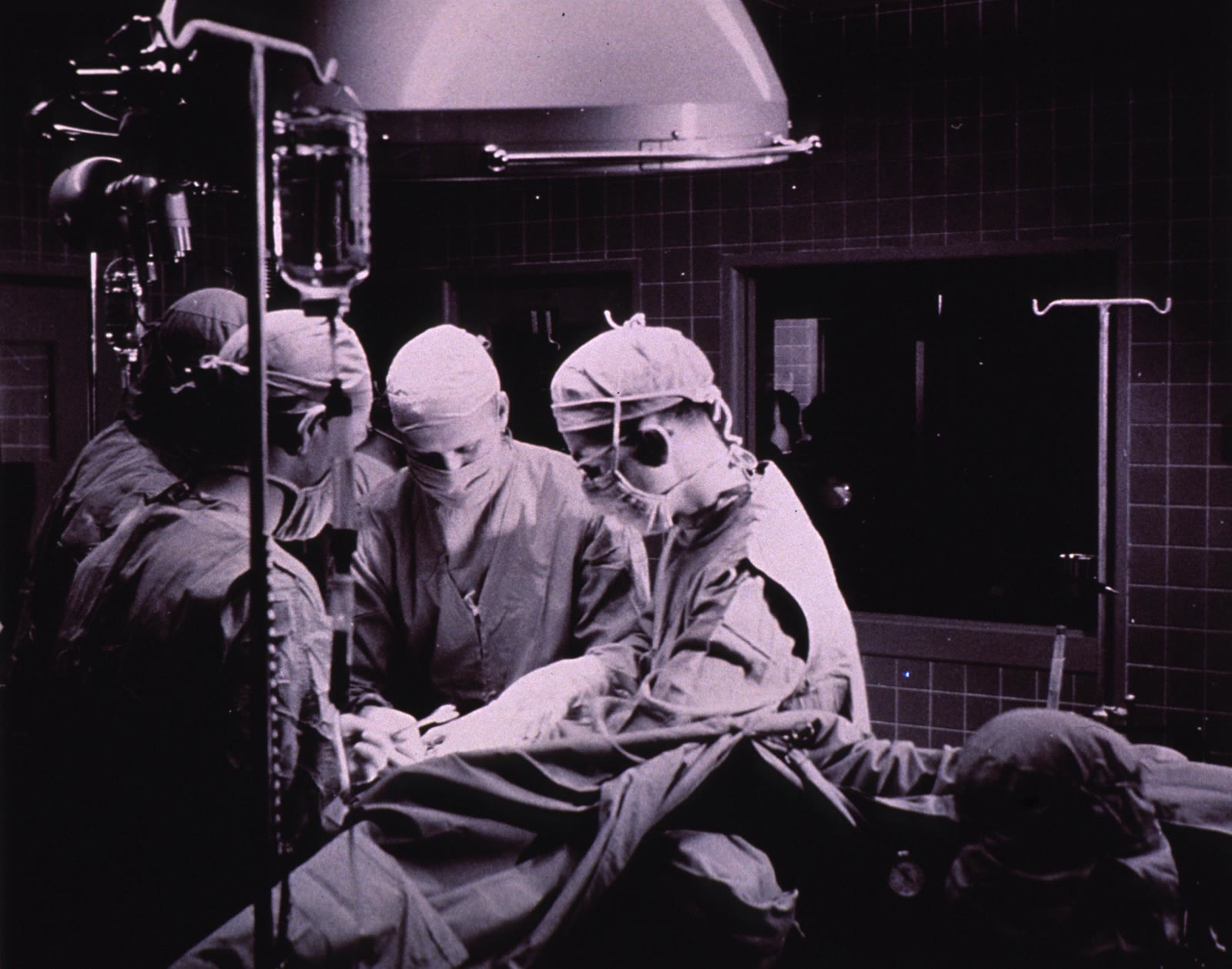
Image context: the cover image is a real archival NIH operating-room photograph from 1955. It belongs here because the breakthrough was environmental as much as mechanical. Open-heart surgery required an entire room to work in sequence: machine, tubing, anticoagulation, monitoring, diagnosis, and a team ready to respond before the operative window closed.[6]
Timeline anchors before interpretation
- 1930: after witnessing a patient die during surgery for pulmonary embolism, Gibbon conceives the idea of a machine that could temporarily support cardiac and respiratory function during operations on the heart and lungs.[4]
- 1935: Lasker's historical summary says Gibbon's experiments had already shown that life could be maintained by an external machine performing the work of the heart and lungs in an experimental animal.[3]
- Late 1940s: with IBM support, Gibbon and his collaborators build a more sophisticated pump-oxygenator after years of earlier experimental work.[4]
- February 1952: according to William Stoney's later reconstruction, Gibbon's team judges the device ready for clinical use after dog experiments in which the machine could support circulation for an hour or more and 9 of 10 dogs survived a sham right-atrial operation.[2]
- 1952: F. John Lewis closes an atrial septal defect under moderate hypothermia, while C. Walton Lillehei's cross-circulation work begins to show a different route to intracardiac repair, each with sharp limits of its own.[2][5]
- May 6, 1953: Gibbon's second clinical case succeeds: a large atrial septal defect is closed under cardiopulmonary bypass after 45 minutes of partial bypass and 26 minutes of total bypass.[2]
- 1955: Mayo's modified Mayo-Gibbon pump-oxygenator begins to convert a dramatic proof into a repeatable operative program.[5]
1. The idea began as a time problem at the bedside
The most important thing about the 1930 origin story is that it was practical before it was visionary. The National Inventors Hall of Fame summary says Gibbon conceived the heart-lung machine after watching a patient die during pulmonary embolectomy.[4] The problem in front of him was painfully specific: the surgeon could reach the chest, but could not stop the circulation long enough to repair what needed repair while still preserving the patient's life.
That framing matters because it keeps the machine tied to its original clinical task. Gibbon was not pursuing a theatrical substitute for the body. He was trying to buy time inside a region of surgery where time had been nearly absent.[4] Once the heart had to be opened, the surgeon faced a brutal tradeoff between visibility and survival. The whole later history turns on stretching that interval.
2. Animal proof solved physiologic possibility, not routine surgery
The long middle phase of the story is easy to flatten into generic "years of research." The sources are more concrete than that. Lasker's award history says that by 1935, Gibbon had already demonstrated in animals that life could be sustained by an external apparatus doing the work of the heart and lungs.[3] The Inventors Hall account adds that over the next decade, he and Mary Gibbon developed experimental devices that kept cats on complete cardiopulmonary bypass for 25 minutes.[4]
Even then, physiologic proof did not equal surgical readiness. Stoney's 2009 Circulation reconstruction shows why the team waited so long. By 1952, they had finally reached a machine-and-protocol package that could support dogs for an hour or more, allow a sham right-atrial operation, and still leave 9 of 10 animals alive.[2] That is the point at which the event changes category. The question is no longer whether extracorporeal circulation is conceivable. The question becomes whether it can survive the messiness of diagnosis, anticoagulation, oxygenation, and human surgical timing.
The late-1940s IBM collaboration belongs in that same operational story. The Inventors Hall page notes that Gibbon persuaded IBM president Thomas J. Watson to provide technical help in building a more sophisticated device.[4] The significance of that partnership lies in what it implies: the machine had become too demanding to remain a one-surgeon workshop project. Open-heart surgery was already turning into an engineering problem before it became a routine medical service.
3. By 1952, Gibbon was competing against stopgaps, not emptiness
One reason the 1953 case matters is that the field around it was no longer empty. Mayo's historical review points out that F. John Lewis had already repaired an atrial septal defect in 1952 with moderate hypothermia and caval inflow occlusion.[5] Stoney adds the hard boundary: at about 30°C, surgeons had only 5 to 7 minutes of safe circulatory arrest, enough for a short atrial defect closure but not for more complex intracardiac work.[2]
The other rival pathway was cross circulation. Mayo summarizes the attraction and the problem in one move: Lillehei and colleagues used the circulation of a healthy donor to support the patient, which opened longer operative possibilities but exposed another person to anesthesia, anticoagulation, cannulation, and the risk of air embolism.[5] Stoney's account makes the tradeoff even clearer. Lillehei achieved real surgical milestones, yet donor accidents and the ethical burden of putting a parent at risk kept the method from becoming a stable general solution.[2]
That is why the heart-lung machine's role should be stated precisely. It did not simply make heart surgery imaginable. Heart surgery was already being attempted. What Gibbon's bypass system promised was a way to lengthen the operative window without cooling the patient into a narrow time slot and without borrowing another person's circulation to keep the case alive.[2][5]
4. The first human attempt failed, and the second nearly failed for a different reason
Stoney's reconstruction is especially valuable here because it preserves the part triumph narratives tend to delete. The first patient placed on Gibbon's machine was a 15-month-old child thought to have an atrial septal defect. Once the chest was open and bypass had begun, no atrial defect was found; the child deteriorated and died, and postmortem examination revealed a large patent ductus arteriosus instead.[2] The lesson was hard and structural. A heart-lung machine could not rescue a wrong preoperative diagnosis.
The second case, the one that entered history, went differently because more pieces aligned. The patient was an 18-year-old college student with repeated right-heart-failure episodes and a catheterization-confirmed atrial septal defect.[2] On May 6, 1953, Gibbon and his team opened the chest, placed her on cardiopulmonary bypass, and closed a large atrial defect with a continuous suture. The machine supported 45 minutes of partial bypass and 26 minutes of total bypass.[2]
Even then, the operation was not a smooth demonstration. Stoney records a major intraoperative problem: the heparinized blood used to prime the oxygenator had not been anticoagulated heavily enough, clot began forming on the oxygenator screens, and oxygen saturation dropped while Gibbon was still at the defect.[2] He had planned to place a pericardial patch. Because the machine's situation was worsening, the team abandoned the slower plan and closed the defect as quickly as possible with a continuous suture.[2] The patient recovered and was awake within an hour, but the lesson of the successful case was broader than "the machine worked." The machine worked inside a rapidly adjusted system that included anticoagulation judgment, diagnosis, and operative improvisation.[2]
The original 1954 paper remains important because it fixes that history in the primary record. Gibbon did not present a simple miracle device. He presented a clinical application of mechanical support to cardiac surgery, with the full burden of actual cases attached to it.[1]
5. The threshold was real in 1953, but routine cardiac surgery arrived later
It is tempting to let the story end on May 6, 1953. The sources resist that shortcut. Stoney notes that Gibbon performed two additional open-heart operations in 1953, and both patients died.[2] Initial reaction was muted in part because the machine's early record was one success and three deaths, and in part because atrial septal defect closure had already been achieved by other techniques.[2]
This is the point where interpretation matters. If one asks whether Gibbon crossed a threshold in 1953, the answer is yes. Lasker and Jefferson are right to treat the operation as a world-historical threshold: it was the first successful open-heart operation performed with a heart-lung machine, and it proved that total cardiopulmonary bypass could carry a patient through direct intracardiac repair.[3][4] But if one asks when the procedure became a system rather than an event, the answer extends beyond that date.
Mayo's account captures the next step. By 1955, John Kirklin's group used a modification of the Mayo-Gibbon pump-oxygenator in a series of open-heart operations with some success.[5] That is the stronger marker for the birth of modern cardiac surgery as an organized field. A threshold becomes a system when the technique survives repetition, staffing, and transfer beyond the original inventor's room.
The strongest two interpretations
Interpretation A: the heart-lung machine changed surgery on one triumphant day in May 1953
This interpretation persists because it contains a true core. The May 6, 1953 case did demonstrate that a machine could sustain total cardiopulmonary bypass long enough for direct intracardiac repair in a human being.[2][3] Without that event, the later field would have lacked its proof point.
Interpretation B: the decisive change was a longer systems threshold from 1930 through 1955
This interpretation fits the evidence better. The bedside idea dates to 1930. Animal work in 1935 and after proved physiologic feasibility.[3][4] By 1952, dog experiments suggested clinical readiness, but diagnosis still failed the first patient and anticoagulation nearly failed the second.[2] Rival techniques such as hypothermia and cross circulation had already shown what shorter windows and donor-supported windows could and could not do.[2][5] Routine adoption required later refinements beyond Gibbon's own early series.[2][5]
Current assessment: Interpretation B is stronger. The machine changed surgery because it eventually created a reproducible operative window, not because one dramatic case by itself settled every surrounding problem.
What would change the assessment: evidence that Gibbon's 1953 setup could already produce a durable multi-case program without later diagnostic, anticoagulation, and machine refinements would strengthen the single-day reading. The sources here point the other way.[2][5]
What the reconstruction changes
The heart-lung machine matters in health history because it changed the unit of surgical ambition. Before reliable bypass, surgeons could work around the heart, cool the body for a few minutes, or ask a donor circulation to help. After bypass matured, they could plan operations that treated intracardiac repair as a matter of managed time, oxygenation, and flow.[2][5]
That is why the event remains larger than a machine biography. It is a story about when medicine learns that a device is never only a device. It is also diagnosis, anticoagulation, staffing, monitoring, and the discipline to turn one narrow success into a repeatable clinical environment. The breakthrough came when all of those layers finally held together long enough for the open heart to stop being a dare and start becoming a field.[1][2][3][4][5]
Sources
- John H. Gibbon, "Application of a mechanical heart and lung apparatus to cardiac surgery" (Minnesota Medicine, March 1954) — original case-series paper reporting the 1953 clinical operations.
- William Stoney, "Evolution of Cardiopulmonary Bypass" (Circulation, 2009 PDF) — detailed historical reconstruction of the 1952-1955 transition, including the failed first case, the May 6, 1953 operation, Lewis's hypothermia case, and Lillehei's cross-circulation work.
- Lasker Foundation, "Heart-lung machine for open-heart surgery" — award history summarizing Gibbon's 1935 animal proof and the first successful heart-lung-machine-assisted open-heart operation in May 1953.
- National Inventors Hall of Fame, "John Gibbon" — origin story, 1930 pulmonary-embolectomy inspiration, experimental bypass work in cats, and IBM support in the late 1940s.
- Mayo Clinic, "Congenital heart disease: The first 50 years … the next 50 years" — concise account of Lewis's 1952 hypothermia repair, the donor-risk boundary of cross circulation, and the Mayo-Gibbon pump-oxygenator in 1955.
- Wikimedia Commons / U.S. National Library of Medicine, "Open-heart surgery, NIH, 1955 (4644490799).jpg" — source page for the archival operating-room photograph used as the article image.