Normal saline has the most persuasive name in hospital medicine. It sounds like the default against which everything else must prove itself: normal, isotonic, familiar, cheap, stocked everywhere. The myth begins when that name is mistaken for physiological neutrality. A liter of 0.9% sodium chloride is not plasma. It is a high-chloride crystalloid that can be entirely reasonable in many circumstances and still be the wrong fluid to treat as harmless by definition.[1][3]
Balanced crystalloids, including lactated Ringer's and Plasma-Lyte-type solutions, entered the debate because they try to place sodium, chloride, potassium, buffers, and osmolality closer to extracellular fluid. That does not make them magical or universally superior. It makes the clinical question sharper: when a patient needs intravenous crystalloid, is the relevant risk dominated by speed, volume, access, compatibility, potassium or calcium concerns, brain injury concerns, kidney vulnerability, sepsis physiology, or local workflow?[1][2][4][5]
This is not bedside advice for patients to request one bag over another. It is an evidence reading. The modern fluid debate is useful precisely because it resists slogans. Small pragmatic trials suggested kidney-signal benefits for balanced crystalloids. Earlier and later multicenter trials were more cautious or null. The right lesson is not "saline is poison" or "balanced fluids are hype." The right lesson is that even basic hospital supplies carry assumptions, and those assumptions should be tested in the populations where they are used.
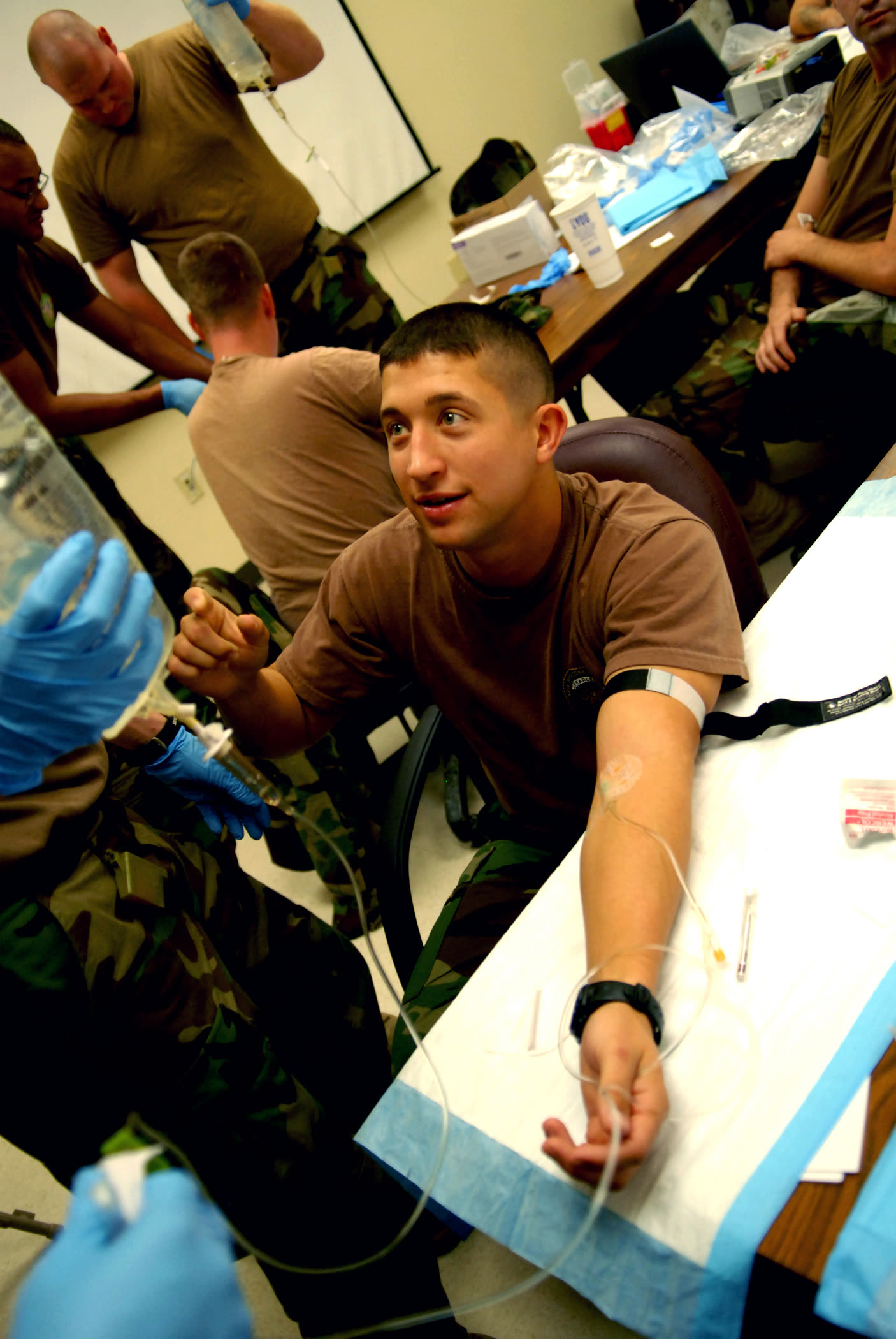
Image context: the cover uses a real U.S. Navy photograph of saline solution being administered by IV in 2008.[6] It is not a glamorous ICU image, and that is the point. Crystalloids are ordinary enough to disappear into the background of care. The essay is about making that ordinary bag legible as a choice rather than a law of nature.
Myth: normal saline matches the body because it is called normal
The word "normal" refers to tonicity in a practical clinical sense, not to a perfect match with plasma. The concern with saline has long centered on chloride. In the SPLIT trial's introduction, the investigators described 0.9% saline as the most commonly used resuscitation fluid globally, while noting the hypothesis that its high chloride content could contribute to acute kidney injury in critically ill patients.[3] That hypothesis is biologically plausible: chloride-sensitive renal blood flow, acid-base shifts, and kidney stress are all reasonable mechanisms to study. Plausible, however, is not the same thing as proven for every patient.
The first major randomized caution came from SPLIT, published in 2015. It enrolled ICU patients across four New Zealand centers and compared a buffered crystalloid with saline in a cluster randomized, double-crossover design.[3] The conclusion was modest and important: buffered crystalloid did not reduce the risk of acute kidney injury in that population.[3] Renal replacement therapy was almost identical, 3.3% in the buffered group versus 3.4% in the saline group, and in-hospital mortality was 7.6% versus 8.6%, a difference that was not statistically significant.[3]
That result did not end the debate because SPLIT also had boundaries. The trial population had a relatively low incidence of kidney injury, the fluid volumes were modest, and many patients had already received fluids before enrollment.[3] The lesson was not that chloride physiology had been disproved. It was that a broad ICU exposure test in a lower-risk, modest-volume setting did not show a clear kidney advantage.
Evidence: the 2018 pragmatic trials made the signal harder to ignore
The fluid debate changed in 2018 because two large Vanderbilt trials tested default fluid strategy at scale. SMART studied critically ill adults in intensive care units, comparing balanced crystalloids with saline as the default crystalloid.[1] Its primary outcome was a major adverse kidney event within 30 days, a composite that included death, new renal replacement therapy, or persistent kidney dysfunction.[1]
The headline result was small but directionally coherent: among 7,942 patients assigned to balanced crystalloids, 1,139 had a major adverse kidney event, compared with 1,211 of 7,860 assigned to saline. That was 14.3% versus 15.4%, with a marginal odds ratio of 0.91 and a 95% confidence interval of 0.84 to 0.99.[1] In-hospital mortality by 30 days was 10.3% with balanced crystalloids and 11.1% with saline, a difference that did not meet the usual statistical threshold by itself.[1]
SALT-ED looked outside the ICU, in noncritically ill adults admitted from the emergency department.[2] Its primary outcome, hospital-free days through day 28, did not differ meaningfully: the median was 25 days in both groups. But the kidney composite again moved in favor of balanced crystalloids, 4.7% versus 5.6%.[2] That matters because a non-ICU trial should be less likely to show dramatic benefits if the intervention only helps the sickest patients. Seeing a smaller but similar kidney-signal direction made the saline question harder to dismiss.
Still, the magnitude must stay in view. A one percentage-point absolute difference in a composite kidney outcome is not a clinical revolution at the level of an individual bag. It becomes meaningful only because crystalloids are given to so many patients. That is the public-health logic inside the hospital: a tiny average shift can matter if the exposure is nearly universal, but it should not be oversold as a guaranteed bedside rescue.
Myth: after SMART and SALT-ED, every saline order became bad medicine
The stronger myth after 2018 came from the other direction. If balanced crystalloids showed a kidney-signal advantage, it was tempting to treat saline as obsolete. Later trials did not support that simple story.
BaSICS, published in JAMA in 2021, randomized 10,520 critically ill patients in 75 Brazilian ICUs who required fluid challenges.[4] The primary outcome was 90-day survival. Mortality was 26.4% in the balanced-solution group versus 27.2% in the saline group, with an adjusted hazard ratio of 0.97 and a 95% confidence interval from 0.90 to 1.05.[4] The authors concluded that the balanced solution did not significantly improve 90-day survival in that population.[4]
PLUS, published in 2022, took the question into 53 ICUs in Australia and New Zealand and compared Plasma-Lyte 148 with saline for ICU fluid therapy.[5] Ninety-day mortality was essentially identical: 21.8% in the balanced multielectrolyte group and 22.0% in the saline group. New renal replacement therapy was also similar, 12.7% versus 12.9%, and the maximum creatinine increase did not differ meaningfully.[5] The authors found no evidence that death or acute kidney injury was lower with the balanced solution.[5]
These trials do not erase SMART and SALT-ED. They do something more useful: they narrow the claim. Balanced crystalloids may reduce kidney-composite events in some pragmatic default-strategy settings, but large blinded multicenter ICU trials did not show a broad mortality or kidney-injury win across all critically ill adults.[1][2][4][5] The honest conclusion is conditional.
Evidence: the real decision is a boundary problem
Fluid choice sits inside several boundaries. The first is patient phenotype. A septic patient receiving multiple liters, a patient with diabetic ketoacidosis, a postoperative patient needing maintenance fluid, a trauma patient, and a neurologic patient do not all present the same tradeoff. Trials with broad enrollment can estimate average effects; they cannot make every subgroup identical.
The second boundary is volume. A small saline exposure is unlikely to carry the same risk profile as repeated liters in a patient already prone to kidney injury or acidosis. SPLIT explicitly noted modest fluid volumes as a limitation when interpreting its null findings.[3] BaSICS reported a median of 1.5 liters during the first day after enrollment.[4] PLUS delivered ICU fluid therapy under a controlled trial protocol, but even there the average result was not a universal verdict on every high-volume scenario.[5]
The third boundary is outcome choice. SMART and SALT-ED emphasized major adverse kidney events within 30 days, while BaSICS and PLUS centered 90-day mortality or death as the primary endpoint.[1][2][4][5] Those are not interchangeable questions. A fluid can plausibly change creatinine trajectories or renal replacement therapy without moving all-cause mortality in a heterogeneous ICU population. Conversely, a mortality-null trial can still leave room for kidney-specific preferences in selected settings.
The fourth boundary is implementation. SMART and SALT-ED were pragmatic, single-center, cluster-style default-strategy trials.[1][2] BaSICS and PLUS were large multicenter randomized trials with different blinding, geography, patient mix, and protocol details.[4][5] None of these designs is automatically superior for every question. Pragmatic trials may better capture real-world default behavior; blinded multicenter trials may better protect against bias and local practice effects. The evidence conversation should compare what each design is good at, not crown one result and discard the rest.
What should replace the slogan
The most defensible reading is that saline remains a useful crystalloid, but it should lose its aura of neutrality. Its familiarity does not prove that it is always the safest default. Balanced crystalloids have enough physiologic rationale and pragmatic kidney-signal evidence to be a reasonable default in many adult hospital settings, especially when kidney risk, acidosis, sepsis physiology, or larger cumulative volumes are part of the picture.[1][2][3]
At the same time, the evidence does not justify treating balanced crystalloids as a universal mortality-improving intervention. BaSICS and PLUS are too large and too direct to ignore.[4][5] A hospital that moves toward balanced crystalloids should do so because the balance of chemistry, kidney-signal data, cost, supply, and workflow makes sense for its patients, not because every saline bag has become malpractice.
The myth-vs-evidence boundary is therefore practical. Normal saline is normal only in the way many hospital defaults are normal: it is available, understood, compatible with many workflows, and historically entrenched. Balanced crystalloids are not miracle fluids; they are an attempt to make the default chemistry less chloride-heavy. The evidence asks clinicians and systems to stop reading the label as destiny. A clear bag can still be a consequential choice.[1][2][4][5]
Sources
- Semler MW et al., "Balanced Crystalloids versus Saline in Critically Ill Adults," New England Journal of Medicine, 2018 - open PMC record for the SMART trial, major adverse kidney events, and 14.3% vs 15.4% result.
- Self WH et al., "Balanced Crystalloids versus Saline in Noncritically Ill Adults," New England Journal of Medicine, 2018 - open PMC record for the SALT-ED trial, hospital-free days, and 4.7% vs 5.6% kidney-composite result.
- Europe PMC record for Young P et al., "Effect of a Buffered Crystalloid Solution vs Saline on Acute Kidney Injury Among Patients in the Intensive Care Unit: The SPLIT Randomized Clinical Trial," JAMA, 2015 - buffered crystalloid versus saline ICU trial and chloride-risk framing.
- Zampieri FG et al., "Effect of Intravenous Fluid Treatment With a Balanced Solution vs 0.9% Saline Solution on Mortality in Critically Ill Patients: The BaSICS Randomized Clinical Trial," JAMA, 2021 - open PMC record for the 75-ICU trial and 90-day mortality result.
- Finfer S et al., "Balanced Multielectrolyte Solution versus Saline in Critically Ill Adults," New England Journal of Medicine, 2022 - PLUS trial abstract and mortality, renal replacement therapy, and creatinine results.
- Wikimedia Commons, "US Navy 081203-N-3674H-278 Ensign Christopher Waldrop receives saline solution via intravenous therapy.jpg" - source page for the 2008 U.S. Navy IV-saline photograph used as the article image.