Glaucoma eye drops are often treated as if they were a simple fix: pressure is high, drops go in, vision is saved. The evidence is more exacting. Glaucoma is a group of diseases that damage the optic nerve and can cause vision loss or blindness; early symptoms are often absent, and treatment does not undo established damage.[1] Drops matter because eye pressure is the most treatable lever in many patients, not because a bottle can rebuild a damaged nerve.
That distinction changes the practical story. A good glaucoma plan is not "use drops until your eyes feel normal." Many people feel normal before damage is obvious. Nor is it "pressure is the whole disease." The National Eye Institute notes that some people with high eye pressure never develop glaucoma, while some people with normal eye pressure do.[2] The cleaner claim is narrower and stronger: lowering pressure can help stop glaucoma-related vision loss, and prescription drops are one common way clinicians do that.[1][2]
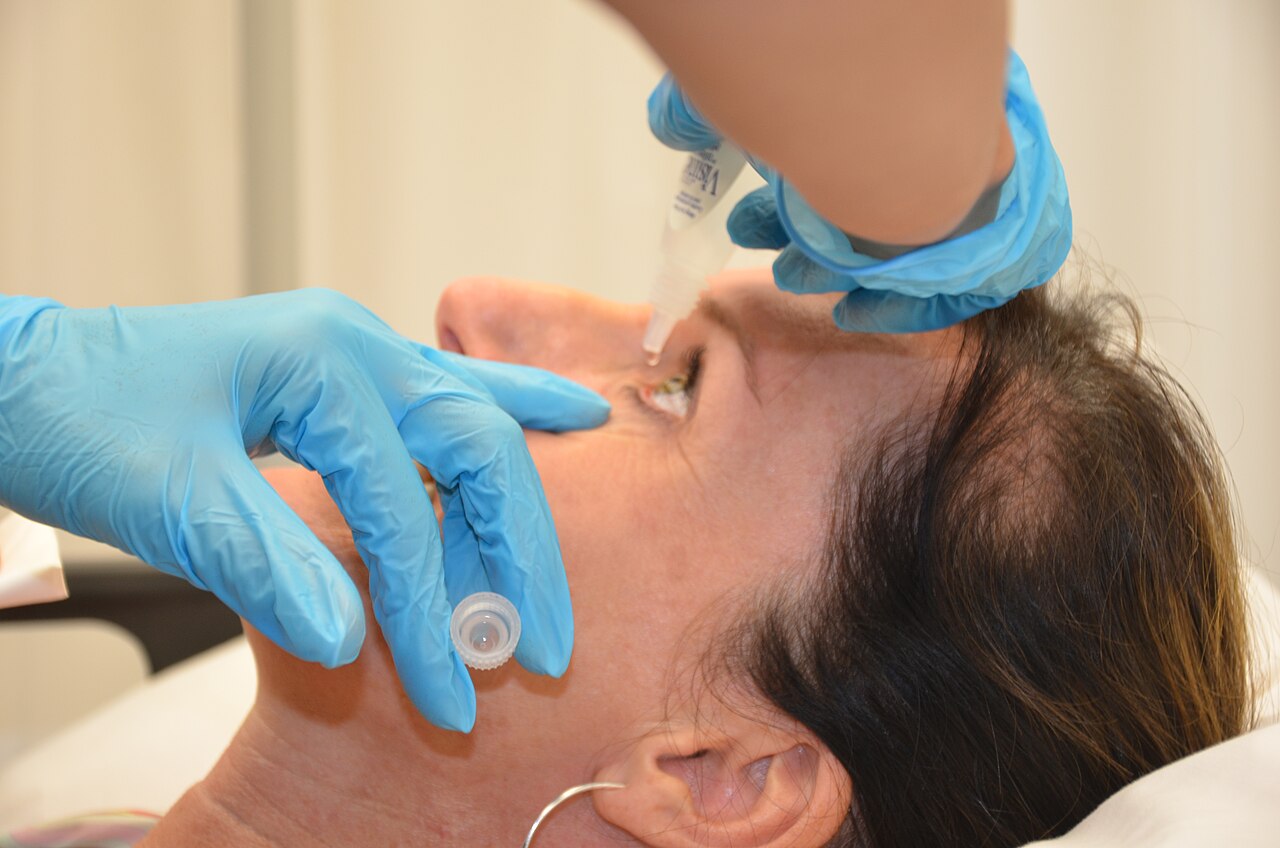
Image context: the cover image is a real photograph of eye medication being instilled. It fits because this article is about the gap between the visible ritual of taking drops and the less visible system of pressure targets, optic-nerve monitoring, side effects, and adherence.[7]
Timeline anchors
- February 1994 to October 1996: enrollment opened and closed in the Ocular Hypertension Treatment Study, a National Eye Institute-sponsored trial of people with ocular hypertension.[3]
- June 2002: the OHTS reported that topical ocular hypotensive medication could delay or prevent the onset of primary open-angle glaucoma in people with elevated intraocular pressure.[3]
- May 2024: CDC public-health guidance still described glaucoma as a leading cause of irreversible blindness and emphasized regular eye exams for diagnosis and treatment.[6]
- December 2024 and November 2025: NEI updated its eye-pressure and glaucoma pages, continuing to frame treatment around pressure control, early detection, and protection of remaining vision.[1][2]
- 2026: patient drug information for latanoprost still makes the boundary plain: the drop controls glaucoma but does not cure it.[4]
Myth 1: If I can see fine, glaucoma is not active
Evidence: early glaucoma can be quiet. NEI's patient page lists early symptoms as "often none" and says many people cannot tell that their vision is changing at first because loss usually begins in side vision and progresses slowly.[1] CDC makes the same public-health point in population terms: because glaucoma usually has no symptoms, only about half of people with glaucoma know they have it.[6]
This is why glaucoma care leans so heavily on measurement. The relevant events happen at the optic nerve, the visual field, and the pressure reading before they necessarily become a felt symptom. A patient may read, drive, and work normally while peripheral-field loss is beginning. Waiting for a subjective change is therefore a poor surveillance method.
The useful correction is not panic. It is humility about what vision feels like. The absence of symptoms is not proof that pressure is harmless, the optic nerve is stable, or the treatment plan is unnecessary. It is a reason regular exams and follow-up tests carry so much weight.[1][6]
Myth 2: Eye drops cure glaucoma
Evidence: drops can control pressure; they do not reverse established optic-nerve injury. NEI says there is no cure for glaucoma and that treatment will not undo vision damage, though it can stop damage from getting worse.[1] MedlinePlus says the same thing for latanoprost: it controls glaucoma but does not cure it.[4]
That boundary is not a minor disclaimer. It is the whole logic of early treatment. If glaucoma damage could simply be repaired later, missed detection would matter less. Instead, drops are used to lower intraocular pressure and protect remaining optic-nerve function. Some drops increase fluid outflow; latanoprost, for example, lowers pressure by increasing the flow of natural eye fluid out of the eye.[4] Other treatments, including laser procedures and surgery, can also be used when a clinician decides they fit the patient's disease and pressure goal.[1]
The myth turns control into repair. The evidence says control is valuable precisely because repair is limited. A drop that preserves remaining vision is doing important work even when it produces no dramatic feeling and no visible daily improvement.
Myth 3: Eye pressure alone tells the whole story
Evidence: pressure is central, but it is not a one-number diagnosis. NEI says high eye pressure increases glaucoma risk and that lowering pressure can help stop vision loss. It also says not everyone with high pressure develops glaucoma, and some people with normal pressure get glaucoma.[2]
The OHTS shows why clinicians take elevated pressure seriously without equating it with automatic disease. The trial enrolled 1,636 people with ocular hypertension, ages 40 to 80, who had normal optic nerves and reliable visual fields at enrollment.[3] Participants assigned to topical medication were treated as needed to reach a 20% reduction in intraocular pressure from baseline.[3] The point was not that every elevated reading was glaucoma. The point was to test whether lowering pressure in higher-risk eyes could reduce later development of primary open-angle glaucoma.
Even the enrollment criteria show the nuance. The study required intraocular pressure between 24 and 32 mm Hg in one eye and 21 and 32 mm Hg in the other, while also requiring normal optic discs and visual fields at the start.[3] That is the difference between a risk state and established optic-nerve damage. Pressure matters because it is modifiable, measurable, and biologically connected to optic-nerve risk. It does not replace the rest of the exam.
Myth 4: The bottle is the treatment
Evidence: the bottle is only useful if the drug reaches the eye, on the intended schedule, with side effects and barriers addressed. MedlinePlus describes latanoprost as one drop to the affected eye or eyes once daily in the evening, separated by at least 5 minutes from other eye drops.[4] It also gives concrete steps for instillation and warns not to stop without speaking with a doctor.[4]
An open-access adherence review explains why that simple instruction can fail in real life. Barriers include cost, patient education and literacy, health beliefs, treatment burden, physical limitations, forgetfulness, side effects, difficulty with eye-drop administration, and the fact that early glaucoma is usually asymptomatic.[5] The review reports an average glaucoma medication adherence estimate of about 60%, while noting that published glaucoma adherence estimates vary widely, from 5% to 80%.[5]
That means adherence is not a character test. It is a design problem in daily life. A person may miss drops because the bottle is hard to squeeze, the schedule conflicts with other medications, the eye burns, the refill runs out early, or the diagnosis feels unreal because vision still seems fine. Those are clinical facts worth naming. The most useful conversation is not "try harder"; it is "what exactly is preventing the plan from working?"
What the evidence leaves you with
Glaucoma drops are neither magic nor trivial. They are a pressure-control tool in a chronic optic-nerve disease where lost vision generally cannot be restored.[1][4][6] Their value depends on the match between diagnosis, target pressure, drug choice, technique, persistence, side-effect management, and follow-up.
The myth says the drop itself is the story. The evidence says the story is a loop: measure risk, lower pressure when indicated, check whether the optic nerve and visual field are stable, adjust when the plan is not working, and keep barriers visible enough to solve.[1][2][5] That is less comforting than a cure, but it is more useful. In glaucoma, protecting sight usually means treating a quiet disease before it proves itself loudly.
Sources
- National Eye Institute, "Glaucoma" (last updated November 26, 2025) - overview of symptoms, optic-nerve damage, diagnosis, treatment, and limits of repair.
- National Eye Institute, "Glaucoma and Eye Pressure" (last updated December 5, 2024) - relationship between intraocular pressure, optic-nerve risk, normal-tension glaucoma, and pressure lowering.
- NCBI dbGaP, "National Eye Institute (NEI) Ocular Hypertension Treatment Study (OHTS)" - enrollment dates, trial design, participant count, age range, pressure criteria, target reduction, and June 2002 report history.
- MedlinePlus, "Latanoprost Ophthalmic" (last revised November 15, 2025) - patient drug information on use, mechanism, timing, missed doses, side effects, and control-vs-cure boundary.
- Shannan G. Moore, Grace Richter, and Bobeck S. Modjtahedi, "Factors Affecting Glaucoma Medication Adherence and Interventions to Improve Adherence: A Narrative Review" (Ophthalmology and Therapy, 2023) - adherence rates, barriers, cost, health literacy, treatment burden, and intervention approaches.
- Centers for Disease Control and Prevention, "Current Glaucoma Programs" (May 15, 2024) - U.S. glaucoma burden, irreversible blindness framing, asymptomatic disease, and detection/follow-up programs.
- Wikimedia Commons, "File:Instilling eye medication.jpg" - photographic source page for the image of a medical professional applying eye drops.