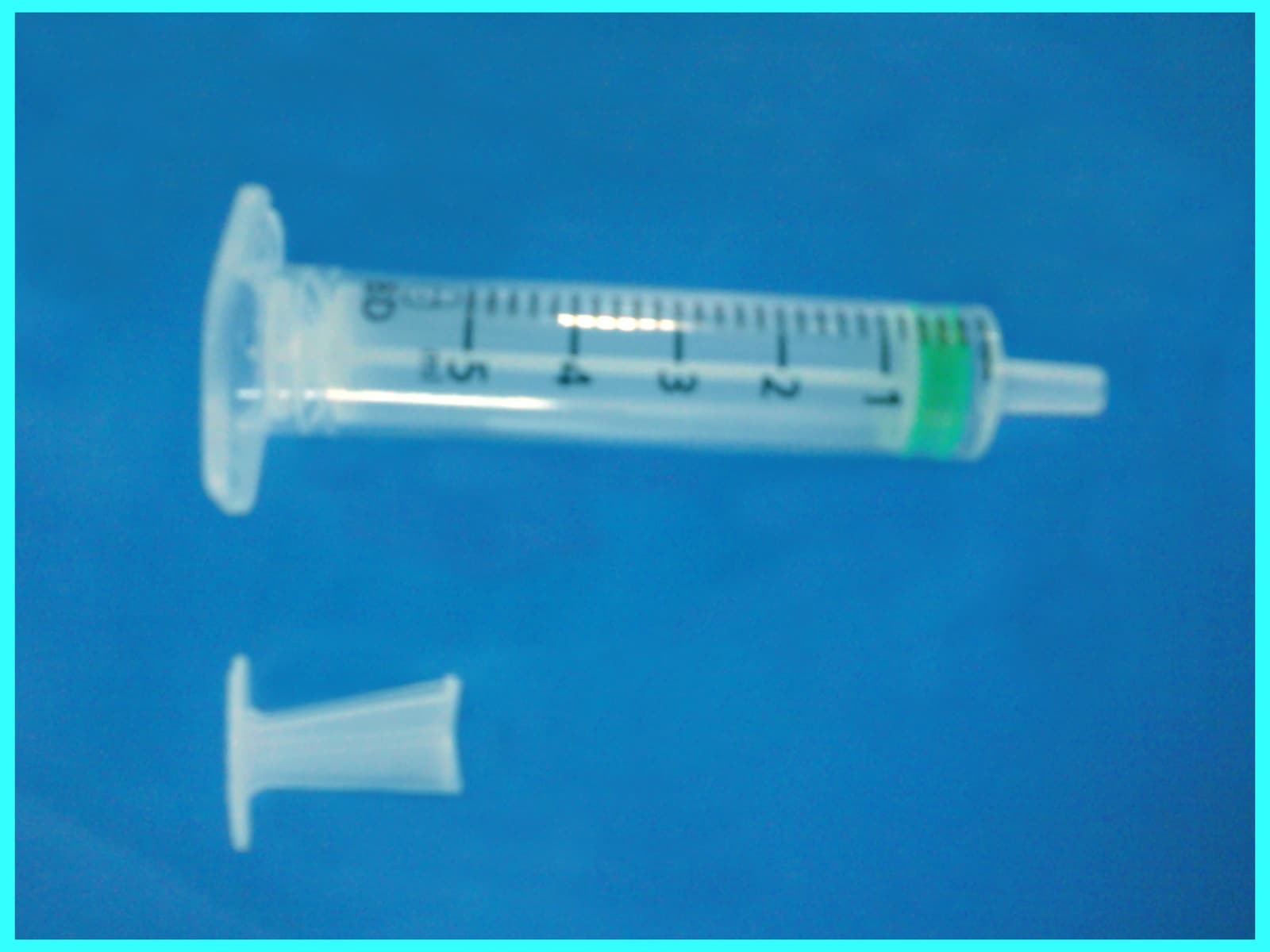
The most important part of an auto-disable syringe is not that it looks different. It usually does not. The change is hidden inside a familiar object: after one injection, the syringe locks, breaks, or otherwise prevents a second use. That small mechanical refusal matters because injection safety has always had a weak point that training alone cannot fully solve. A syringe can be sterile when it leaves the package and dangerous if it is used again.
That is the mechanism this article follows. Auto-disable syringes did not make injections risk-free. They did not solve contaminated medication vials, poor aseptic technique, sharps injuries, waste disposal, or the overuse of injections when oral medicine would work. But they changed one specific failure mode: a used syringe returning to the patient stream. The device turns a norm into a constraint. "Use once" stops being only an instruction and becomes part of the hardware.
WHO's 2015 "smart syringes" policy announcement explains why that mattered. The agency cited estimates from a WHO-sponsored 2014 study that, in 2010, unsafe injections caused up to 1.7 million hepatitis B infections, up to 315,000 hepatitis C infections, and as many as 33,800 HIV infections.[1] It also put the scale of injection practice in context: roughly 16 billion injections were administered each year, with about 90% given into muscle, skin, or similar routes for medicines rather than immunization or other procedures.[1] At that scale, a small behavioral failure can become a large population risk.
The failure was reuse, not merely ignorance
Unsafe injection is often imagined as a simple knowledge problem: teach people not to reuse needles and the hazard disappears. That is too thin. Reuse can come from stockouts, cost pressure, weak supervision, informal private practice, patient expectations for injections, poor waste handling, and the resale value of used equipment. The 1999 WHO-UNICEF-UNFPA joint statement is blunt about this context. It notes that unsterile practices were widespread, that insufficient supplies of syringes and needles were a major contributor, and that used equipment could be reused, sold, or recycled because it still had commercial value.[2]
The same document shows why the policy response became bundled rather than purely educational. It called for auto-disable syringes, vaccines, and safety boxes to be supplied together for campaigns, and urged countries to move away from standard disposable syringes for immunization by the early 2000s.[2] That bundling is the key public-health idea. A vaccine without a safe way to inject it is an incomplete intervention. A syringe without a safe box can still become a community hazard after the injection is over.
The causal chain therefore runs like this: injection demand creates repeated contact between sharp equipment and blood; reuse can carry blood-borne pathogens from one person to another; ordinary disposable syringes rely heavily on correct behavior after use; auto-disable syringes lower the chance that the same barrel can be reintroduced as if it were new. The device does not replace a safe system, but it removes one dangerous option from that system.
The mechanism sits in the plunger
The practical designs vary. WHO described smart syringes that break at a weak spot in the plunger if someone pulls back after use, models with a metal clip that blocks the plunger from moving back, and models in which the needle retracts into the barrel after injection.[1] PATH's technology summary describes auto-disable syringes as devices whose features automatically and permanently disable the syringe after a single use; it also notes fixed-dose volumes such as 0.05, 0.1, 0.25, 0.3, 0.5, and 1.0 mL.[6]
That fixed-dose detail is not trivia. It explains why auto-disable syringes fit immunization especially well. Vaccination often uses standardized dose volumes, repeatable workflows, and high-volume sessions. A device that gives one fixed dose and then disables itself is well matched to that setting. WHO's prequalification page now states that auto-disable syringes are the only type of single-use equipment WHO strongly recommends for vaccine administration in all settings, and it links that recommendation to the low risk of person-to-person transmission because the device cannot be reused.[3]
This is not magic. A poorly handled injection can still be unsafe. A needle can still injure a worker. A contaminated vial can still spread infection if a used syringe is inserted into it. A used auto-disable syringe still needs proper disposal. But the mechanism is powerful because it is narrow. It attacks the exact moment when a used syringe might otherwise be made ready for another person.
Procurement became part of prevention
One reason the auto-disable story is useful is that it shows prevention moving upstream. The safety decision is not made only by the nurse at the point of care. It is also made by the procurement officer, donor, immunization planner, manufacturer, warehouse manager, trainer, and supervisor. UNICEF's supply page places auto-disable syringes inside vaccine logistics, including the early 2021 effort to deliver 1 billion auto-disable syringes for COVID-19 vaccination campaigns.[5] That number makes the operational point: safe injection equipment is not an accessory. It is part of the vaccine supply chain.
WHO's prequalification system reinforces the same idea from the quality side. It lists auto-disable syringes under single-use injection devices and ties them to product specifications and verification protocols.[3] The point is not merely to buy "a syringe." It is to buy a syringe whose disabling feature, sterility, dose suitability, packaging, and performance can survive procurement at scale.
That upstream design also helps explain the policy difference between immunization and every possible injection. Auto-disable syringes are strongest where one-use fixed-dose delivery is the intended workflow. WHO's 2015 announcement explicitly recognized exceptions where blocking reuse would interfere with care, such as syringe pumps, and called for policies and standards for safe procurement, use, and disposal in settings where reusable potential remains necessary.[1] Good safety design does not pretend one device fits every procedure. It reduces risk where the fit is strong and names the boundary where it is not.
The remaining risks are different risks
CDC's injection-safety guidance is a useful guardrail because it prevents the story from becoming device triumphalism. The agency defines safe injection practices as including one-time use of needles and syringes and limiting medication-vial sharing, then lists unsafe practices such as reusing a syringe for more than one patient and "double dipping" into medication containers after a syringe has been used.[4] That means the auto-disable syringe solves only part of the larger injection-safety map.
This distinction matters in real clinics. If the problem is direct syringe reuse, the disabling mechanism is central. If the problem is drawing from a contaminated multidose vial, the answer also requires vial discipline, aseptic technique, medication labeling, and workflow separation. If the problem is needlestick injury, protection features and sharps containers matter. If the problem is too many unnecessary injections, substitution with oral medication or other care pathways can reduce exposure before a syringe is opened at all.[1][4]
The public-health success, then, is not that one object became perfect. It is that one object made one unsafe behavior harder to repeat. In a high-volume system, that is a serious gain. The most durable prevention tools often work this way: they do not ask every person to make a fresh perfect decision every time; they reshape the default so the dangerous path is less available.
The lesson is a system lesson
Auto-disable syringes changed injection safety because they joined four layers that are often discussed separately. First, there is biological risk: blood-borne pathogens can move when injection equipment is reused.[1][4] Second, there is device design: the plunger or needle mechanism can make reuse physically difficult.[1][6] Third, there is procurement policy: agencies can require safety-engineered devices rather than leaving each clinic to choose the cheapest familiar object.[2][3][5] Fourth, there is waste management: safety boxes and disposal planning prevent used sharps from becoming a second hazard after the clinical act is finished.[2]
That is why the phrase "one-use contract" fits. The contract is not only moral. It is mechanical, logistical, and institutional. The syringe disables. The campaign budget includes the right equipment. The supply chain delivers enough devices for the planned doses. The safety box receives the used sharps. The training explains exceptions instead of pretending all injections are identical.
The boundary should stay clear. Auto-disable syringes are not a reason to ignore broader infection prevention. They are not designed to solve syringe-service needs for people who inject drugs, where sterile access and harm reduction have different goals and device requirements. They are not a substitute for fewer unnecessary injections. Their value is more precise: where a clinical or immunization program intends a single-use injection, the safest design is one that does not calmly permit a second use.
That precision is the larger lesson. A safe injection is not just a sterile needle at the start. It is a chain that stays safe through dose preparation, administration, non-reuse, worker protection, and disposal. Auto-disable syringes made one link in that chain much harder to break.
Sources
- World Health Organization, "WHO calls for worldwide use of 'smart' syringes" (23 February 2015) - policy announcement, burden estimates, device mechanisms, injection-volume context, and exception boundaries.
- World Health Organization, UNICEF, and UNFPA, Safety of Injections: WHO-UNICEF-UNFPA Joint Statement on the Use of Auto-disable Syringes in Immunization Services (1999, PDF) - bundled vaccine, syringe, and safety-box policy.
- WHO Prequalification, "E008: Single-use Injection Devices" - current WHO prequalification category and recommendation context for auto-disable vaccine syringes.
- CDC, "Preventing Unsafe Injection Practices" - clinical safety guidance on one-time syringe use, medication-vial handling, and consequences of unsafe injection practices.
- UNICEF Supply Division, "Safe injection equipment" - supply-chain context for auto-disable syringes and vaccination logistics.
- PATH, Technologies for Injection Safety (November 2025, PDF) - device categories, auto-disable mechanism summary, dose-volume examples, and technology lineage.
- Wikimedia Commons, "File:Auto Disable Syringe.jpg" - photographic source for the article image.