Nitrate in drinking water is a quiet risk because the water usually gives no warning. It can look clear, taste normal, and smell ordinary while still carrying enough nitrate to matter for an infant. That is why the health problem is not simply "dirty water." It is a specific exposure chain: nitrate enters a well, formula turns that water into an infant's main fluid source, gut conditions convert some nitrate to nitrite, nitrite oxidizes hemoglobin into methemoglobin, and oxygen delivery falls even though the baby is still breathing.[1][2][3]
The phrase "blue baby syndrome" is memorable, but it can make the problem sound like folklore. The mechanism is more precise. EPA's national drinking-water rules set the nitrate maximum contaminant level at 10 mg/L measured as nitrogen and the nitrite maximum at 1 mg/L measured as nitrogen. EPA states that infants younger than six months who drink water above those limits can become seriously ill and, if untreated, may die; the named symptoms include shortness of breath and blue-baby syndrome.[1] The rule is built around a narrow protective target: keep the most vulnerable formula-fed infants away from water that can overload their oxygen-carrying system.
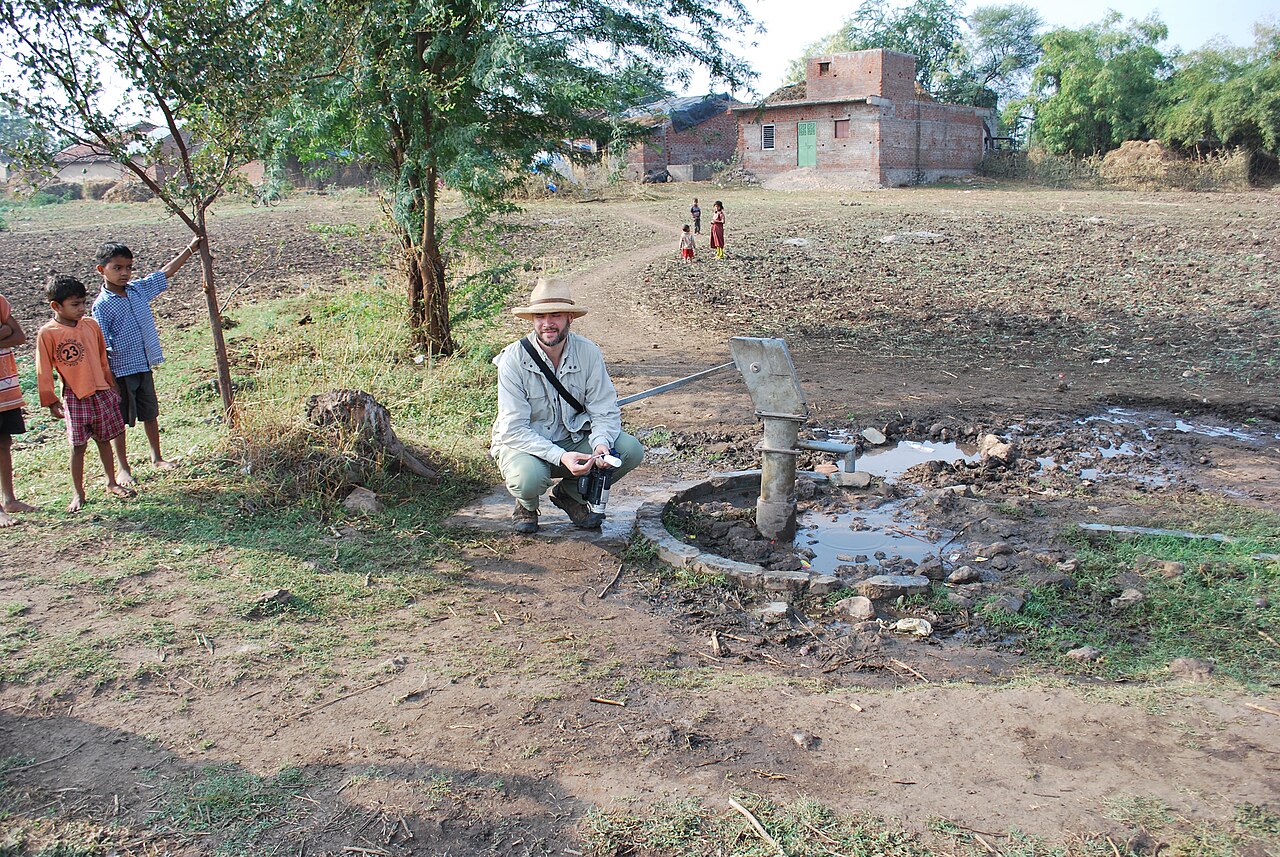
Image context: the cover is a real photograph of field testing at a hand well in Gujarat. It belongs here because the practical lesson is testing, not visual inspection. Nitrate cannot be seen, smelled, or tasted in well water; a household needs a sample result before it can know whether the water is safe for infant formula.[6][7]
The well is the exposure route
The first boundary is regulatory. EPA limits nitrate and nitrite in public drinking-water systems, but private wells sit in a different world. EPA's infant-focused private-well guidance says there are no requirements for testing private wells, but users should have well water tested, especially when an infant is in the household or a pregnancy is expected.[3] That makes nitrate a household infrastructure problem as much as a chemistry problem.
The geography of the risk is not random. EPA's contaminant table names fertilizer runoff, leaking septic tanks, sewage, and natural deposits as source pathways for nitrate and nitrite in drinking water.[1] ATSDR's clinical education page adds the practical field clue: when infant cyanosis may involve contaminated well water, clinicians should ask where the home is, what activities occur around it, what sewer system serves it, and what source supplies the family's drinking water.[2] In other words, a private well can turn surrounding land use into infant exposure without changing the appearance of the water.
The operational rule is blunt. EPA says not to mix well water containing more than 10 mg/L nitrate with infant formula or food; if the water exceeds that limit, or if its safety is uncertain, use bottled water, public-supply water that is tested, or water from a tested deeper well.[3] That does not say every rural well is unsafe. It says "our water has always seemed fine" is not a measurement.
Formula changes the dose
Adults get nitrate from many foods, especially vegetables, and that is not automatically a problem. WHO's nitrate and nitrite background document makes the exposure split clear: when nitrate concentrations in drinking water are low, food is usually the main source; when drinking-water nitrate exceeds 50 mg/L as nitrate ion, drinking water can become the major source, especially for bottle-fed infants.[4] The infant-formula point is crucial because powder formula makes water into food.
That is why the same nitrate concentration has different meanings in different bodies and routines. A breastfed infant is not usually drinking the well water directly. A formula-fed infant may be drinking it repeatedly all day. ATSDR says infants younger than four months who are fed formula diluted with water from untested rural domestic wells are especially prone to nitrate-related health effects.[8] Minnesota's health department gives the public-facing version: bottle-fed babies under six months are at the highest risk, and nitrate cannot be tasted, smelled, or seen in water.[6]
The private-well failure mode is therefore mundane. A family draws water from a tap, mixes formula carefully, and believes ordinary-looking water is ordinary risk. But nitrate is not a visible contaminant, and different contaminant types require different treatment methods.[3][6] The step that works for one hazard can fail for nitrate unless testing and appropriate treatment are part of the plan.
Nitrite is the blood problem
Nitrate itself is not the final actor. The mechanism runs through reduction to nitrite. ATSDR explains that high infant gut pH favors nitrate-reducing bacteria, and that fetal hemoglobin is more readily oxidized to methemoglobin by nitrites than adult hemoglobin is.[8] Minnesota's health department summarizes the clinical result: methemoglobinemia affects how blood carries oxygen and can produce bluish lips or skin, though the color change may be hard to detect in infants.[6]
Infants are not just smaller adults in this mechanism. ATSDR says infants younger than four months are most at risk through formula diluted with nitrate-contaminated water. It also gives the repair-side reason: at birth, the enzyme that reduces induced methemoglobin back to normal hemoglobin has only about half the adult activity, and does not reach adult levels until at least four months of age.[8]
That explains why the risk rule focuses so tightly on early infancy. The danger is not that every person who drinks nitrate-containing water immediately turns blue. The danger is that a bottle-fed infant can sit at the wrong intersection of dose, gut conversion, fetal hemoglobin, immature repair capacity, and repeated exposure.
The evidence is real, but not cartoon-simple
The classic warning remains justified, but the strongest evidence also keeps the story disciplined. EPA's HERO record for the 2000 Environmental Health Perspectives article "Blue babies and nitrate-contaminated well water" summarizes two Wisconsin cases in which infants became ill after formula was prepared with private-well water. Samples from the wells during the illnesses contained nitrate-nitrogen concentrations of 22.9 and 27.4 mg/L, more than twice the EPA limit.[5]
That case evidence fits the mechanism. It does not mean every infant methemoglobinemia case is caused by nitrate-contaminated well water alone. A separate EPA HERO record for Avery's 1999 review notes a more complex interpretation: gastrointestinal infection and inflammation may have contributed to many historical cases attributed to drinking-water nitrate.[2] WHO reaches a similar caution from another direction, noting that methemoglobinemia is complicated by microbial contamination and gastrointestinal infection, which can increase risk for bottle-fed infants when nitrate or nitrite is present.[4]
This is not a reason to ignore nitrate. It is a reason to stop treating the story as a single-factor fable. Nitrate-contaminated well water is a preventable exposure. Gastrointestinal infection, microbial contamination, and infant physiology can make that exposure more dangerous. The practical conclusion is broader than "avoid nitrate": the water used for infant formula should be both chemically and microbiologically safe.[3][4][6]
The prevention step is boring because it works
The most useful prevention rule is also the least dramatic: test the well before trusting it for infant formula. ATSDR's clinical education material says suspected contaminated well water should be replaced by an alternate water source until testing results are available, and it notes that EPA suggests annual private-well maintenance testing that includes nitrate, coliform bacteria, total dissolved solids, and pH.[2] Iowa's current private-well guidance says the only way to know if well water is safe to consume is to sample it and send it to a drinking-water laboratory; it recommends at least annual testing for coliform bacteria and nitrates, with arsenic testing as well.[6]
Clinical rescue matters, but treatment is the back half of the story. The front half is household prevention: know the well, test it, use an alternate safe water source when nitrate is elevated, and do not assume ordinary-looking water is safe for formula.
That is the cleanest way to read nitrate in well water. The disease name sounds dramatic, but the control point is ordinary infrastructure. A private well is not a public water system. Formula is not just powder. Boiling is not chemical treatment. And clear water is not evidence. The blood-oxygen problem begins at the tap, so prevention has to begin with a sample bottle and a lab result.[1][2][3][6]
Sources
- U.S. Environmental Protection Agency, "National Primary Drinking Water Regulations" - nitrate and nitrite MCLs, infant-risk language, and contaminant source notes.
- ATSDR, "Nitrate/Nitrite Toxicity: Initial Check" - clinical education page on infant methemoglobinemia, nitrate-contaminated well water, alternate water, and annual private-well testing.
- U.S. Environmental Protection Agency, "Private Wells and Drinking Water Safety and Infants" - private-well testing guidance, infant formula warning above 10 mg/L nitrate, and alternate-water advice.
- World Health Organization, Nitrate and Nitrite in Drinking-water - exposure routing, 50 mg/L nitrate guideline, bottle-fed infant basis, and microbial-contamination caveat.
- EPA HERO, Knobeloch et al., "Blue babies and nitrate-contaminated well water" (Environmental Health Perspectives, 2000) - two Wisconsin infant cases with private-well nitrate-nitrogen levels of 22.9 and 27.4 mg/L.
- Minnesota Department of Health, "Nitrate in Well Water" - current public-health guidance on invisible nitrate, the 10 mg/L nitrate-nitrogen standard, infant risk, and testing.
- Wikimedia Commons, "Daniel Oerther testing samples of drinking water in rural Gujarat.jpg" - source page for the real hand-well testing photograph used as the article image.
- ATSDR, "Nitrate/Nitrite Toxicity: Who Is at Most Risk of Adverse Health Effects from Overexposure to Nitrates and Nitrites?" - infant formula exposure, gut-pH mechanism, fetal hemoglobin, methemoglobin reductase, and gastroenteritis caveats.