Jane C. Wright is often introduced through firsts: a pioneering Black woman physician, an early chemotherapy researcher, a founding member of the American Society of Clinical Oncology, and by 1967 the highest-ranking African American woman at a nationally recognized medical institution.[1][2] Those markers are true, but they can make her achievement sound like a biographical triumph appended to a medical advance. The sharper history runs the other way. Wright helped make chemotherapy credible because she treated it as a disciplined clinical system before oncology had the language of targeted therapy, translational pipelines, or precision medicine.
Her microhistory belongs in the cramped interval between chemical hope and clinical proof. In the late 1940s, surgery and radiation still dominated the imagination of cancer treatment, while drug therapy was often experimental, toxic, and uncertain.[1][2] Wright's answer was not to pretend that chemotherapy was already neat. It was to build memory into the experiment: compare patient response with tissue response, record cancer type and drug effect, test sequences and combinations, and keep returning the laboratory question to the person in the bed.[1][2][3]
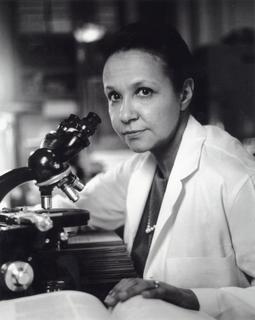
That is why the archival photograph matters. Wright beside a microscope is not a decorative image of scientific seriousness. It shows the scale at which her work operated. She was trying to make a bridge between a tumor outside the body, a drug's observed effect, and a patient's clinical course. The bridge was imperfect, but it was an early version of a question modern oncology still asks: can the biology of one patient's cancer change the treatment choice?
Harlem Hospital as the starting instrument
Wright was born in New York City in 1919, into a family that had already forced open medical doors. Her father, Louis Tompkins Wright, was one of the first African American graduates of Harvard Medical School, the first Black physician appointed to a staff position at a New York City municipal hospital, and the founder of the Cancer Research Center at Harlem Hospital.[1][2] Jane Wright graduated from New York Medical College in 1945, interned at Bellevue Hospital in 1945-1946, and completed residency work at Harlem Hospital in 1947-1948.[1]
Those dates matter because they place her at the edge of a changing cancer field. The National Library of Medicine's biography says she joined her father at the Harlem Hospital Cancer Research Foundation in 1949, after a short period as a staff physician with the New York City Public Schools.[1] At Harlem, Louis Wright worked in the laboratory while Jane Wright performed patient trials.[1] The division is easy to summarize, but hard to overstate. Their research was not a remote animal-lab program waiting years before clinical contact. It began with the problem of patients who had few good options.
In 1949, the Wrights began testing anticancer chemicals in human leukemias and cancers of the lymphatic system; several patients had some remission.[1] The ASCO Post's later profile describes the father-daughter team as experimenting with potential anticancer agents in both tissue cultures and patients, including nitrogen mustard-like compounds and folic acid antagonists.[2] In that setting, "experimental" did not mean casual. It meant the rules of usefulness were still being written.
The first lesson from this microhistory is therefore institutional. Harlem Hospital was not just a backdrop for Wright's biography. It was the place where a segregated medical world, a Black medical dynasty, and a high-need patient population met a new therapeutic hypothesis. When Louis Wright died in 1952, Jane Wright became head of the Cancer Research Foundation at age 33.[1] That succession was not only a family story; it kept a clinical-research program alive at a moment when drug treatment for cancer still needed proof that it could do more than injure.
The method was comparison, not miracle
Wright's best-known methodological contribution was the attempt to correlate what happened to a patient's tumor tissue in culture with what happened to the patient under treatment. NLM summarizes her career as analyzing anticancer agents, exploring the relationship between patient and tissue-culture response, and developing new techniques for administering chemotherapy.[1] The ASCO Post points to the same hinge: Wright and coauthors argued that primary tissue culture could be useful for screening and selecting chemotherapy for specific tumors in individual patients.[2]
The 1957 New England Journal of Medicine paper, "Investigation of the Relationship Between Clinical and Tissue Response to Chemotherapeutic Agents on Human Cancer," is the clean bibliographic marker for that idea.[4] The later 1963 PubMed record for "Further investigation of the relation between the clinical and tissue culture response to chemotherapeutic agents on human cancer" shows that the question was not a one-off claim; it became an ongoing research program.[3] Wright's team was asking whether the tumor's observed response outside the body could help predict treatment inside the body.
That may sound obvious now. It was not obvious then. A cancer drug could shrink one tumor type, fail another, poison a patient before any benefit appeared, or work temporarily and then lose effect. Wright's method did not solve all of those problems. It did something more foundational: it made the uncertainty inspectable. A patient was not only a case; the patient's tumor could become evidence. A drug was not only a dose; it could become a candidate to compare across biological and clinical settings.
This is the second lesson from Wright's life: the heroic story should be restrained. She did not discover a universal cancer cure. She worked in an era when remissions could be temporary, toxic effects could be severe, and many cancers remained lethal. Her importance lies partly in keeping the negative space visible. By correlating tissue response with clinical response, by classifying tumors and drugs, and by studying sequences and combinations, she helped chemotherapy become a field that could remember its own experiments.[1][2][4]
Methotrexate and the solid-tumor threshold
One reason Wright's name remains attached to modern oncology is methotrexate, an antifolate that became one of the backbone cancer drugs of the twentieth century. The ASCO Post describes the Wright team's work with seven folic acid antagonists in 93 patients with varied solid tumors and blood cancers, noting that aminopterin and amethopterin, now known as methotrexate, appeared to produce the greatest effect and supplied early evidence for methotrexate against solid tumors.[2]
This is a crucial boundary. Methotrexate's later fame can make the early work look inevitable. In the early 1950s, it was not. Chemotherapy was still trying to cross from hematologic malignancies and short-lived remissions into a broader claim: that chemical agents might matter for solid tumors too. Wright's contribution was to help define that crossing as a clinical question rather than a promise.
Her work also pushed against a single-drug imagination. The ASCO Post notes that the Wrights investigated combinations, specific sequences of administration, and toxicity as well as efficacy.[2] NLM similarly describes her later work at New York University and New York Medical College as including new ways to administer potent drugs to tumors deep within the body, as well as a database that cross-referenced cancers and patients to evaluate treatment effectiveness.[1] In plain language, Wright understood that chemotherapy was not one medicine. It was a timing, toxicity, tumor-type, delivery, and record-keeping problem.
That record-keeping point can feel mundane until the alternative is remembered. Without a durable way to connect drug, dose, tumor, patient condition, response, and toxicity, chemotherapy becomes anecdote piled on anecdote. Wright's database work and tissue-culture comparisons were primitive by modern informatics standards, but they pointed toward the same discipline: treatment has to generate usable memory if the next patient is to benefit from the last one.
Firsts are not the whole achievement
The chronology after Harlem shows how Wright's scientific method became institutional authority. In 1955, she became an associate professor of surgical research at New York University and director of cancer chemotherapy research at NYU Medical Center and affiliated hospitals.[1][2] In 1964, President Lyndon B. Johnson appointed her to the President's Commission on Heart Disease, Cancer, and Stroke; NLM notes that the commission's report helped lead to a national network of treatment centers.[1] That same year, she was the only woman among seven physicians who founded ASCO, a society organized around clinical oncology and patient-oriented cancer care.[2]
Then came 1967. Wright was appointed professor of surgery, head of the Cancer Chemotherapy Department, and associate dean at New York Medical College.[1][2] NLM emphasizes that, at a time when African American women physicians numbered only a few hundred in the United States, she was the highest-ranking African American woman physician at a nationally recognized medical institution.[1]
These firsts matter, but only if they are tied back to the work. Wright was not merely present at symbolic tables. She had helped prove that chemotherapy deserved a clinical discipline around it. She had worked on patient trials, tissue-response correlation, methotrexate, combination and sequence logic, drug delivery, and professional infrastructure.[1][2][3][4] The institutional ascent was built on a practical claim: cancer drugs needed physicians who could think simultaneously like clinicians, researchers, record keepers, and builders of systems.
That is also why her 1971 election as the first woman president of the New York Cancer Society belongs in the same story.[1][2] By then, cancer chemotherapy was no longer an eccentric corner of desperate care. It was becoming a central arm of oncology. Wright's career shows how that transition required more than a molecule. It required people willing to make toxic, uncertain drugs accountable to evidence.
What the microhistory leaves behind
Wright retired in 1987 after a forty-year cancer-research career.[1] Her later review article, "Cancer Chemotherapy: Past, Present, and Future," published in the Journal of the National Medical Association in 1984, shows the historical position from which she could write: not as an outsider celebrating progress, but as one of the physicians who had watched chemotherapy move from experiment toward standard care.[6] She died in 2013 at age 93.[2]
The afterlife of her work should be read with two cautions. First, personalized medicine did not begin fully formed in Wright's laboratory. Modern tumor genomics, molecular diagnostics, targeted drugs, immunotherapy, and trial design are different technologies built on different evidence. But Wright's tissue-culture work belongs to the prehistory of personalized oncology because it asked a structurally similar question: can treatment selection be informed by the behavior of this patient's cancer rather than by diagnosis alone?[2][3][4]
Second, her story should not be reduced to "forgotten woman genius" shorthand. That phrasing is tempting because it repairs an omission, but it can flatten the medical content. Wright's achievement was not simply that she succeeded despite race and gender barriers, though that was real. It was that she helped turn cancer chemotherapy into a system of comparison: tumor to patient, drug to response, dose to toxicity, trial to future practice, local hospital to national oncology institution.[1][2][4]
That is the durable health lesson. A treatment field matures when it learns how to remember. Wright's career was one long effort to make chemotherapy remember: what worked, for whom, against which tumor, at what cost, and with what next question still open. The microscope photograph captures the beginning of that discipline, but the real image is larger. It includes Harlem Hospital, patient charts, tissue cultures, early antifolates, ASCO's founding table, and a generation of oncologists inheriting a field that Wright helped make legible.
Sources
- National Library of Medicine, "Biography: Dr. Jane Cooke Wright" - NLM profile covering Wright's training, Harlem Hospital work, chemotherapy research, 1967 appointment, 1971 New York Cancer Society presidency, and retirement.
- Jo Cavallo, "ASCO Cofounder Jane Cooke Wright, MD, Defied Racial/Gender Barriers and Helped Usher in the Modern Age of Chemotherapy," The ASCO Post, May 15, 2014 - professional profile with methotrexate, tissue-culture, ASCO founding, and institutional context.
- J. C. Wright et al., "Further investigation of the relation between the clinical and tissue culture response to chemotherapeutic agents on human cancer," PubMed record, 1963 - bibliographic record for Wright's continued tissue-culture/clinical-response research program.
- J. C. Wright et al., "Investigation of the Relationship Between Clinical and Tissue Response to Chemotherapeutic Agents on Human Cancer," New England Journal of Medicine 257:1207-1211, 1957 - PubMed-linked reference cited by ASCO Post for the tissue-response method.
- National Library of Medicine, "Jane C. Wright at work" - archival image file used as the article's lead photograph.
- Jane C. Wright, "Cancer Chemotherapy: Past, Present, and Future--Part I," Journal of the National Medical Association, 1984 - PubMed record for Wright's retrospective review of chemotherapy.