The leaded gasoline phaseout is usually remembered as a regulatory victory. That is true, but it can make the mechanism sound too clean. The public-health breakthrough was not simply that a toxic additive was banned. It was that one of the most ordinary machines in modern life stopped spreading a neurotoxic metal through exhaust, air, soil, dust, and the hand-to-mouth world of young children.[1][2][3]
Leaded fuel mattered because it made exposure ambient. A child did not need to work in a smelter, chew paint chips, or live next to a single industrial source to be touched by it. By the early 1970s, EPA described gasoline lead as a controllable contributor to lead in urban air, dirt, and dust, layered on top of paint, food, water, and other sources.[1] That is the key to why the phaseout changed population blood lead so dramatically: it removed a background source that millions of people were sharing.
The story also explains a boundary that still matters. Removing lead from highway gasoline did not end lead exposure. Old paint, contaminated dust, soil, plumbing, industrial emissions, battery recycling, and other reservoirs still matter.[3][4] But the gasoline phaseout shows what prevention looks like when a policy reaches upstream far enough. Instead of finding poisoned children one by one, it changed the environment before the next exposure happened.
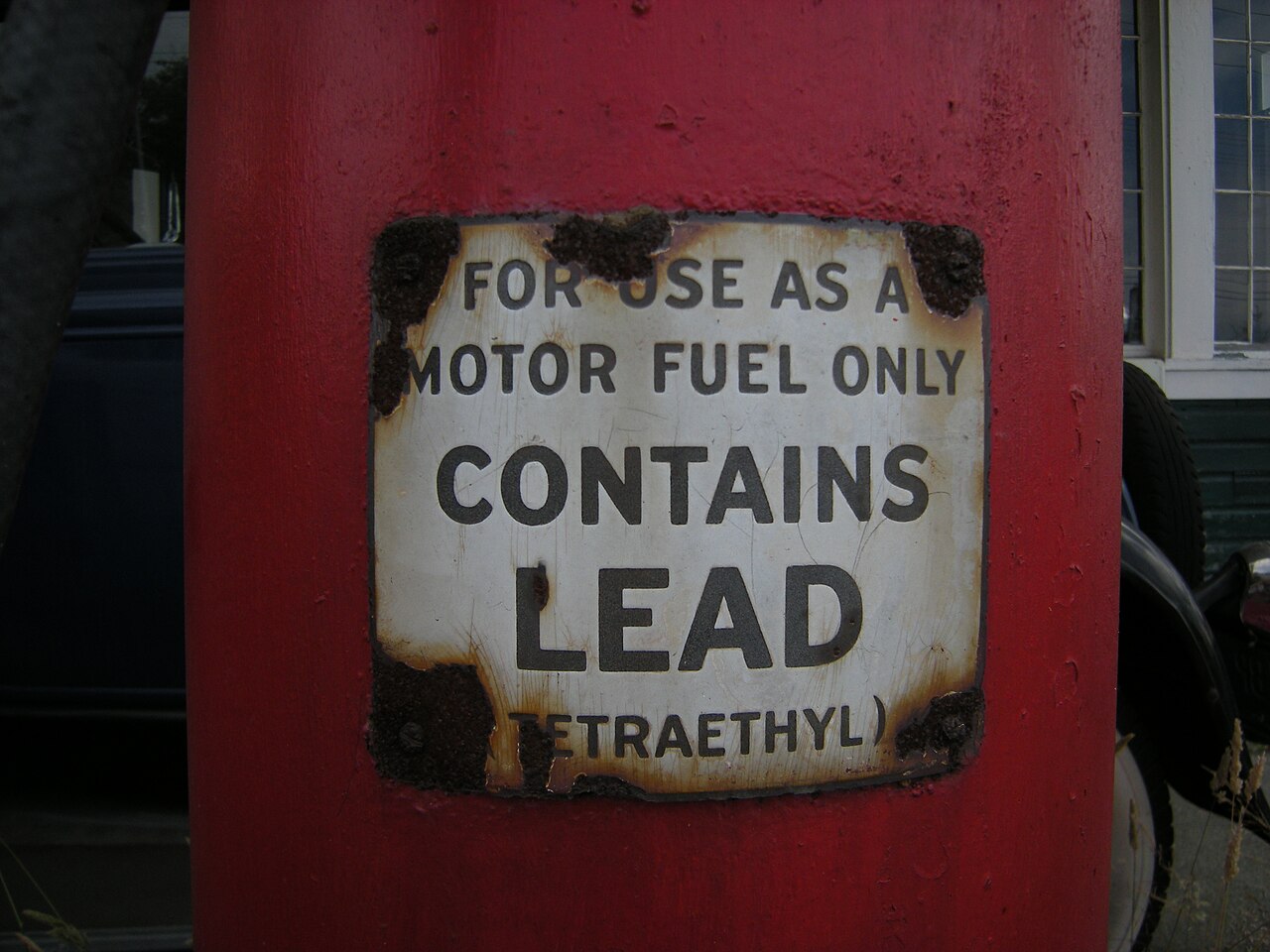
Image context: the lead photograph shows a pump warning rather than a laboratory instrument. That is the right scale for this mechanism. The decisive public-health object was not a test tube. It was the fuel dispenser, the tailpipe, the curb, the windowsill, and the dust a toddler could reach.[6]
The Mechanism: A Fuel Additive Became Household Dust
Tetraethyl lead entered gasoline in the early 1920s because it helped engines run at higher octane and reduced knock.[2][5] That technical benefit created a public-health problem because combustion did not make the lead disappear. Once burned, lead compounds left the vehicle and entered the local environment. EPA's 1973 phaseout announcement put the point plainly: lead from gasoline combined with stationary sources and deteriorating paint to create high lead levels in dirt and dust, and gasoline was the most ubiquitous source of lead found in urban air, dust, and dirt.[1]
That matters because lead is not a toxin with a useful safe margin for children. WHO's 2026 lead fact sheet says exposure can affect multiple body systems, is particularly harmful to young children and pregnant people, and has no known level without harmful effects.[4] EPA's children's environmental health indicators similarly connect childhood lead exposure with reduced cognitive function and behavioral problems, while noting that no safe level has been identified.[3]
The pathway is simple enough to be easy to miss. Fuel is burned. Lead leaves the tailpipe. Particles settle on soil, sidewalks, porches, and interior dust carried in from outside. Children encounter the residue by crawling, touching, mouthing objects, breathing dust, or eating with contaminated hands. Blood lead then becomes the short-term marker of exposure, while lead can also be stored in teeth and bone over time.[4]
This is why leaded gasoline was more than a product-safety issue. It was a citywide exposure system. The additive sat inside fuel, but the dose pathway ran through traffic density, housing location, ventilation, cleaning burden, neighborhood soil, and childhood behavior. A clinic could measure the injury after the fact. Only source control could turn down the whole exposure channel.
Regulation Changed The Source Before Medicine Could Fix The Patient
EPA's first decisive move came in 1973, when Administrator Russell Train announced final regulations to reduce lead in all grades of gasoline. The rule set quarterly average limits of 1.7 grams per gallon by July 1, 1975, 1.2 grams by July 1, 1976, 0.9 grams by July 1, 1977, and 0.6 grams by July 1, 1978.[1] The same announcement said leaded gasoline accounted for well over 200,000 tons of lead per year.[1]
The policy did not rely on one lever. In 1975, new passenger cars and light trucks began using catalytic converters that required lead-free fuel because lead damaged the converters.[2] That technology shift changed the fuel market while the health-based phasedown squeezed the lead content of gasoline still being sold. EPA's 1996 account says the agency's standards called for a gradual reduction to one tenth of a gram per gallon by 1986, and that by 1995 leaded fuel made up only 0.6 percent of total gasoline sales and less than 2,000 tons of lead per year.[2]
The final legal step for on-road vehicles arrived on January 1, 1996, when the Clean Air Act ban on the remaining highway leaded fuel took effect.[2] That date can make the story sound like a single switch. It was really the endpoint of a long source-removal process: new-car design, unleaded availability, refinery standards, enforcement, market adjustment, and the gradual disappearance of leaded fuel from ordinary driving.
The reason this sequence worked is that it did not ask families to manage every exposure pathway individually. Parents could not know which invisible particles came from traffic. Pediatricians could not chelate a neighborhood. Source control attacked the shared input.
Blood Lead Followed The Source Down
The strongest evidence that the mechanism worked is that children's measured blood lead moved with the source reduction. CDC's 1988-1991 MMWR report, using NHANES data, says the amount of lead used in gasoline declined by 99.8 percent from 1976 to 1990.[5] Over roughly the same policy era, the prevalence of high blood lead in young children collapsed. In NHANES II, 53 percent of children aged 1 to 5 had blood lead levels at or above 15 ug/dL, and 9.3 percent were at or above 25 ug/dL. In NHANES III, those shares fell to 2.7 percent and 0.5 percent.[5]
EPA's longer-running biomonitoring indicators show the same arc in modern form. Among U.S. children ages 1 to 5, the median blood lead level was 0.6 ug/dL in 2017-2020, a 96 percent decrease from 1976-1980. The 95th percentile was about 2 ug/dL in 2017-2020, a 93 percent decrease from 1976-1980.[3] EPA identifies the largest decline as occurring from the 1970s to the 1990s, following the elimination of lead in gasoline.[3]
Those numbers are the public-health meaning of prevention. The result was not a better antidote. It was a lower dose delivered to nearly everyone. The highest-exposed children still needed identification and intervention, but the distribution itself shifted down. That is much harder to see in an individual exam room than in population surveillance.
The decline was not caused by gasoline alone. CDC's 1988-1991 report also pointed to the decline of lead-soldered food and soft-drink cans, the residential lead-paint ban, plumbing changes, occupational standards, screening, education, and abatement programs.[5] That complexity should not weaken the gasoline lesson. It clarifies it. Lead exposure is multi-source, so the biggest gains come when the largest routine sources are removed together.
The Inequality Did Not Vanish With The Average
The phaseout lowered the average, but it did not erase the geography of exposure. CDC's same report estimated that 35 percent of poor non-Hispanic Black children living in central-city areas had blood lead levels at or above 10 ug/dL, compared with 5 percent of nonpoor non-Hispanic white children living outside central cities.[5] The report tied the remaining pattern partly to older housing, deteriorated paint, and urban soil and dust contaminated by past gasoline emissions and exterior paint.[5]
That is the important second half of the mechanism. Source removal can quickly reduce new deposition, but legacy contamination remains distributed according to older decisions about traffic, housing, poverty, industrial land use, and municipal maintenance. A child born after the gasoline phaseout could still meet the residue through soil, dust, paint, or water.
EPA's current children's indicator page makes this boundary explicit. Lead in car fuel and paint were phased out beginning in the 1970s, producing substantial reductions, but children continue to be exposed because lead is widespread in the environment.[3] Today, EPA describes lead-contaminated house dust, often from deteriorated or disrupted lead-based paint, as the major U.S. source of early childhood lead exposure, with drinking water, soil, ambient air, and other sources also relevant.[3]
So the honest lesson is not "ban one product and the problem is solved." It is "remove the shared source, then keep chasing the reservoirs it left behind." The first part delivers the visible population drop. The second part determines whether the remaining burden is allowed to concentrate in children with the least power to avoid it.
The Global Lesson Was Source Control At Planetary Scale
The United States was not the end of the story. EPA's international-cooperation account describes the Partnership for Clean Fuels and Vehicles as a public-private effort launched in 2002, with EPA as a charter member, and says the partnership helped achieve the elimination of leaded gasoline worldwide in 2021.[7] The same page frames the global phaseout as producing economic benefits by preventing lead exposure in children everywhere.[7]
That global milestone should be read as a source-control achievement, not as a reason to forget local work. Ending leaded petrol removed an enormous exposure source, but WHO still identifies lead as a major public-health concern, with ongoing exposures from batteries, mining, smelting, recycling, paint, plumbing, traditional products, contaminated soil, water, and food.[4] The gasoline phaseout therefore belongs to a larger doctrine: for cumulative toxicants, the best clinical outcome is often produced before the patient becomes a case.
That is why the pump warning is such a useful image. It reminds us that public health sometimes works by making a familiar object less dangerous. The car still moved. The fuel market adapted. Engines did not require a neurotoxic additive as the price of ordinary transportation. Once the source was removed, children's blood lead levels showed what had been hidden in the air all along.
Sources
- U.S. Environmental Protection Agency, "EPA Requires Phase-Out of Lead in All Grades of Gasoline" (EPA press release, November 28, 1973) - original phaseout announcement, grams-per-gallon schedule, and public-health rationale.
- U.S. Environmental Protection Agency, "EPA Takes Final Step in Phaseout of Leaded Gasoline" (EPA press release, January 29, 1996) - final on-road ban context, 1973-1996 timeline, catalytic-converter link, and remaining off-road exceptions.
- U.S. Environmental Protection Agency, "Biomonitoring - Lead" (America's Children and the Environment, web update 2023) - current U.S. children's blood-lead indicators and remaining exposure-source context.
- World Health Organization, "Lead poisoning" (June 10, 2026) - health effects, no-known-safe-level framing, exposure routes, and global burden context.
- Centers for Disease Control and Prevention, "Blood Lead Levels - United States, 1988-1991," MMWR 43(30), 1994 - NHANES blood-lead decline, gasoline-use reduction, and remaining inequality pattern.
- Wikimedia Commons, "File:Gas pump lead warning.jpg" - Joe Mabel photograph of a lead warning on a gas pump at Keeler's Korner, used as the article image source.
- U.S. Environmental Protection Agency, "Promoting Cleaner Fuels and Vehicles Worldwide" (last updated January 8, 2026) - Partnership for Clean Fuels and Vehicles context and global leaded-gasoline elimination milestone.