The word "accident" has always done too much work. It can describe a collision, a fall, a burn, or a poisoning without saying whether anyone could have changed the conditions that produced the harm. That looseness is exactly what the injury-prevention field spent the late twentieth century trying to undo. The Haddon Matrix matters because it gave public health a way to treat injury as a structured event rather than a moral shrug.[1][3][4]
William Haddon Jr.'s best-known matrix looks simple: factors on one axis, time phases on the other. The factors are the host, the agent or vector, and the physical and social environment. The phases are pre-event, event, and post-event.[1][3] In traffic terms, that means injury prevention does not begin and end with a driver's choice. It can involve speed, alcohol, lighting, vehicle design, road geometry, restraint systems, crashworthiness, emergency response, and rehabilitation.[3][4]
The historiographic debate is not whether the matrix exists. It is what kind of intellectual break it represents. One reading treats it as a tidy planning table for road safety. The stronger reading treats it as a change in medical imagination: injury moved from the category of chance into the category of preventable energy transfer, distributed responsibility, and system design.[2][3][5]
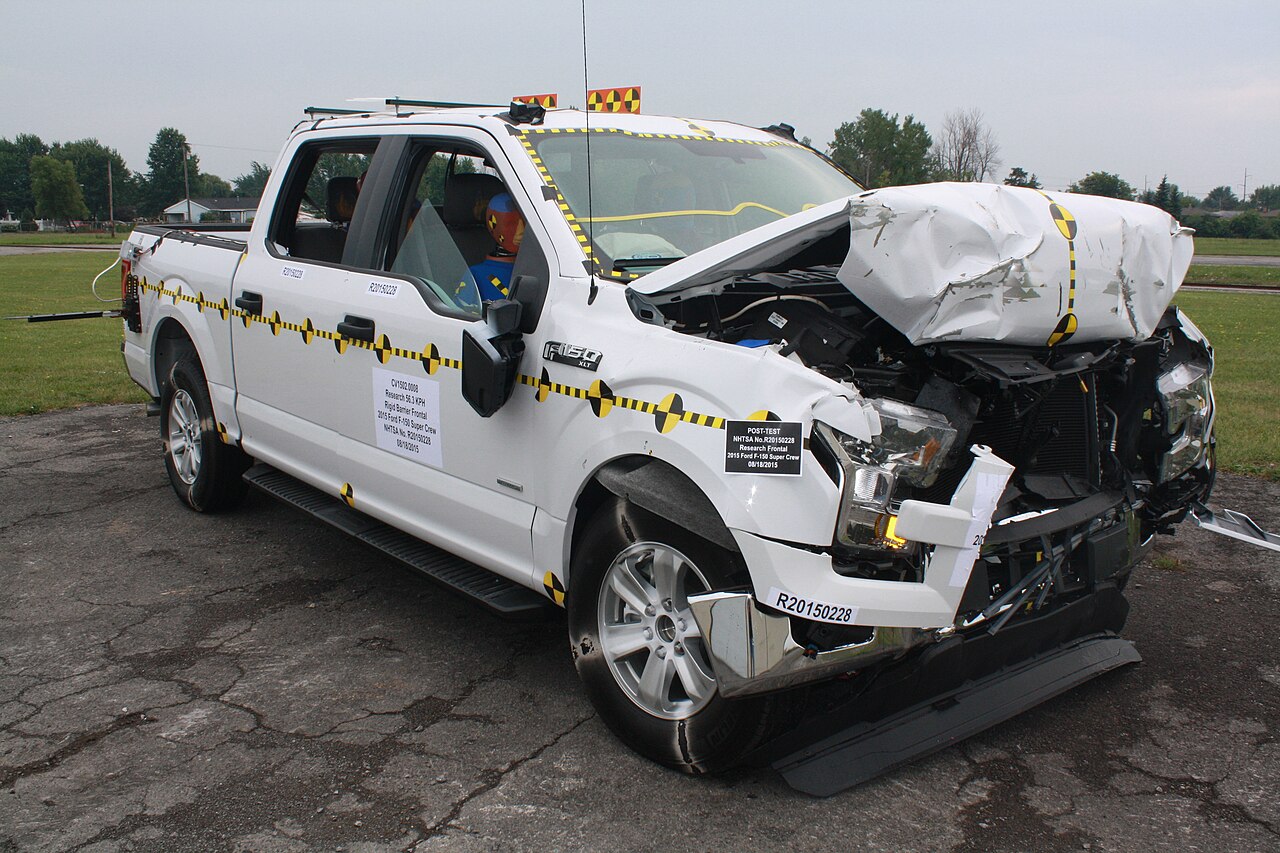
Image context: a crash-test photograph is not a diagram of the matrix, and that is why it works here. The image shows the event phase, but the article's argument is that the event cannot be understood alone. A controlled test already assumes pre-event design, measured energy, engineered structures, dummies as instrumented hosts, and post-event interpretation.[3][6]
The Older Story: Accident As Misfortune
Before the modern injury field stabilized, many injuries were described as unlucky episodes or personal failures. CDC's historical review calls the first half of the twentieth century a largely prescientific era of injury control, shaped by the belief that injuries came from random or unavoidable "accidents."[3] Safety work existed, but it often leaned on education, engineering, and enforcement without a mature epidemiologic framework explaining how those elements fit together.[3]
That older language had consequences. If a crash is mainly an accident, prevention tends to look like exhortation: be careful, pay attention, behave better. Those appeals are not useless. A sober, attentive driver matters. A parent who stores poison safely matters. A worker who follows lockout procedures matters. But exhortation leaves too much untouched. It does not ask why speed is easy, why a dashboard is hard, why a road edge is unforgiving, why rescue arrives late, or why a product releases energy in a way the body cannot tolerate.
The conceptual foundation began changing before Haddon. CDC's account points to Hugh De Haven's work on survival after high falls, John Gordon's 1949 argument that injuries had epidemic patterns and could be analyzed through host, agent, and environment, and James Gibson's 1959 energy-transfer framing.[3] Those steps mattered because they made injury look less like bad luck and more like disease ecology. Something happens to a host, through an agent, inside an environment, across time.
Haddon's contribution was to make that ecology operational. The matrix gave the field a reusable grammar for asking where intervention might occur.[1][3]
Interpretation One: A Road-Safety Table
The narrow interpretation begins with the highway setting, and it is not wrong. Haddon's 1972 article was explicitly a logical framework for categorizing highway-safety phenomena and activity.[1] CDC's retrospective places him inside the 1960s transformation of traffic safety: in 1966 he became the first administrator of the federal National Highway Safety Bureau, which became NHTSA in 1970.[3] In that institutional world, the matrix helped organize a practical problem with many moving parts.
The road-safety reading is strongest when it points to concrete design and policy effects. CDC describes the matrix as a two-dimensional phase-factor model and says it can be applied readily to a motor vehicle crash.[3] Pre-event factors might include impairment, speed, braking, road layout, and lighting. Event factors might include restraints, vehicle structure, roadside objects, and the force pattern of impact. Post-event factors might include rescue access, fire risk, trauma care, and rehabilitation.[3][4]
That division matters because it prevents a common policy error: choosing one favorite lever and pretending it explains the whole injury. Driver education can reduce some risks before the event. Seat belts and airbags reduce harm during the event. EMS and trauma systems reduce death and disability after the event. They do not compete as explanations; they occupy different cells in the same sequence.[2][3]
On this reading, Haddon's matrix is a disciplined checklist. It helps planners avoid blank spots. If every proposed intervention sits in the driver-behavior cell, the matrix reveals that the vehicle, road, and post-crash system have been neglected. If every intervention sits in rescue, the matrix asks why the crash or injury severity was accepted as inevitable.
Interpretation Two: A New Theory Of Injury
The broader interpretation is more important. Haddon and Susan Baker's 1974 Milbank article says the injury problem had been misunderstood and neglected, even though public health had already applied scientific approaches to hazards such as lead and infectious organisms.[2] Their argument was not merely that crashes needed better tables. It was that injury should be treated with the same causal seriousness as other health damage.
That move changes the unit of analysis. The harmful agent is not "a car" in the abstract or "a careless person" in isolation. It is energy transferred to tissue beyond tolerance, shaped by human behavior, product design, environments, timing, and response systems.[2][3][5] Haddon's later work in Public Health Reports sharpened that definition, framing injury for public-health purposes around damage produced by energy exchanges that appears quickly, often within a short period after exposure.[5]
This is why the matrix still travels beyond traffic. Once injury is understood as a host-agent-environment problem unfolding through phases, the same thinking can be applied to burns, falls, drownings, poisonings, occupational injuries, sports injuries, and violence-related injuries, while still respecting differences among them.[4][5] The model does not flatten all injuries into one cause. It insists that each injury mechanism can be decomposed.
The National Academies' injury-field history makes the vocabulary fight explicit. It notes that U.S. injury-field architects deliberately displaced "accident" with "injury" because accident language implied randomness and bad luck, while injury language pointed toward a health outcome that could be studied and prevented.[4] That is the deeper Haddon turn. The matrix belongs to a larger campaign to make preventability thinkable without requiring perfect individual behavior.
The Productive Tension
The road-safety-table interpretation keeps the matrix usable. The theory-of-injury interpretation keeps it radical. The first prevents abstraction; the second prevents underreach.
If the matrix is only a table, it can become bureaucratic. A team fills cells with programs, files the worksheet, and misses the sharper question: which energy transfers are actually killing or disabling people, and which countermeasures reduce reliance on flawless human cooperation? Baker and Haddon were already concerned with that issue in 1974, emphasizing that effective injury countermeasures can reduce harm even when events themselves are not fully prevented, and that choosing measures requires attention to effectiveness, cost, and how much individual cooperation is required.[2]
If the matrix is only a grand theory, it can lose contact with implementation. People do not die from "energy exchange" in general. They die in cars, houses, workplaces, playgrounds, waterways, bedrooms, intersections, fields, and hospitals. The matrix is valuable because it forces theory back into those specific settings. Who is the host? What is the agent? Which environment matters? Are we before, during, or after the harmful event?[1][3]
That tension explains why the matrix remains useful rather than merely historical. It is abstract enough to move across injury mechanisms and concrete enough to discipline prevention design.
What The Debate Settles
The strongest conclusion is that the Haddon Matrix did not simply add another safety tool. It reorganized where responsibility could be seen. In the old accident story, responsibility often narrowed to the person closest to the visible event. In Haddon's framework, responsibility spreads across design, policy, engineering, behavior, emergency care, and recovery systems.[1][2][3][4]
That does not erase agency. A person can still speed, drink, ignore a warning, or choose a risky act. But the matrix refuses to stop there. It asks why the host was vulnerable, how the agent reached the host, what the environment allowed, what protections existed at the moment of transfer, and how the system responded afterward.[3][4]
This is the real reason "accident" became suspect in public health. The word makes a preventable pattern sound like a surprise. Haddon's matrix makes the pattern visible. It turns one harmful episode into a set of modifiable relations before, during, and after injury. Once that happens, the question changes. It is no longer "Who was careless?" It is "Which cell failed, and what would make the next failure less likely or less severe?"[2][3][4]
Sources
- William Haddon Jr., "A logical framework for categorizing highway safety phenomena and activity," Journal of Trauma, 1972 - DOI record for the original matrix article and highway-safety framing.
- Susan P. Baker and William Haddon Jr., "Reducing Injuries and Their Results: The Scientific Approach," Milbank Memorial Fund Quarterly, 1974 - classic statement of injury as a scientific public-health problem beyond traditional accident prevention.
- CDC MMWR, "Injury Prevention, Violence Prevention, and Trauma Care: Building the Scientific Base," 2011 - historical overview of De Haven, Gordon, Gibson, Haddon, the Haddon Matrix, NHTSA, and federal injury-prevention institutions.
- National Research Council and Institute of Medicine, Reducing the Burden of Injury: Advancing Prevention and Treatment, "The Injury Field" chapter - history of the accident/injury vocabulary shift, field boundaries, and public-health framing.
- William Haddon Jr., "Advances in the Epidemiology of Injuries as a Basis for Public Policy," Public Health Reports, 1980 - CDC Stacks record for Haddon's energy-exchange definition and policy framing.
- Wikimedia Commons, "File:Ford F-150 Crew Cab Frontal Crash Test.jpg" - NHTSA public-domain frontal crash-test photograph used as the article image.