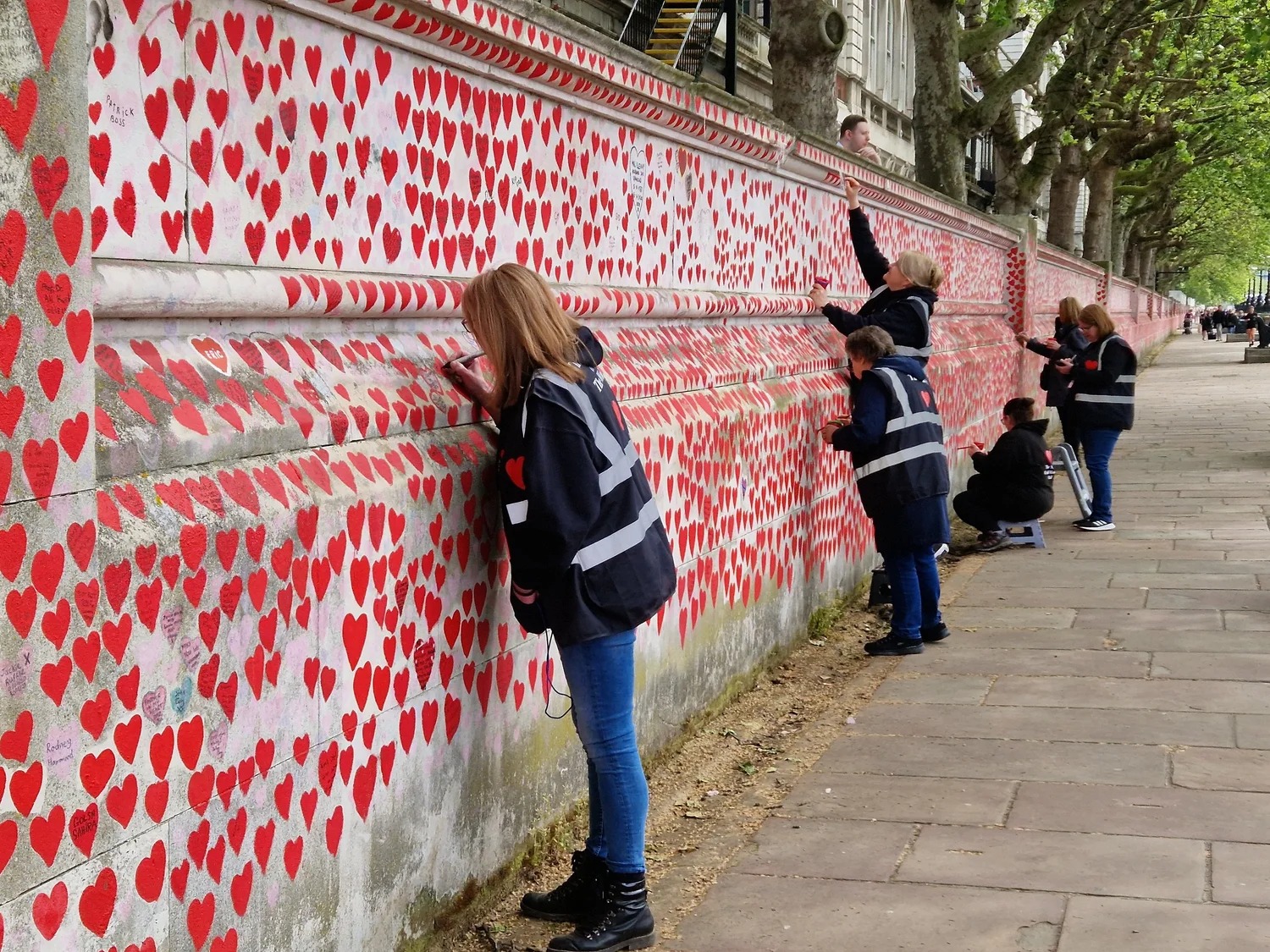
The National Covid Memorial Wall can be mistaken for a memorial whose main work is emotional closure. It does offer a place to grieve, but that reading is too small. In health terms, the Wall has done something harder and more durable: it has kept pandemic death legible after the acute emergency ended. By turning loss into a half-kilometre field of red hearts opposite Parliament, it converted an experience that could have been absorbed into statistics and private mourning into a continuing public-health memory.[1][2][3]
That is why the Wall matters in 2026. It is not simply an object of remembrance, and not simply a protest artwork that survived. It sits at the junction of three health questions that COVID exposed brutally: how societies count death, how they handle disrupted mourning, and how they decide whether large-scale loss becomes a lasting institutional lesson or just a painful period everyone is encouraged to “move on” from.[3][4][5][6]
Image context: the hero image shows the National Covid Memorial Wall in London. It is used here because this article is about public visibility — the Wall’s health significance lies partly in the fact that it makes mortality and bereavement impossible to reduce back into an invisible denominator.
Timeline anchors: how an unofficial memorial became part of the health afterlife of COVID
- 2021-03-29: the Wall began as a bereaved-led action on the Thames embankment opposite Parliament, with hearts painted for people who had COVID-19 on their death certificates.[1][2]
- 2023-09: the UK Commission on Covid Commemoration published its final report and recommended a broader commemorative infrastructure, including memorials, online remembrance, and durable public access to pandemic stories.[4]
- 2025-03-17: BBC reporting showed that, five years after the pandemic began, the Wall was still functioning as an unofficial but socially central memorial maintained by volunteers from the bereaved community.[2]
- 2025-11-13: the UK government confirmed that the National Covid Memorial Wall would be preserved, effectively converting more than four years of bereaved-led volunteer upkeep into a formal commemorative commitment and folding annual COVID-19 remembrance into a larger programme.[3][4][5]
- 2026-03-08: the UK-wide COVID-19 Day of Reflection took place again, now explicitly anchored to the government’s longer commemorative programme.[5][6]
The sequence matters because it shows the Wall moving through three stages: improvised memorial, public pressure point, and finally part of an official memory system. What changes across those stages is the traffic between private grief and public administration.
1) The Wall kept the denominator visible
One of the hardest things about pandemic mortality is that the scale becomes cognitively flat. A chart can show a rising line, but the line still lets the eye slide away. The National Covid Memorial Wall works differently because it insists on physical countability. The official Wall site describes it as a visual representation of the United Kingdom’s catastrophic loss to COVID, stretching 500 metres along the Thames.[1] Government language in late 2025 described the memorial as containing more than 240,000 hand-painted hearts, and the wider commemoration guidance later described approximately 250,000 hearts.[3][5] The slight shift in official number is revealing in its own right: this is an accretive memorial still being maintained, interpreted, and added to, not a sealed monument with one frozen final count. The deeper point the Wall keeps making is that each heart stands in for one death, and that the public is asked to confront scale spatially rather than statistically.[3][5]
That transformation matters in health memory because counting is not neutral. Once a crisis recedes, the denominator becomes vulnerable to compression. Deaths get folded into phrases such as “the pandemic years,” “the emergency period,” or “lessons learned.” The Wall resists that compression. It says that mortality remains enumerable, and that enumeration still has moral and policy force.
BBC reporting from March 2025 captured the point well through the volunteers’ own language. Visitors and maintainers kept returning to the difference between seeing a statistic and seeing a visual field of loss. The Wall’s scale was described not as an illustration of grief but as a record of catastrophic loss that remained hard to domesticate into retrospective calm.[2]
That makes the memorial closer to a public-health instrument than many culture-war arguments around memorials allow. It preserves a denominator that public memory is otherwise tempted to smooth over.
The easiest way to read the Wall’s policy afterlife is as a memory ladder rather than a single monument:
2) The Wall also made bereavement a health issue again
COVID memorials are often discussed as cultural or political objects. That is true, but it is incomplete. They also belong to health because the pandemic damaged the conditions under which mourning normally happens. Restrictions on visiting, funerals, bedside presence, and social gathering did not just interrupt ceremony; they altered the health experience of loss itself.[4][7]
A 2025 public-health study on COVID bereavement in Ireland is useful here, not because it can be pasted directly onto the United Kingdom, but because it describes the broader kind of injury the pandemic produced. In a survey of 1,223 bereaved participants, respondents repeatedly described loss of connection, loss of ritual, and the harm of not being able to say goodbye; 14.2% screened in a range likely to indicate prolonged grief disorder, and another 26.1% were in a sub-threshold range.[7] The national setting is different, but the mechanism travels. COVID bereavement was not only sadness after death. It was bereavement under conditions of interruption, isolation, and institutional control.[7]
That is why the Wall’s unofficial origin matters so much. It was not commissioned after a settled national consensus. It was built by bereaved families and allies because ordinary channels of mourning had been broken and because many people felt that the dead had not been adequately seen in public.[1][2][3] The memorial therefore does two kinds of work at once:
- it names the scale of mortality;
- it repairs, at least partially, the social visibility that pandemic mourning stripped away.
The Wall is not therapy, and it is not a substitute for bereavement services. But it does restore one public condition of grieving: a shared, durable place where loss can be witnessed collectively rather than scattered into private aftermath.
3) Its location turned remembrance into accountability pressure
The Wall’s political force is impossible to separate from where it sits. It faces the Houses of Parliament from the river path near St Thomas’ Hospital.[1][2] That choice matters because the memorial was never only retrospective. It kept loss in the visual field of the state.
The BBC account of the Wall’s creation makes this explicit. The original organizers included Covid Bereaved Families for Justice UK and Led By Donkeys; the memorial was made to look official, but it was also a direct statement that bereaved people wanted a visible record of loss in the place where political responsibility could not be easily abstracted away.[2] That does not mean every heart is an accusation. It means the memorial never allowed a clean separation between grief and governance.
This is exactly the point at which commemoration becomes health memory rather than generic remembrance. Health disasters do not end when excess mortality falls. They continue in disputes over inquiry, preparedness, and what kinds of institutional change count as having learned something real. The UK government’s 2025 response to the Commission on Covid Commemoration makes this clearer than many purely symbolic readings do. Alongside preservation of the Wall, the response committed to an annual Day of Reflection, online commemoration resources, oral histories, and a fellowship scheme focused on natural hazards and resilience.[3][4][5]
That mix is revealing. Official memory was not limited to a plaque or a statue. It was paired with archives, recurring ritual, and a preparedness vocabulary. In other words, the state eventually accepted that remembering COVID had to include an administrative afterlife, not just ceremonial language.[3][4][5]
4) The Wall’s most important achievement may be duration
Many memorials matter intensely at the moment of unveiling and then become static. The National Covid Memorial Wall has operated differently because it has required maintenance and repetition. The Friends of the Wall repaint hearts, add dedications, organize remembrance events, and keep the site active as a place people still travel to in order to grieve.[1][2][5]
That upkeep changes the meaning of the memorial. It is not frozen remembrance. It is recurring remembrance. The Day of Reflection page for 2026 frames the day as a chance to remember those who lost their lives and honour the work and kindness shown during the pandemic, and it explicitly connects the annual event to the broader government commemorative programme.[6] The broader GOV.UK commemoration page then links the Wall to oral histories, memorial mapping, education material, and St Paul’s Remember Me online memorial.[5]
Duration is the core health lesson here. Public memory only becomes policy memory when it survives the moment of maximum emotion. The Wall has lasted long enough to help push remembrance from spontaneous grief into a more structured ecosystem of annual ritual, public archive, and official obligation.[3][4][5][6]
For readers trying to judge whether this memory system is deepening or merely stabilizing, the next test is not symbolic preservation alone. The harder measure is whether the Wall stays braided into durable public infrastructure: yearly rituals that still draw institutional attention, accessible archives and oral-history work, and a maintenance model that does not leave bereaved families carrying the commemorative burden by themselves.[3][4][5][6]
That is also where the article’s health argument becomes most practical. A memorial starts to matter differently once it changes what the state must keep funding, convening, and publicly naming. In that sense, the Wall’s afterlife is still in motion; preservation was the threshold, not the finished policy outcome.
5) What the Wall can do — and what it cannot do
It would be too generous to say that preserving the Wall proves the United Kingdom has adequately metabolized the health lessons of COVID. Memorialization is not the same thing as accountability, and collective ritual is not the same thing as service provision. A memorial can coexist with inadequate bereavement support, disputed inquiry findings, and uneven pandemic preparedness.
But it would also be too dismissive to treat the Wall as mere symbolism. Symbols are one of the ways health systems decide what remains thinkable after a crisis. If the dead vanish from public sight, it becomes easier for institutions to narrate the pandemic mainly as a logistical challenge overcome by resilience. The Wall blocks that neatness. It keeps alive a harder proposition: pandemic management was also mass bereavement, interrupted goodbye, and a scale of loss that still deserves visible political space.[2][3][5][7]
That is why the memorial’s preservation matters. It does not close the argument about what the UK owes its bereaved families or what the inquiry should ultimately change. It keeps that argument from becoming historically weightless.
Working assessment
The National Covid Memorial Wall matters in health not because it offers a perfect answer to grief, and not because it can substitute for inquiry or care. It matters because it performs three durable tasks at once:
- it keeps mortality legible after the emergency phase has ended;
- it restores public visibility to disrupted mourning rather than leaving bereavement entirely private;
- it helps convert remembrance into a long-tail policy memory through annual ritual, archive-building, and state acknowledgment.[3][4][5][6]
That combination is unusually important. Many societies can count deaths during a crisis. Far fewer build institutions that keep those deaths publicly meaningful once immediate danger has passed.
Three takeaways worth carrying forward
- Health memory needs public form: if mortality remains only a spreadsheet, institutions can declare closure faster than families can.
- Bereavement is part of health history, not a separate sentimental appendix: COVID showed that disrupted goodbyes and broken mourning rituals carry real long-tail consequences.[7]
- Commemoration matters most when it creates duration: annual reflection, archives, and maintained memorial spaces do more policy work than one-off ceremonial gestures.[3][4][5][6]
A policy test other countries can borrow
If a state says it has truly “remembered” pandemic loss, three questions cut quickly:
- Is the loss still visible in public space, not only archived online?
- Do bereaved families still have an active role in maintenance, ritual, or interpretation?
- Has remembrance been tied to records, annual recurrence, and preparedness work rather than left as one unveiling day?
If the answer is “no” to most of those questions, the memory system is probably symbolic first and institutional second. The Wall is notable precisely because it does better than that minimalist standard.
Sources
- National Covid Memorial Wall, official site
- BBC News, “A Wall of Hearts: The guardians of the Covid memorial” (2025-03-17)
- GOV.UK press release, “Government confirms National Covid Memorial Wall will be preserved” (2025-11-13)
- GOV.UK, “UK government response to the report by the UK Commission on Covid Commemoration” (2025-11-13)
- GOV.UK guidance, “Commemorating the COVID-19 Pandemic” (published 2025-11-13)
- COVID-19 Day of Reflection 2026, official campaign site
- Weathers E, et al. (2025), “A public health model for bereavement care: learnings from COVID-19 bereavement experiences in Ireland”
- Source image — National Covid Memorial Wall site hero image