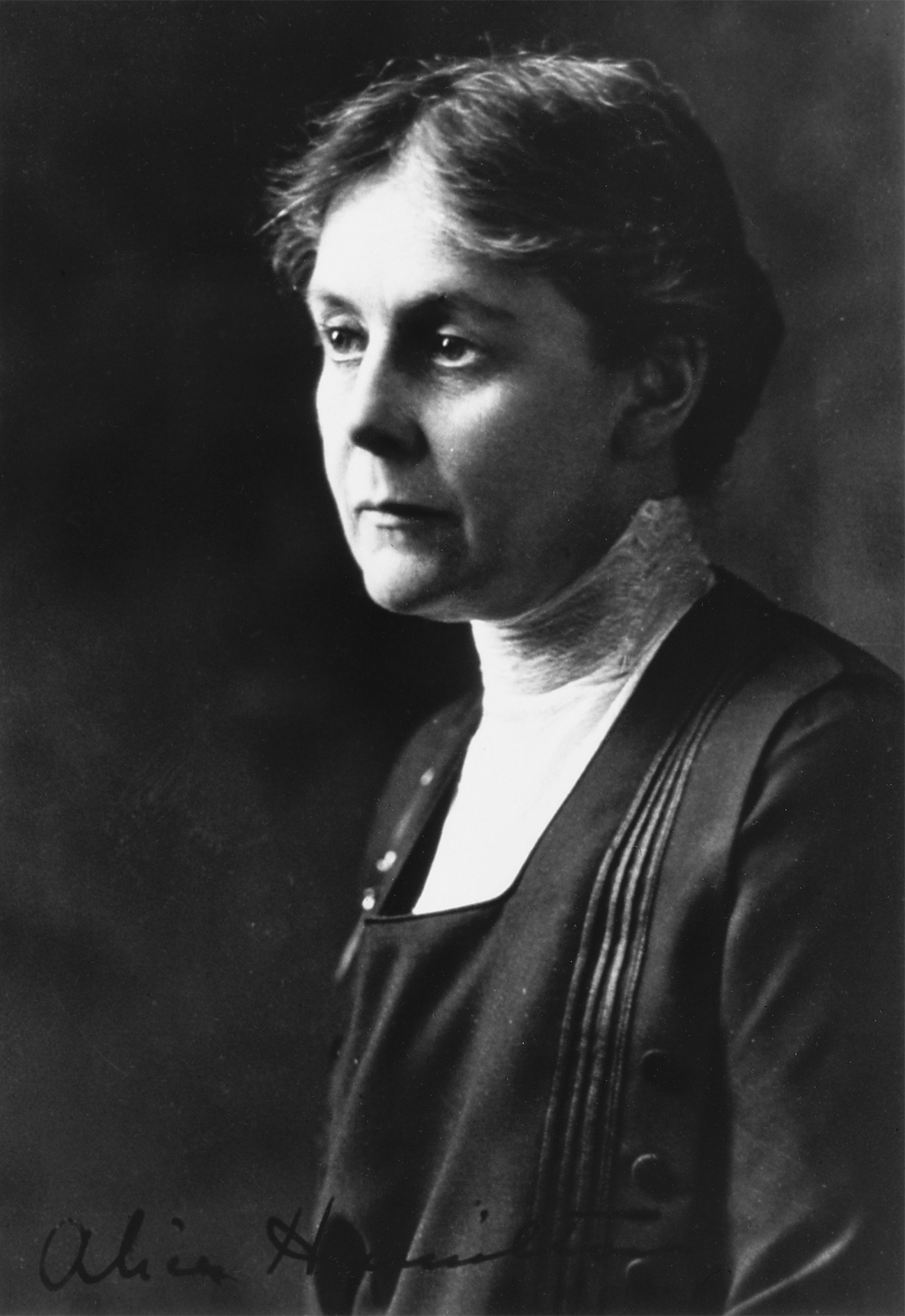
Industrial lead in early 20th-century America was not chemically mysterious. The harder problem was institutional vision. Employers hid the dirtiest process lines, hospitals recorded diagnoses without exposure histories, and public officials could still reassure themselves that European occupational-disease findings did not really apply to American workers. Alice Hamilton became consequential because she changed the unit of observation. She did not wait for perfect factory disclosures or elegant national datasets. She followed poisoning from shop floor to boarding house, from hospital chart to kitchen table, until the exposure story became too concrete to ignore.
That is why her career still matters in 2026 health history. Hamilton did not merely add facts to industrial medicine; she changed where evidence had to be collected and whose testimony counted.
Timeline anchors: the years that built the method
- 1893: Hamilton earned her MD from the University of Michigan.[1][2]
- 1897: She moved to Chicago, joined the Woman’s Medical School of Northwestern University, and began living at Hull House among immigrant and working-class families.[2][3]
- 1910: Hamilton became medical investigator for the Illinois Commission on Occupational Diseases, the first statewide inquiry of its kind in the United States.[2][4]
- 1914: She published Lead Poisoning in the United States in the American Journal of Public Health, pushing physicians to study work processes rather than just symptoms.[5][6]
- 1919: Harvard appointed her assistant professor of industrial medicine, making her the university’s first woman faculty member, though without equal rank or full institutional inclusion.[1][2][7]
- 1925: In Industrial Poisons in the United States, Hamilton argued that American records of occupational illness were still radically inadequate and warned publicly about tetraethyl lead as a population risk, not just a factory problem.[4][8]
The chronology matters because it shows a pattern: each career step widened the distance between what industry claimed to know and what careful field observation could actually document.
Hull House turned pathology outward
Hamilton arrived in Chicago as a trained pathologist. Hull House altered the scale and direction of that training. Living there from 1897 into the late 1910s put her inside neighborhoods where wage work, sickness, and household survival were tightly coupled. This was not an abstract reform milieu. It meant hearing from families whose illnesses did not stay inside factory walls; exposure returned home on skin, clothes, appetite loss, tremor, weakness, and wages gone missing.
A later NIOSH/AJPH retrospective puts the shift clearly: Hamilton’s settlement-house life exposed her to the realities of working-class immigrant communities and to the gap between official confidence and lived industrial danger.[6] She also wrote in her autobiography that settlement life made it impossible not to see “how deep and fundamental are the inequalities in our democratic country.”[6] That sentence is useful because it shows the core fusion of her method: clinical observation plus social proximity.
In practice, Hamilton’s medicine stopped behaving like elite consultation and started behaving like field investigation. She learned early that occupational disease could not be reconstructed from laboratory theory alone. It required local knowledge, employer skepticism, and attention to workers’ own descriptions of what happened on particular shifts using particular compounds.
The Illinois lead problem was also a records problem
By 1910 Hamilton was investigating occupational disease for Illinois. Lead quickly became one of her defining subjects because it exposed a larger systems failure. Lead poisoning was not simply under-treated. It was under-described.
Her 1925 book contains one of the sharpest statements of the problem. Hamilton wrote that in the United States, sources of knowledge about industrial poisoning were “neither full nor, for the most part, accurate,” then added a devastating operational detail: “Not one hospital in twenty has records which yield the sort of information which the student of industrial toxicology craves.”[8] She complained that hospital staff often wrote only “lead worker,” without specifying which lead trade had produced the illness.[8]
That complaint is more than archival frustration. It is a theory of why occupational health lagged. If exposure is coded badly, aggregated badly, and severed from process detail, poisoning remains socially deniable. Managers can call it anecdote. Officials can call it uncertain. Doctors can treat symptoms without reconstructing cause.
Hamilton’s intervention was to reconnect diagnosis with process. In her surveys and reports, she tracked lead hazards across white-lead manufacture, smelting and refining, painting, storage-battery work, enameling, and printing.[2][4][8] The point was not that all lead trades were identical. The point was that industrial medicine had to become specific enough to distinguish one route of exposure from another.
Her method: go to the factory, then go home
Hamilton is often praised as a pioneer, but the real substance is methodological. She inspected workplaces, read hospital and dispensary records, interviewed local physicians, and then went where workers might speak more freely. A 2009 AJPH essay on Hamilton quoted her own explanation that workers had courage to speak more openly in their homes.[6] The same article recounts one of her most revealing lead inquiries: in a bathtub factory, Hamilton only discovered the relevant enameling process after speaking with a poisoned worker, because the owners had not shown her the crucial part of production.[6]
That story is the center of her biography/microhistory. Hamilton did not win because she had superior access to power. She won because she treated concealment as part of the disease environment.
The method also made her hard to dismiss. She could triangulate between symptoms, production steps, neighborhood testimony, and comparative trade knowledge. In the preface to Industrial Poisons in the United States, she describes gathering leads not only from physicians but also from apothecaries, visiting nurses, undertakers, charity workers, priests, and workers themselves.[8] This sounds almost journalistic, but it was actually a rigorous answer to fragmented data. When formal surveillance is weak, distributed witness becomes part of serious epidemiology.
1914 and 1925: from dangerous trades to evidence politics
Hamilton’s 1914 Lead Poisoning in the United States helped shift occupational lead from a scattered clinical concern into a public-health object.[5] The article itself matters, but so does what later readers saw in it. The AJPH/NIOSH retrospective argues that Hamilton was effectively telling physicians to leave the comfort of the office, observe work directly, and learn the truth about exposure conditions.[6]
This is why Hamilton belongs in health history rather than only women-in-science commemoration. She contributed to a change in evidentiary standards. The old model asked whether a patient showed signs compatible with poisoning. Hamilton’s model asked a harder chain of questions: what exact task did the worker perform, what dust or fumes were produced, what process had management omitted, what did home life reveal about timing and severity, and how often did official records blur distinct hazards into one meaningless category?
By 1925, she had widened the argument. Industrial Poisons in the United States is strikingly modern in its distrust of bad data infrastructure. Hamilton is explicit that private insurance data are partial, census records track deaths rather than illness, and European literature cannot simply be imported because American industrial methods differ.[8] That combination produces a recognizable health-policy lesson: poor comparability plus poor surveillance lets preventable exposure survive for decades.
Harvard gave prestige, not full power
Hamilton’s 1919 appointment at Harvard Medical School is often told as a first-woman breakthrough, which it was. But the health-history value lies in the friction. Countway and later historical summaries note that she became Harvard’s first female faculty member while still being denied ordinary forms of inclusion and advancement.[1][2][7] Prestige arrived before equality did.
That mismatch mirrors the substance of her work. Institutions were willing to borrow Hamilton’s expertise faster than they were willing to absorb the political implications of what she was finding. The same pattern appears in the 1920s fight over tetraethyl lead. A 2024 review of her legacy notes that Hamilton spoke against adding lead to gasoline at a 1925 Public Health Service conference, warning about harms that would extend beyond the immediate factory gate.[4] She was early, and she was substantially right, but being right did not produce immediate control.
That is the deeper biography. Hamilton’s life is not only the story of an exceptional doctor entering elite rooms. It is the story of how long institutions can keep exposure visible enough to study yet still too inconvenient to govern.
What this biography changes in 2026 health reading
Alice Hamilton’s enduring contribution is not reducible to “first woman at Harvard” or even “mother of occupational medicine.” Those are true, but they can make her feel ceremonial. The sharper takeaway is operational.
Hamilton showed that exposure science fails when it relies on official self-description, weak coding, and detached expertise. It gets stronger when investigators treat process detail, worker testimony, and local observation as core evidence rather than anecdotal residue. Her work on lead trades made industrial poisoning legible precisely because she refused the clean border between clinic and factory, expert file and household story.
Read against the present, her method becomes easiest to recognize in three recurring settings: contract manufacturing chains where the dirtiest exposure is pushed onto smaller suppliers; housing-linked hazards where clinic data miss what happens at home; and low-trust industries where the most polished account is the least useful one for regulators. Hamilton’s answer in each case still feels bracingly modern: rebuild the chain from process to household to record system, then ask which institution had the strongest incentive not to write that chain down in full.
That lesson still travels. Whenever a health system has incomplete exposure records, outsourced risk, disputed denominators, or industry-controlled visibility, Hamilton’s method remains contemporary. The disease may change. The evidentiary politics often do not.
A 3-question Hamilton test for modern exposure stories
If you want to apply Hamilton’s method to a current health claim, start with three questions:
- Can the case be reconstructed from task and process detail, not diagnosis alone? If the answer is no, the exposure story is still under-described.
- Which witnesses see the hazard before formal records do? Workers, family members, nurses, repair staff, or neighborhood clinicians often notice the chain first.
- Who benefits if categories stay vague? Any institution that can keep “lead worker,” “chemical exposure,” or “environmental complaint” at a blurry level gains room to delay action.
Those questions are useful precisely because they force the reader to inspect visibility, not just toxicity.
Three field habits Hamilton still teaches
- Rebuild the exposure chain end to end: a diagnosis without process detail is only half an explanation.
- Treat worker testimony and home interviews as structured evidence: when institutional records are thin or self-serving, local witness is part of the method, not a sentimental add-on.
- Audit the record system itself: vague categories and missing trade detail are not clerical noise; they are part of the hazard.
Sources
- National Library of Medicine, Changing the Face of Medicine — Alice Hamilton overview
- Countway Library / Harvard, Alice Hamilton · OnView
- National Library of Medicine exhibition, This Lead Is Killing Us — Alice Hamilton image/item detail
- Tawde PP et al. (2024), Alice Hamilton: A Legacy of Advancing Occupational Health and Safety Standards (PMC)
- Hamilton A. (1914), Lead Poisoning in the United States (PMC/AJPH)
- Baron SL. (2009), Alice Hamilton (1869–1970): Mother of US Occupational Medicine (PMC/AJPH)
- ACS National Historic Chemical Landmark, Alice Hamilton and the Development of Occupational Medicine
- Hamilton A. (1925), Industrial Poisons in the United States (Internet Archive / NLM copy)